Showing posts with label US. Show all posts

The Era of Deglobalisation and Distrust

Old boat in storm. Source: George Hodan, public domain pictures

Here we are, it’s 2016 and we see a rise in right wing demagogues across Europe and in the United States amidst a prolonged economic downturn. Somehow it feels eerily similar to the 1930s era of the Great Depression and trade wars leading up to World War II. In some respects we do see similar tendencies: excessive borrowing and speculation leading to bubbles and defaults, money printing and currency wars, mass unemployment and destruction of the middle class, a small ruling elite, and more aggressive nationalistic foreign policy. Perhaps it shouldn't be a surprise that human nature has not changed much over a mere 86 years. 

There are, however, some crucial differences from the 1930s and now. In 1930 there were only 2 billion people on the planet, today the count is 7.5 billion. Back then there were still untapped resources, e.g. plenty of easily accessible fossil fuels to dig up and burn, functioning ecosystems and a relatively stable climate. Now, we have reached peak production and headed for decline in almost all natural resources while having to adapt to a changing climate and trying compensate for lost ecosystems. In other words, the situation right now is actually far worse than it was in the 1930s in terms of real world physical conditions. 

These conditions are also the underlying factors to why the global economy is tanking. Reaching a peak in energy production implies hitting a wealth peak since there cannot be any real economic growth without increased energy consumption. Since 1973, when the United States went through local peak oil, and started importing large amounts of oil from the Middle East, the world has seen what happens when peak oil is passed. The average Americans living standard has been in decline ever since and multiple wars have been waged in the interest of securing oil from the Middle East.

I understand that people are fed up with the status quo, the existing power structures, and want change. But no politician can change the fact that resources are diminishing, at most he/she can perhaps do something about the management and distribution of remaining resources. This could be done peacefully but history tells us it will most likely end up in a grab for what’s left by any means necessary. Instead of solving the problems at home many nations will probably turn outwards and try to grab other people's resources while claiming to be under attack from these “others” in form of terrorism, immigration, religious conversion etc. Well, that’s if they can afford it. 

Overall, I think that the deglobalisation trend that started in 2008 will only continue, with more protectionism, stricter border controls, capital controls and failing international cooperation. And when the next major financial crisis hits there will be very little trust left in the international monetary system. Then all hell could break lose. But who knows, we cannot predict the future based on the past.

The Failure of Urban Design


James Howard Kunstler holding a presentation about urban design in Sweden at the Royal Institute of Technology (KTH), Stockholm.

Swedes fear environmental destruction and North Americans corruption

What do people in Sweden and the U.S. fear most?

It's always fun to compare results among countries, especially when it concerns cultural attitudes. So when I happened to find the american version of top 10 fears, that I just published a post about on my Swedish blog Resurstoppen, I simply had to make a comparison.
Based on data from: SOM-institutet

Now, I am biased since I think ecosystem destruction and climate change poses much bigger threats to humanity than terrorism or cyber warfare. This is the sane position most rational individuals would take, I think. If we don't have clean drinking water or a stable climate then why bother worrying about anything else really. However, most people worry about things that are more regional or national in scale than global. That's just human nature.
Based on data from: Wilkinson College of Arts

Real or imagined threats?

Anyway, let's go through some of the topics listed in the two diagrams and assess the threats, the risk they pose, i.e. how likely and with what potential impacts (serious, medium, low). 

Threat 1. Environmental destruction/Climate Change
Human engineering has left a mark on 83 per cent of the planet. At the time of the Roman Empire Earth held about 1000 billion tonnes of carbon in living biomass (plants and animals) but since then humans have consumed about half of that, leaving only 550 billion tonnes of carbon in biomass. This probably means that we have destroyed at least 50% of terrestrial ecosystems. A limit that many scientists believe we should not pass since it could trigger a state shift in the biosphere. As for climate change, given a climate sensitivity of about 3C for doubled CO2e, atmospheric concentration of CO2 must be reduced from its current 400 to 350 ppmv, to maintain the relative Holocene climate stability within which civilization has evolved. In other words, this threat is very likely and with serious consequences. 

Threat 2. Government Corruption
The US have long expensive political campaigns that are privately funded by big corporations that thus have power over decision making. Elected officials spend 30-70% of their time on fundraising. The financial and fossil fuel industry (among others) have spent billions on lobbying for the removal of critical regulations (i.e. regulatory capture). It's basically a case of legalized corruption. Institutional corruption has eroded trust which makes the country socially unstable. And we have seen an increase in protests and uprisings due to police corruption. In Sweden we don't have those kinds of problems, sure some corruption occurs, especially in the construction sector and some municipalities. So this is a likely threat with medium consequences for americans but not for Swedes.

Threat 3. Terrorism
A U.S government report stated that only 17 americans were killed worldwide as a result of terrorism in 2011, including deaths in Afghanistan and Iraq. According to some sources a U.S. citizen is 35,079 more times likely to die from heart disease or 33,842 times more likely to die from cancer than from a terrorist attack. In Sweden there have been no deaths from terrorist attacks, as far as I know. In any case people are much more likely to die in a car crash. In other words, the threat from terrorist attacks is low and very unlikely.

Wake up call for California?

US Drought Monitor

Worst drought in a century

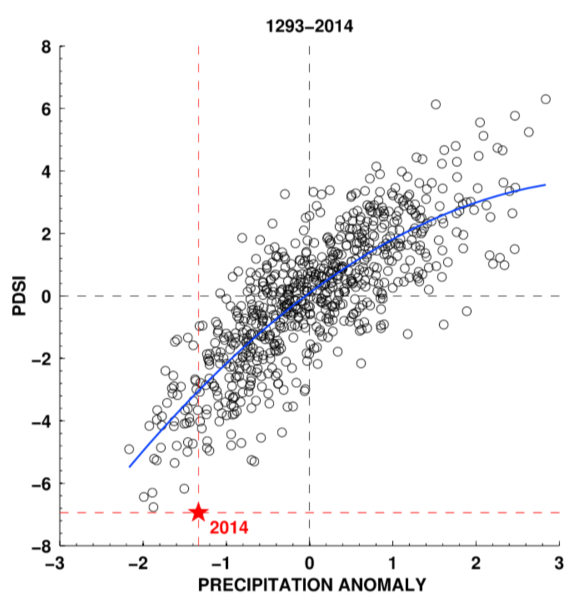
Last couple of years (2012-2014) California has experienced severe drought conditions. However, the worst effects won’t be felt until this year when the conditions continue due to lack of precipitation and record heat. This winter has been the warmest on record in California, resulting in less snow and rain. The overall trend toward drought persistence has continued, depleting already low snowpacks and reducing spring runoff for much of the region. The lack of snow raises concerns for this years spring and summer water supplies.

Griffin & Anchukaitis (2014)
California's record warm winter comes after the warmest year on record globally, 2014. The 2012-2014 Californian drought has already been claimed to be the worst drought in 1200 years, according to a new study

Last week governor Jerry Brown declared restrictions for water use for the first time in California history. Over 400 local water plants are now forced to reduce water consumption by 25% compared to 2013 levels. Other restrictions include: a ban on garden irrigation other than drip irrigation, limits on golf course and churchyard irrigation, detailed water use reporting by farmers etc. 

Previously, groundwater was only used as reserves but now they are pumping like crazy. Some regions have reported collapsing soil and salt intrusion, both a sign of overpumping. Despite the very serious water scarcity, California is the only state in Western US that have no limits on private pumping or consumption of groundwater. 

Farmers can buy water rights from one another and they can pump as much groundwater as they like. As a result, the state's groundwater has been depleted considerably. Gov. Brown recently signed a restricting groundwater use law but it will take years to implement and it doesn't require groundwater basins being run sustainably until 2040. Too little too late, in my opinion. 

Colorado river groundwater is also disappearing at a stunning rate. Streamflow from the river is the most overallocated in the world. Demand for this renewable resource is now outstripping supply, according to a 2014 study. Between December 2004 and November 2013, more than 75% of the water lost in the Colorado River Basin was from groundwater. The region has been experiencing drought conditions for the last ten years according NOAA.

Because of the long duration of these drought conditions, all kinds of people are becoming interested in expert opinion on climate-related topics. Unfortunately so far it seams like most are only interested in whom to blame. Hopefully Californians and the rest of Americans will start realising that climate change is already happening, and effecting them personally. Maybe then negotiations on climate change will take a turn for the better, but it has to happen before December 2015.

A critical view of the TPP

Trade agreement that upsets

The Trans-Pacific Partnership (TPP) is a regional free-trade agreement between the United States and some pacific countries. It threatens local economies self-determination over big corporations and any hope of a green trade deal that could ultimately do more to reduce carbon emissions. Critics have described the TPP as NAFTA on steriods (stoptpp.org) because of its focus on giving legal power to multinational corporations over nation states and their citizens. The proposed TPP is now, however, running into difficulties as the public learns more about it.

What is TPP?
TPP is a proposed regional free-trade agreement that as of 2014 includes twelve countries throughout the Asia-Pacific region (see map below). These countries combined represents an economic power of more than 40% of the worlds GDP, making the TPP the largest economic trade agreement to date. The agreement started with discussions in 2005 and should have finished by 2012 but was delayed because of major controversies and outrage due to leakages of secret documents around Intellectual Property and Environment Chapters in the proposed agreement by WikiLeaksThe push for this kind of an trade agreement probably started as a alternative way to WTO negotiations after 12 years of stagnation, partly due to well-organized public resistance in many countries. At the moment U.S. corporate interests are driving the agenda of the TPP (The Guardian).  It is according to many commentators no coincidence that leftist Latin American governments and China has been left out of the agreement.


Controversy
There has been extremely little transparency regarding the TPP negotiations. Few people have had access to the draft agreement and outermost secrecy has been in place. Large corporations and lobbyists, however, have been able to see chapters of the document. Thus when WikiLeaks first revealed parts of the TPP draft in November of 2013 many people and citizens rights groups got very upset. One part of the TPP which consist of giving corporations the right to directly sue governments for regulations that infringe upon profits or potential profits may explain why the TPP negotiators tried to hide the details from public awareness (Guardian, 2013). Because they knew it would evoke strong opposition, given the value people place in national sovereignty. Other parts of the draft, which have been leaked, includes:

Intellectual Property (IP) Chapter
The IP Chapter covers topics from pharmaceuticals, patent registrations and copyright issues to digital rights. Experts say it will affect freedom of information, civil liberties and access to medicines globally. The latest 77-page document is a working draft from the negotiations in Vietnam, dated 16 May 2014. The IP chapter of TPP would, if signed, effectively let corporations monitor citizens online activities, cut off peoples Internet access, delete content, impose fines and pursue stronger criminal regulations related to online copyright (ComputerWorld). It would end up instituting very controversial laws such as SOPA and PIPA that would restrict internet freedoms and free speech to the benefit of corporations. Overly protective patent laws on medicines and biological seeds etc. would also increase health care costs and farming practices and thus have a major impact on public health and food security, especially in poorer nations. 

Environment Chapter 
The environmental chapter in the TPP does not require nations to follow legally binding environmental provisions or other global environmental treaties. Pollution controls could vary depending on a country's domestic circumstances and capabilities. The chapter shows how trade above all is promoted, beyond environmental goals and values, basically stating that local environmental laws are not to obstruct trade or investment between member countries. Furthermore there is an emphasis on ...flexible, voluntary mechanisms, such as voluntary auditing and reporting, market-based incentives, voluntary sharing of information and expertise and public-private partnership”, but that even such measures should be designed in a manner that “...avoids the creation of unnecessary barriers to trade” (WikiLeaks). At a time of worldwide environmental challenges (including species die-offs, dangerous pollution of the oceans and climate change) people would expect that trade could be a tool to protect the planet, not hasten ecological collapse. 

Conclusion
According to Noam Chomsky, the MIT professor, the TPP is not about "free trade" at all. He says “These are extreme, highly protectionist measures designed to undermine freedom of trade. In fact, much of what’s leaked about the TPP indicates that it’s not about trade at all, it’s about investor rights” (Huffington Post). Simply put, this proposed agreement protects corporations over citizens and profits over the environment. If signed, this agreement could further exacerbate economic inequalities and environmental degradation in many nations.