Facts don't drive change
Facts are of course very important to making the right decisions in regards to environmental problems and potential solutions. But facts alone, don't engage people and drive change on a larger scale. For that to happen a wider cultural conversation is needed. Telling a story is a more effective way to send a complex message and start a dialogue. It goes through emotions and connects with logic, giving real examples of change.
Storytelling and adapting messages to specific target groups
Psychology plays an important role in how we humans view information and act based upon new facts. Environmental communication needs to understand this and focus on how to inspire people, rather than scare them. In this case, storytelling can be a successful way of communicating sustainability concerns and visions to the broader public or a specific target group. Communicating a coherent story is something many companies are good at but environmental organizations have only just begun using this strategy for outreach. Creative initiatives like the Story of Stuff have started to do this by helping to shift the conversation from the buying of more stuff to having less, but better, stuff.
What makes a good story?
To help friends, colleagues and your community become more aware of environmental issues and sustainable development, use stories. The model suggested below can be applied as much to articles (e.g. blogs, newspapers) as to videos, podcasts, oral presentations or other media. Key ingredients for a good story include:
- It gets noticed!
- It tells a story of real people and/or real situations
- It gives a living example of the broader, more abstract message you wish to convey
- It expresses a single, main idea
- It adopts a tone (e.g. sad, happy, excited) to go with the issue
- It touches emotions by speaking to universal values (e.g. love, fear, bravery)
- It uses rational arguments, appealing to logic (e.g. using numbers and placing the issue within a broader context)
Nature is speaking
Another interesting example of attractive storytelling can be found in the project natureisspeaking.org by Conservation International (CI). In this collaboration between companies (Virgin, Radical media, hp etc.) and CI, famous actors and actresses take on the voices of different parts of nature such as the oceans, the soil, and the rainforests. With stunning images, nature sounds and famous narrators this campaign makes for a compelling story about the human-nature relationship and our dependence on nature.
The information Age
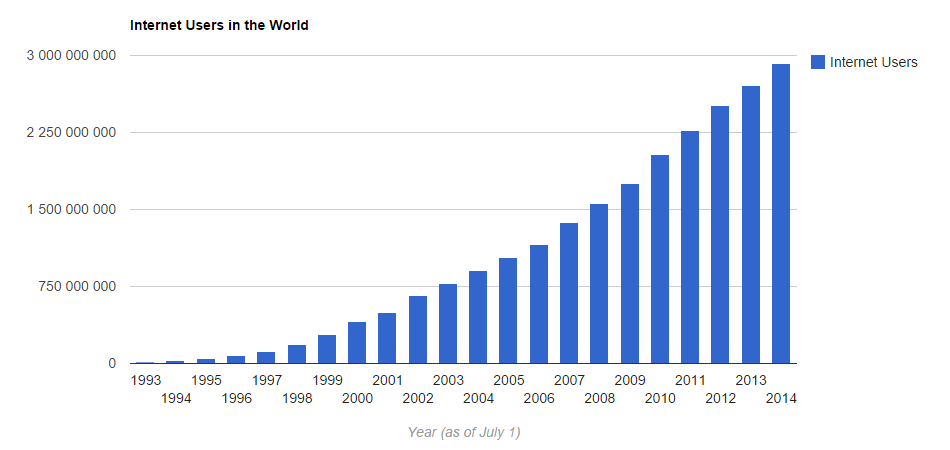
As a kid who grew up in the 1990s I have always seen myself as part of the first generation of kids who truly grew up with modern communications technology, with cell phones, home computers and the internet (world wide web) as an integral part of everyday life. I remember that computer science was the only subject in school that us kids knew much better than the teachers, to many grown ups frustration. In 1995 <1% of the world population had access to internet connection. It almost sounds ridiculously low and I now realize how fortunate I am to have come from a Swedish middle class home with a dad and an older brother who were (still are) both computer geeks. I'm not sure what year we first got a modem but I do remember how slow it was and how my mum yelled at my brother to disconnect so that she could use the phone. Much has happened since then. In 2000 the number of internet users globally was around 6.7%, five years later it reached one billion users. The second billion was reached in 2010 and the third billionth user is expected at the end of this year, then accounting for 40% of the global population (figure 1). As of 2013 Asia stands for almost 50% of internet users globally (figure 2).
Fig. 1 Internet users globally
Economy 4.0
We are now in the middle of a third industrial revolution - the information age. The invention of the steam engine turned agricultural society (economy 1.0) into industrial society (economy 2.0) and wide-spread education turned it into the service society (economy 3.0). Now, the invention of computers, the internet, the world wide web and social media are transforming service societies into digital societies (economy 4.0). With computers reaching the level of human brainpower in perhaps 10 years, with intelligent service robots, and Big data some 50 % of jobs in the industrial and service sectors could be lost within the next 20 years (Helbing, 2013). Example of changes in different sectors include:
- Education: Massice Open Online Courses (MOOCS)
- Research: Big Data Analytics
- Transportation: self-driving cars, drone transportation of goods
- Shopping: online stores for example Amazon, eBay
- Production: robots, 3D printers
- Health care: personalized medicine
- Politics: citizen participation
- Financial: crypto currencies, algorithmic trade, online co-funding platforms
- Military: drones, cyber warfare
Governing the masses?
Some believe that we need more government resources to watch over all these new activities, however, it might not be plausible. Because the amount of data doubles every year and the complexity of networked systems is growing even faster (see figure 3) top-down control will become less and less effective. Moreover, many of the industrialized nations already have record high public debt levels of 100 to 200 % of their annual productivity. How should we be able to pay for this? or even more regulation?
Fig. 3 Data evolution
One logical answer is bottom-up self control. While this vision has not worked well in the past due to coordination and market failures there is strong evidence from complexity research that smaller but connected units of decision-making make for stronger resilience of the overall system. Nobel prize winner Elinor Ostrom have demonstrated that guided self-organization can produce desirable outcomes in a flexible and more efficient way. One example of such organization is the self-ruling of Swedish municipalities, within the framework of national policy. In a rapidly changing world, feedback processes must enable the system to adapt in a flexible manner to local conditions and needs. In the recent Swedish election we experienced a growing disconnect between national politics and local needs and opinions. Political feedback processes, from the local to the national, have been ignored or broken down. Perhaps real time data could help in this matter by providing a more direct link between citizens and politicians.
What about the future economy?
We know from environmental science that market failures and coordination problems are two of the main reasons why we are degrading our planet in such a rapid pace. However, we also know that top-down control seldom works well in protecting local peoples and habitats. Therefore one could argue that there needs to be some kind of mix between both self-regulation and top down enforcement of rules and regulations. In any case, it seems like a new economy is already underway whether we like it or not. A participatory market society is on the rise. As the 20th century was an era of democratization of consumption the 21st century can become an era of democratization of production. Social media platforms make it possible to bring ideas and skilled workers together. This could complement large-scale industrial production by creating more diverse production, tailored to individual needs. Thus, while computers will replace old manufacturing jobs we might have an opportunity to replace such jobs with more creative activities.
New challenges
Information is everywhere and instantly available in ways that dissolves borders. Secrets will be very hard to keep. Changes will come with extreme speed, so much so that our knowledge will likely be outdated by the time we make decisions. We therefore need the help of smart devices that can keep us up to date. The more connected different systems are the higher the complexity and less controllable they become. Increased bureaucracy will not help solve this issue, but simple bottom-up solutions will. As data volume grows, data becomes cheaper but also harder to interpret and can lead to information overload. Designing algorithms that can mine the data therefore becomes more important and profitable.
To think about
At the moment no country in the world seems to be well prepared for the latter part of the digital era. Countries who recognize these new challenges and can turn them into their advantage will fare much better than those who don't adapt to these new realities. Therefore it is key to invest in digital infrastructure, adopt policies that foster small-scale businesses and digital innovations and modernize the education system with increased digital literacy and interactive ways of learning. Moreover, institutions and legal frameworks will be needed to protect the integrity of citizens. A third party organization could ensure transparency and consent in regards to data collection, and thus establish stronger trust between governments and their citizens. As data is a artificially unlimited resource increased consumption and production of data will not degrade the environment as is the case in others sectors. However, energy supply is vital so thinking about renewable ways of supplying households with energy will also be key to a sound future development.
NASA will be monitoring the world's forests
And now to some good news. In four years or so NASA will be monitoring the world's forests by creating 3D maps from laser pulses sent out from the ISS. The Global Ecosystem Dynamics Investigation (GEDI) lidar will be a great new resource for studying Earths vegetation (forest biomass) and the carbon cycle. Since it is not well known how much carbon trees actually absorb and store it is not possible to date to determine how much carbon would be released if a forest were destroyed. NASA and partners at the University of Maryland hope that this new instrument can help reveal some new information on this issue. GEDI will sample all of the land between 50 degrees north latitude and 50 degrees south latitude covering most tropical and temperate forests. "GEDI lidar will have a tremendous impact on our ability to monitor forest degradation, adding to the critical data needed to mitigate the effects of climate change," Patrick O'Shea - University of Maryland Vice President (Nature World News)
Apparently the GEDI is expected to be completed and launched by 2018, something to look forward to!
 |
| Illustration of 3D map of forest. Source: NASA |




 Posts

