Showing posts with label biodiversity. Show all posts

Getting rid of lawns - Planting Meadows


There are many ways in which we as individuals can impact biodiversity and ecosystem health. One simple positive change would be for households to change their monoculture grass lawns into biodiverse meadows. 

In Sweden, 52% of the urban green areas are lawns and in the United States lawns cover about 2% of the land area. Lawns may cover as much as 1.4% of the global grassland area and lawn grass is the largest irrigated nonfood crop. This is a extremely wasteful use of resources simply to maintain lawnscapes that does not promote biodiversity or food production.


Gardens could have many positive impacts, for example: providing habitats, storing carbon, air purification, nutrient cycling, water filtration, that are ruined by destructive management practices such as power lawn-mower, irrigation, pesticide use and chemical fertilizers. Lawns usually have very little biodiversity because they are monocultures. 

Lots of studies show that allowing gardens to become more wild, i.e. more diverse like natural ecosystem, by for example planting meadows or food forests would help promote biodiversity while providing us with vital ecosystem services such as fruits, healthy soils, pollination, cleaner air etc. Biodiverse healthy garden ecosystems also provide tremendous aesthetic and cultural values that are achievable without lots of money. Not only that it gives us joy and mental reprieve in a time of enormous social stress.

In many industrial societies, gardens have an enormous potential to provide habitat for many species on the verge of extinction due to the loss of traditional landscapes. Meadows and food forests require very little intervention, are beautiful and provide habitat for a number of threatened species. In a temperate climate like Sweden, meadows that bloom from spring to autumn are a suitable replacement for lawns and would provide relief for many species that once were common in the days of open pastures and small scale non-mechanical farming.

There is now a practical handbook in how to cultivate a meadow in your own garden from the Swedish University of Agriculture that can be found here.


Rapid loss of life on Earth

Turtle caught in plastic pollution in the Ocean.

Humanity's population explosion and massive overconsumption of natural resources is killing off wildlife at an unprecedented rate. In the 2018 Living Planet Report by the World Wildlife Foundation (WWF) we come to understand that there has been a 60% decline in species population sizes since 1970. Especially hard hit are the tropics in South and Central America, which have seen a 89% loss compared to 1970. And freshwater ecosystems, like rivers and lakes, have experienced the largest decline of 83%. We have killed off 83% of all mammals and 50% of all plants since the dawn of civilisation, and its irreversible on human timescales. It is truly a biological annihilation as coined in a scientific study published by Ceballos et al. in PNAS last year.


In 2017 the world lost an amount of forest area equivalent to the size of Italy, destroying habitats, causing biodiversity loss and polluting the environment. There is a growing number of scientists that are now calling for a global deal for nature, creating vast nature reserves to prevent biological armageddon.


The loss of biodiversity is a tragedy in itself but it also threatens the survival of civilisation says experts to the Guardian. People don't understand that biodiversity underpins ecosystem health and thus human health. We already see a dramatic rise in chronic diseases caused by unhealthy diets and pollution. Around 93% of the world's children under the age of 15 years, 1.8 billion children, breathe air so polluted it puts their health at risk and tragically about 600,000 children die from acute lower respiratory infections every year. Studies have also shown that it's not just seabirds that have plastic in their stomachs but we humans have it too. 

Can we turn this development around? We only have until the year 2020 to get our act together according to the WWF-report or it will be too late. Governments need to increase investments several fold into safeguarding biodiversity on land and in the oceans. Protected areas should be expanded to cover at least 20 percent of natural habitats on land and 30 percent of habitats in the ocean. But I'm having a hard time seeing that happening in a world of depleting resources and growing population. Do we have foresight enough to safeguard life on Earth for our own survival? It remains an open question I guess...


Albatross - A sad love story


"Until my gastly tale is told, this hearth within me burns" - Samuel Taylor Coleridge

Midway atoll, located at the middle of the remote North Pacific Ocean, is the farthest you can get from any continent on Earth. There, tens of thousands of Laysan albatross chicks lie dead on the ground, their bodies filled with plastic. Chris Jordan, artist and filmmaker, started visiting this remote place in 2009 and returned again and again over eight years to document the cycles of life and death of these magnificent seabirds.

Its a movie that moves you to tears of sadness and joy over the way the Albatross fights to survive in a world degraded by humans. Most of all, its a beautiful piece of art. Its hard, emotionally, to watch but we cannot turn our eyes away from reality. Can we let ourselves be moved deeply, to take action to transform our socities for a better future, not just for us but also for the sake of other living beings on this planet? I hope so, I sure do.

You can watch the entire movie for free at www.albatrossthefilm.com/watch-albatross

Guns, nets and bulldozers

Causes of biodiversity loss

While climate change is a major threat to all species on Earth a new report published in Nature shows that overexploitation and agriculture are the two biggest culprits of biodiversity loss.

75% of all the plant, amphibian, reptile, bird and mammal species that have gone extinct since 1500s were caused by humans. A growing global population will only put other species under more pressure, and eventually impact human mortality too.

Biodiversity underpins all ecosystem services (e.g. climate regulation, flood protection, pollination, nutrient cycling, water purification etc) that we currently consume "for free" but will have to replace with costly infrastructure or restoration project once they are gone.

Now that we are reaching limits to what these ecosystems are able to withstand without collapsing or drastically altering states we will see a steep increase in costs for the most basic of resources. Those costs are often dumped on the public by the private sector and may not turn up in prices of goods but instead in  form of increasing taxes, poorer health, growing debts etc.

It is truly a sad fact that most people are so disconnected from the land and oceans that they are blind to the fact that Earth's resources are finite. Once a fish stock has collapsed it may never recover, on a timescale relevant to us.

There is no "replay" button that we can magically push and turn back to some previous healthy state. All we can do now is to minimize the damage. And the best way to do that is by not having more kids than we can feed and not consuming more than we actually need for basic needs.


The Great Barrier Reef in Danger


Satellite image of the Great Barrier Reef.
Photo Credit: NASA | Wikimedia Commons
The Great Barrier Reef stretches 2,300 km down the eastern coast of Australia. Covering an area the size of Italy it is the largest coral reef on the planet. With over 1500 species of fish, 600 coral species and 30 different whale and dolphin species, it is one of the most biodiverse and complex ecosystems on the planet.

Two weeks ago I wrote about the mass bleaching event that had struck the Great Barrier Reef due to extra warm ocean waters. Now the aerial and underwater survey results are in and it makes for some very sad reading. Only 7% of the reef remains unaffected, in other words, 93% of the reef has suffered damage from the bleaching event. 

“We’ve never seen anything like this scale of bleaching before. In the northern Great Barrier Reef, it’s like 10 cyclones have come ashore all at once,” says Professor Terry Hughes, convenor of the National Coral Bleaching Taskforce

Map of the Great Barrier Reef showing results of aerial surveys for 911 reefs.
“North of Port Douglas, we’re already measuring an average of close to 50% mortality of bleached corals. At some reefs, the final death toll is likely to exceed 90%. When bleaching is this severe it affects almost all coral species, including old, slow-growing corals that once lost will take decades or longer to return.”

A recent study reports that the Great Barrier Reef is losing its resilience to withstand bleaching events under climate change. This happens when seawater temperatures rise by as little as 0.5 °C, exposing corals to major stress.


I highly recommend watching the tv series "Great Barrier Reef", with David Attenborough as narrator, and exploring more about the reef  and the filming of the series on www.attenboroughsreef.com 

8 key trends Spring 2016

Coastal permafrost collapsing. Source: USGS Alaska Science Center
I have been away from blogging for a while but decided to try and pick it back up today. So much has happened this spring that I haven't been able to write about so I decided to pick out some key trends/headlines that I found most important.

1 - Civil war in Turkey!? Turkey houses some 2.6 million Syrian refugees, out of the more than 4.7 million Syrians who have fled their country’s civil war. Turkey is also currently engaged in the conflict in Syria fighting (US supported) Syrian kurds more than ISIS due to fears of escalating internal conflict. But the Turkish strategy backfired as three suicide bombings in three cities killed 150 people and shocked the nation. Experts now fear that the Turk-Kurd conflict inside Turkey could turn into a full blown civil war if hostilities keep increasing. Erdogan is supposed to have asked Obama to halt support to the Syrian kurds YPG which has close historic ties with the Turkish kurds, PKK. However, that has not happened since the YPG is fighting ISIS, and so the confusing war in Syria continues while another one is brewing in Turkey.

2 - Extreme February Temperature Anomaly shows worrying signs of a potential non-linear response to continued global warming, but probably due to a strong El Niño. According to NASA scientists the average global temperature in February was about 0.5 degrees Celsius warmer than the previous record set in 1998 and 1.35 degrees above the 1951-80 average. The average global atmospheric CO2 level reached 402.59 ppm, according to NOAA. Vietnam, Zimbabwe and Fiji suffered major economic losses from February droughts and storms as reported by Wunderground.   

3 - How the refugee crisis turned out to be a major preparedness crisis. A prime minister that was invisible when the crisis erupted. A director-general that played golf and ran marathons. Prognoses which were completely wrong, greatly underestimated the number of refugees. Total lack of coordination and pressing decisions that were put on hold. The Swedish government's handling of the refugee crisis has been a complete mess. Politicians kept denying the  facts until there were no more beds, no more supplies and no willingness to comply. And so they had to change policy. On the 4th of January border patrol with ID-control between Denmark and Sweden was enforced, delaying all traffic with some 20-60 minutes every day. According to the Immigration Office some 81% of refugees lack any kind of identification papers when they arrive. It is still too early to tell the consequences of such major mismanagement of a country.


4 - The Panama Papers Scandal shows just how widespread and pervasive tax evasion and government corruption is at the moment, from prime ministers to global banks. The leaked 11.5 million files includes nearly 40 years of data (1977-2015) on offshore secrecy and and includes names of high-level politicians, such as the president of Argentina and Iceland's prime minister etc. I'm surprised there has not been a bigger outrage over this topic, but then again, maybe because it was somewhat expected in our grossly unequal society.


5 - Negative Interest Rates madness continues despite its ineffectiveness. The only thing that has changed here in Sweden in regards to this topic is that people are piling up ever more private debt, or going bankrupt, with a major increase among 18-25 year olds. The housing bubble is still going strong and our dear politicians are already backing on implementing harsher mortgage repayment requirements decided upon in 2015. Perhaps it's because they realize they might prick the bubble or the fact that so many now rely on an income generated by flipping property. 

Brilliant economist Steve Keen writes in FORBES that Sweden rank as top 3 on highest risk for a debt crisis within the next one to three years. Looking at the graph below it becomes rather obvious that the current credit growth trend is unsustainable.
Source: Steve Keen, FORBES

6 - The Great Barrier Reef is currently undergoing the worst mass bleaching event on record, according to Australia's national coral bleaching taskforce. As a marine biodiversity hotspot this is a major threat to species conservation. Many corals will die, without them lots of species will lack a habitat and nursing ground for young ones. As such it's hard to ascertain the scale of devastation, even though the immediate effects already seem dire. 

Source: Coral Reef Watch, NOAA

7 - Marine heat waves last longer and cover larger areas due to global warming (extra strong during El Niño years), devastating marine life. An example of such is "the Blob" that emerged off the Pacific Northwest in 2014. Sea life outside the US west coast has suffered greatly, with stranded sea lions, increase in whale deaths and entire beaches full of dead shrimp. Marine life has been hit hard by this double whammy. 

8 - The American Election - it's just tragic. I'm so tired of reading about Trump I could puke. I can't imagine what would happen if Trump is elected and we have him and Putin trying to get along. Scary.

Transgressing Planetary Boundaries

Are humans shifting the entire Earth system?

The diagram shows the nine planetary boundaries. Source: Steffen et al. (2015), Design: Globaia

Four out of nine Planetary Boundaries (PB), beyond which humanity runs the risk of major environmental crisis, have to date been transgressed. These include: genetic diversity, climate change, biogeochemical flows and land-system change. That is the message of a large group of scientists, lead by Will Steffen, who recently published their improved estimation in the journal Science. 

The concept planetary boundaries was first used in the original paper from 2009, in which Rockström et al. identified nine different natural processes that are critical for the stability of the Earth system. In that paper they also estimated boundaries, parameters of change, within which humanity would like to stay to ensure long term progress and survival.

By transgressing four out of nine boundaries humanity is now on the verge of shifting the entire Earth system, from a friend with predictable and temperate climate full of diversity to a foe with unpredictable and warmer climate with less diversity. For example, large marine ecosystems could change dramatically due to ocean acidification and eutrophication, higher temperatures could threaten agricultural productivity and human health, and continued loss of biodiversity could mean faster spread  of diseases and pests.

Steffen explains that once we have passed a threshold it becomes increasingly difficult to turn back or even slow down changes in the Earth system. In other words, it could potentially have catastrophic consequences. The authors have named two of the nine PBs "core" since they are fundamental to the integrity of the Earth system. These two include climate change and biosphere integrity, and we have basically passed both of those two boundaries.   

Entering Earth's 6th Great Mass Extinction

The 6th Great Mass-Extinction

For a decade now it has been widely debated whether humanity has set in motion a sixth great mass extinction event, comparable to the catastrophe which erased the dinosaurs some 66 million years ago. According to a recent study by Ehrlich et al. (2015) there is no longer any doubt, we truly have.

There is general agreement among biologists that extinction rates have reached levels unparallelled since previous mass extinctions on Earth. However, some have believed the numbers to be overestimated. But this new study confirms that species are disappearing up to about 100 times faster than the normal rate between mass extinctions, known as the background rate. If allowed to continue, life would need millions of years to recover.

The study took a precautionary approach and only allowed for conservative estimates, which means that their calculation probably underestimate the severity of the extinction crisis.

As human population continues to grow and consumers become more affluent more and more natural habitats will be altered or destroyed. Already in 2005 scientists warned that about 60% of all ecosystem services had been degraded or destroyed (Millennium Ecosystem Assessmentt). The long list of impacts include: land clearing for farming, logging and settlement, invasive species, carbon emissions that drive climate change and ocean acidification and toxins that alter and poison ecosystems. 

While there is still much discussion about the causes of some mass extinctions, it is generally believed that they can occur when the biosphere is under long-term stress, for example from a warming climate generated by greenhouse gasses in the atmosphere. As ever more species face extinction we lose the vital ecosystem services they provide, such as: pollination, water purification, pest control, storm control, soil regeneration etc. For its continued existence mankind is reliant upon an untold number of species that maintains the function of those services. As these species disappear, that existence becomes increasingly fragile.

Stanford biologist Paul Ehrlich calls for fast action to conserve threatened species and habitat before the window of opportunity closes. Below is a video from Standford with Ehrlich describing the issue.

Why you should care about the Arctic

Arctic Sunset. Wikimedia Photo: P J Hansen 

The Arctic is Warming


Rising temperatures in the Arctic are contributing to melting sea ice, thawing permafrost, and destabilization of a system also known as “Earth’s Air Conditioner”. The Arctic regulates ocean and atmospheric circulation and keeps the the planet cool. Climate change is impacting weather patterns, natural systems, and human life around the world. The Arctic, however, is central to these impacts as it is warming more rapidly relative to lower latitudes, about twice as fast as the rest of the globe, making it “the canary in the coal mine”. What happens in the Arctic is of utmost importance to us humans if we want to know how climate change will impact our only home, planet Earth.

Reinforcing feedbacks and potential tipping points


The Arctic is very sensitive to global heat forcing, and any small warming there could rapidly trigger a number of feedbacks that generate more warming for the Arctic and the globe. These feedbacks include but are not limited to: A) snow and ice melting; B) changes in ocean and atmospheric circulation; C) thawing permafrost and methane release. The concept of a “tipping point” - a threshold beyond which a system shifts to an alternate state - has become familiar to most people concerned with the climate debate. If tipping point means crossing a critical threshold in which a system enters substantial, potentially irreversible, change that causes it to move into an entirely new state, there may be precursors or early warning signals of such change. Such warnings are exactly what climate researchers and ecologists are looking for and trying to map out. The graphic below shows potential tipping elements in the Arctic region.

Map show potential tipping points in the Arctic region: ice melting (white); ocean and atmospheric circulation (aqua green); and biome changes (dark green).
Source: Lenton (2012)
Snow & Ice melt

greenland_ice_sheet_reflectivity_2012.png
Source: meltfactor.org
As snow and sea ice retreat, exposing land and sea with lower albedo (i.e. less reflectiveness), more solar energy is absorbed, thus leading to further melting and retreat in a vicious cycle. The present thinning and retreat of Arctic sea ice is one of the most serious geophysical consequences of global warming and the rate of ice melting have greatly exceeded the predictions of most models (Wadhams, 2012). Experts suggest that we may have, in 2007, passed a tipping point towards having sea-ice free summers in the Arctic (Livina and Lenton, 2013). Some studies suggest that the Arctic could have sea-ice free summers in only a couple of years, 2016-2020 (Maslowski et al. 2012; Wadhams 2014) while others predict it to occur later, around 2041-2050 (Cawley 2014; Liu et al. 2012) given continued warming. Eighty-one percent of Greenland, which is located mostly inside the Arctic Circle and is the world’s largest island, is covered by ice. The Greenland ice sheet is currently losing mass at a rate that has been accelerating (Lenton, 2012). And in July of 2012 Greenland ice sheet reflectivity at 2000m-2500m collapsed during the summer (figure 1). In a study published in Nature Reyes et al. (2014) argued that between 4.5 and 6.0 meters of sea level rise 400,000 years ago could be attributed to a collapse of Greenland's southern ice sheet. Data from marine records in the North Atlantic show that the average temperatures in Greenland during that period were only about 1°C warmer than today’s temperatures. The similarity in climate between then and now “suggests the threshold for ice sheet collapse is pretty low”, according to one of the co-authors, “We could be nearing the tipping point” (Oregon Live, 25th June 2014).

Changes in ocean and atmospheric circulation

In recent years radical shifts in atmospheric circulation patterns have occurred in the Arctic, strengthening poleward heat transport and bringing warm air and warm ocean currents from the Atlantic right into the centre of the Arctic (Lenton, 2012). This behavior in wind and water circulation limits winter sea-ice growth and thus contributes to further summer sea-ice decline. The additional warming in the Arctic affects weather patterns in the Arctic and beyond by altering the temperature gradient in the atmosphere and atmospheric circulation patterns (WWF, 2011). The polar jet stream is a high-altitude, blisteringly fast wind that blows around Earth at mid- and polar latitudes. It dips into and out of the Arctic, shifting high and low pressure air masses. Rising temperatures in the Arctic slows and increases the waviness of the Jet Stream which generates more south to north transfer of temperate and tropical warmth into the Arctic together with a greater export of Arctic cold to lower latitudes. Experts view a tipping point for ocean circulation to be somewhere around 4C warming (Lenton, 2012) while atmospheric circulation is more difficult to assess and needs to be further investigated.     

Thawing permafrost & Methane 

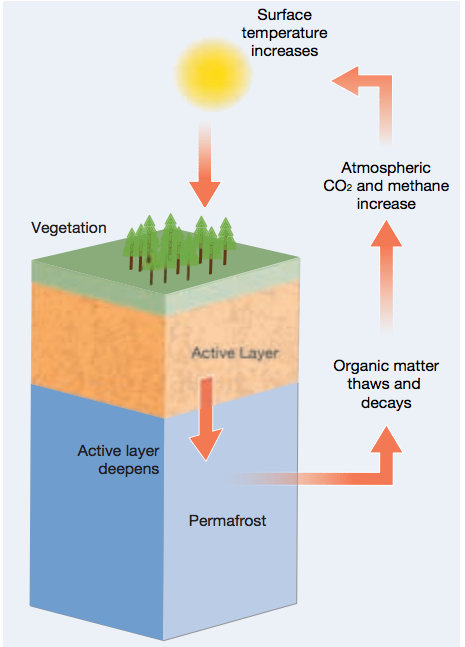
permafrost_feedback.jpgPermafrost—the ground that stays frozen for two or more consecutive years—is a ticking time bomb of climate change. Some 24 percent of Northern Hemisphere land is permafrost. That's 23 million square kilometers found mostly in Siberia, the Tibetan Plateau, Alaska, the Canadian Arctic, and other higher mountain regions. When the Arctic warms, permafrost can start thawing and releasing carbon and methane into the atmosphere (figure 2). In a controversial paper in Nature, Comment, Whiteman et a. (2013) posited a scenario whereby a 50 Gigatonne (Gt) methane pulse would occur over a decade time period and calculated its potential economic costs. To put this in context, the total amount of methane in the world’s air now is about 5 Gt, and the annual input is about 0.5 Gt, so this would double the methane in the air within the first year. Newspapers such as the Guardian and popular blogs were quick to pick up the story and claimed that there was a possibility of an Arctic “methane bomb”. Following articles have, however, shown little evidence pointing to the likelihood of such a scenario. A group of international scientists wrote in Nature Geoscience in 2014 that “significant quantities of methane are escaping the East Siberian Shelf as a result of the degradation of submarine permafrost over thousands of years” (Shakova et al. 2014). The authors claim that a sudden release of methane, in a “pulse”, seems unlikely and that methane will probably continue to bubble up slowly, contributing to greenhouse gases in the atmosphere. But they do caution that its possible that global warming could cause more storms in the Arctic Ocean, releasing methane on a bigger scale. There is no established tipping point for methane release, but some studies suggest that a tipping point for continuous Siberian permafrost thaw could be as low as 1.5°C warmer than the pre-industrial period (Oxford University). 

Consequences

Sea level rise
Sea level rise at +1-4C warming scenarios. Source: PIK

Sea levels are rising due to thermal expansion from warmer oceans and melting of land-based ice. Satellite measures since 1993 show global sea level rise of around 3.2 mm/year (CSIRO). The potential for increases in sea level rise is enormous because the ice caps of Greenland and Antarctic contain over 99% of all the freshwater on Earth (NSIDC). Estimates suggest that if Greenland ice sheets would melt completely it could raise sea level 6 meters. In other words, a one per cent loss of the Greenland ice cap would result in a sea level rise of 6cm (NSIDC). In a process that is accelerating, ice caps are losing mass. In past periods of Earth’s history, levels of atmospheric greenhouse gasses and sea levels have followed one another closely, allowing an inference about where sea level is headed. Sea levels may rise by more than 2 meters for each degree Celsius of warming the planet experiences over the next 2000 years (see figure), according to one study (Levermann et al. 2013). But even a one meter sea level rise could cause major problems for low-lying countries such as the Maldives and Bangladesh, forcing inhabitants to migrate. Around 150 million people live within 1 metre of high tide level (CSIRO). Coastal cities, ports and airports could be flooded, as could cities sited near tidal estuaries, like London. And many nuclear installations are built by the sea which is of great concern knowing what happened in Fukushima.

Extreme weather events 
Jet stream and hurricane Sandy.
Source: mprnews

Shifts in atmospheric circulation could influence weather patterns. Rising temperatures seems to slow down and increase the waviness of the jet stream, increasing long duration extreme weather patterns such as droughts, floods, and heatwaves (YaleEnvironment, 2012). This has significant impacts on temperature and precipitation patterns in Europe and North America. That weather patterns can "get stuck" might explain why the intensity of extreme weather events has increased. We have seen many examples of “stuck” weather patterns during the past few years. Deep southward dips in the jet stream hung over the U.S. east coast and Western Europe during the winters of 2009/2010, 2010/2011, and 2012/2013 bringing a seemingly endless string of snow storms and cold. In the early winter of 2011/2012, in contrast, these same areas were under northern peaks in the jet stream which brought unusually warm and snowless conditions (Francis, 2013). And in summer times persistent weather have been responsible for droughts and heat. The record heat waves in Europe and Russia have been linked to early snowmelt in Siberia (Jaeger and Seneviratne, 2011). These changes affects agriculture, forestry and water supplies. For example, farming becomes more precarious as weather patterns and prognosis are no longer reliable. Changes in weather patterns also impact storm surges and hurricanes. Some scientists suggest that changes to the jet stream drove hurricane Sandy west, towards the coast of northeastern United States (LiveScience, 2013). Ranking as the second costliest hurricane in United States history (Huffington Post, 2013) one can see how changes to storm patterns can have enormous costs to society and the economy.

Warming & Acidic Oceans
Coral reef at +1-3C warming. Source: FurmanWiki

The complete loss of Arctic summer sea ice has major knock-on effects, such as boosting phytoplankton and absorbing more heat in the oceans. Ocean warming effects marine life in temperate latitudes making species such as cod, haddock and flounder shift their geographic ranges, leaving fewer cold water species (NASA, 2013). Disease also spread faster in warmer water so parasites are having larger effects on species, especially sensitive coral reefs. Because the planet’s oceans currently absorb about a quarter of the carbon dioxide, which lowers the pH level of the water, the oceans are becoming acidic. Acidification makes shell-formation among marine organisms such as plankton and mollusks more difficult, which could have major cascading effects on marine life as these organisms make up the base of the ocean’s food chain. Coral reefs, which are marine biodiversity hotspots, are particularly sensitive to changes in temperatures and pH. Coral reef ecosystems are in global decline and this means loss of storm buffers and loss of estuaries for fish species that generate 200 million jobs and food for a billion people (NOAA).

Summary - Tipping points

Greenhouse gasses
According to most scientists, a CO2 amount of order 450 ppm or larger, if long maintained, would probably push Earth toward an ice-free state (Hansen et al. 2008, 2013). 450 ppm is considered a climate tipping point, beyond which we would have no control. We are at 400 ppm today, which constitutes high risk of transgressing the tipping point. According to science we need to get back down to 350 ppm to be considered in the safe zone. 

Arctic ice free summers

Some studies suggest that we may have passed a tipping point in relation to having sea-ice free summers in the Arctic already in 2007 (Livina and Lenton, 2013). The loss of reflective surfaces in the summer reinforces further warming, as dark water absorbs more heat from the sun, causing further melting. The loss of summer sea-ice cover is reversible, given that warming slows down (i.e. drastic reduction in greenhouse gas emissions). 

Greenland ice sheet

By looking at sediment records a team of scientists found that 1°C warmer than today's temperatures in Greenland contributed to a 4-6 meter sea level rise from the collapse of the southern part of the ice sheet (Reyes et al., 2014). 

Permafrost methane release

At 1.5°C warming, from pre-industrial levels, Siberian permafrost starts thawing on a large scale (Vaks et al., 2013). Crossing this tipping point could potentially lead to runaway climate change because of the scale of carbon stores and because methane is 20 times more effective in increasing global temperatures than equal amount carbon dioxide.

Conclusion

What is happening in the Arctic impacts us all. Rapid climate changes are now taking place in the Arctic with impacts on a planetary scale. We do not know how to fix it except from lowering our emissions. Many experts say we need a rapid reduction in greenhouse gas emission, starting now. Global leaders have to come to an agreement that substantially reduces emissions, the rich world taking the lead. Our only home, the Earth, is changing rapidly and we are now running into dangerous risks of substantial warming and triggering climate tipping points that reinforces further warming beyond our control. The last call is coming up in November of 2015 Paris Climate Meeting. “The Arctic acts as an early warning system for the entire planet” (Dr. Chip Miller, NASA Jet Propulsion Laboratory). We should all follow what happens there closely and warn the world of the potential dangers of going on with "business as usual".

Living Planet?

“Biodiversity is the totality of all inherited variation in the life forms of Earth, of which we are one species. We study and save it to our great benefit. We ignore and degrade it to our great peril.” — E.O. Wilson


State of global biodiversity

Today the World Wildlife Fund - Living Planet Report 2014 - was released. This latest edition shows that since 1970 population sizes of vertebrates (mammals, birds, reptiles, amphibians and fish) have dropped by 52%. Many see this as yet another sign of that we might be in the middle of a sixth mass extinction event in Earth’s history. This post will therefore deal with the topic of biodiversity.

What is biodiversity?

Biological diversity (i.e. biodiversity) reflects the number, variety and variability of living organisms. It includes diversity within species, between species, and among ecosystems. The concept also covers how this diversity changes from one location to another and over time. Indicators such as the number of species in a given area can help in monitoring certain aspects of biodiversity. When one wants to understand the health of an entire ecosystem, however, some species may be more important than others in the sense that they provide a key function within the entire system. Ecologist often refer to such species as keystone species. Take for example the otter. They are considered a keystone species because of their critical importance to the health and stability of nearshore marine ecosystems. Otters eat sea urchins and other invertebrates that graze on giant kelp. Without sea otters, these grazing animals can destroy kelp forests and consequently the wide diversity of animals that depend upon kelp habitat for survival (Fig. 1). Additionally, kelp forests protect coastlines from storm surge and absorb carbon dioxide from the atmosphere.

Fig. 1 The difference in a marine ecosystem with and without Sea otters
Source: seaotters.com

Threats

Some of the main threats to biodiversity include: invasive species, climate change, nutrient loading and pollution, habitat change, and overexploitation. These are direct drivers of change, but there are also indirect drivers of change. Such as demographics, urbanization, transportation, agriculture, trade and many more. With higher interconnectivity on the planet, species loss may occur at a faster rate. In a recent study Lenzen et al. (2012) showed that some 30% of biodiversity threats could be attributed to international trade by mapping out supply chains around the globe (Fig. 2).

Fig. 2 Example of flow map of species threats caused by trade

Source: Lenzen et al. 2012

What defines a mass extinction?

Of the four billion species estimated to have evolved on the Earth over the last 3.5 billion years, some 99% died out (Novacek, 2001). Extinctions are common but normally it is balanced by speciation. Sometimes, however, the balance wavers such that extinction rates become elevated. Palaeontologists characterize mass extinctions as times when the Earth loses more than 75% of its species in a geologically short interval (due to e.g. super-eruptions, impacts of asteroids, global climate changes, continent drifts), as has happened only five times in the past 540 million years (Barnosky et al., 2011). Lately biologists have been suggesting that a sixth mass extinction may be under way. By comparing the rates and amounts of extinction during those earlier events with the range of species losses over the past few centuries in human times, scientist find a similar trend. According to evolutionists like E.O. Wilson and N. Eldredge we thus have evidence that humans are now causing a mass extinction. Through a mix of impacting activities such as habitat destruction, overpopulation, chemical pollution, overexploitation of resources etc. humans have produced the conditions for a serious biodiversity crisis. According to an article in Nature (2011), Earth could reach the mass extinction levels (75%) within just a few centuries if current threats to many species are not alleviated (Barnosky et al., 2011).


Fig. 3 Graphic illustration of threatened species globally
graphics biodiversity loss
Source: NYT graphics editor Bill Marsh

Amphibians

Here I want to make a case for the amphibians of the planet since they are some of the most vulnerable and endangered, and people generally ignore them. The latest figures from the International Union Conservation of Nature (IUCN) Red List of Threatened Species show that there are nearly as many threatened species of amphibians (30%) as birds (12.5%) and mammals (20.6%) combined (iucnredlist.org). Most of the world’s amphibian species are located in tropical regions, especially the Amazon Rainforest (Fig. 4). In the past three decades declines in populations of amphibians have occurred worldwide due to for example: habitat destruction, pollution & pesticides, disease, and changing precipitation patterns.

 
Fig. 4 Global assessment (2004)

In Sweden all native amphibians and reptiles are protected by law (2007:845) with the conditions not to kill, harm, capture or destroy their habitat. Naturskyddsföreningen and SLU have nominated 2014 to be the year of the frog, focusing on collecting data on amphibians and educating the public. Many of our frogs in the South are critically endangered while others can be found nation wide.

Why it matters

Biodiversity underpins ecosystem functioning and the provision of ecosystem services. Ecosystem services such as water purification, pollination, storm protection, nutrient cycling, and climate regulation are essential for human well-being. Undermining diversity of life on Earth thus implies undermining our own well-being. Moreover, according to some studies (e.g. TEEB, 2010) there is a strong link between biodiversity loss and poverty. Why? Because the world’s poor, especially subsistence farmers and pastoralists are the first to suffer from the loss of free services provided by ecosystems and biodiversity. In rich countries people substitute natural nutrient cycling, pest control and pollination by buying expensive fertilizers, pesticides and renting bees/pollinating by hand. Because we don't value the services nature provides for us we often end up in a position where we have to pay more to restore ecosystems than if we had used preventive measures from the beginning. This is the case with the Baltic Sea which is today home to seven of the world's 10 largest marine dead zones due to eutrophication and overfishing leading to hypoxia. Trying to restore parts of the Baltic Sea to it's former conditions is a complex issue and attempts have yet to succeed. And for those who think Sweden is such a environmentally sound country, perhaps you should read the Living Planet Report (2014) which states that Sweden climbed from place 13 to 10 on the list over countries average ecological footprint in the world. Now Swedes need 3,7 planets to satisfy their lifestyle.

Fishy Business

Aquaculture

Aquaculture is the farming of aquatic organisms such as fish, crustaceans, molluscs and aquatic plants. At the moment aquaculture is the fastest growing food sector in the world. From 1990 to 2010 cultivation of fish and shellfish in terrestrial and marine systems grew at an annual rate of 7.8% worldwide, a much higher rate than any other food commodity. Although there are many potential benefits to farming aquatic organisms such as increases in food and fuel supply there are also many potential drawbacks. In this post I will go through some of the latest scientific findings regarding the pros and cons of aquaculture from a global food security perspective.

Fig.1 Map over societies dependence (%) on fish for nutrition (2008)
Source: Mark Nowlin, Seattle Times (2013)

Aquaculture’s role in the global food system?

Fish is an important food commodity and more than 3 billion people obtain ⅕ of their animal protein from fish. Some societies are more dependent on fish as a source of nutrition than others (Fig. 1). In 2012 the global fish market was valued at 129 billion dollars. However, global wild fish catches peaked around 2002-2003 and is now at a plateau (Fig. 2a and b), thus, there is an sense of urgency in the scientific and public policy community to match the gap in food needed with sustainable options.The international community's interest in aquaculture has thus become ever more present. And business is booming, roughly half of the fish consumed worldwide now comes from aquaculture and its share is expected to increase in the future as wild fisheries exceed their sustainable limits (Troell et al. 2014). Freshwater fish comprise the majority of aquaculture production today. These fish are raised in ponds, lakes, canals, cages and benefit from a wide range of inputs, technology and management.

Common environmental problems                 

global fish catch peak
Fig. 2 A) Global Wild Fish Peak Catch
The most common environmental problems include pollution of marine ecosystems, destruction of coastal habitats, enhanced disease and parasite transmission between farmed and wild fish populations, introduction of invasive species, increased stress on freshwater resources, and overfishing of wild fish stocks to feed farm fish. The use of wild fish in feeds can also have food security implications for low-income households that depend on low-trophic level fish as a key source for nutrition.
world fisheries extraction
Fig.2 (b) World fish production (million tons) Source: World Resources Institute

Pros

- Provides year-round fish supplies and incomes
- Can provide ecosystem services remediation: habitat structure, relieving fishing pressure on wild fish stocks and rebuilding of wild populations

Cons

- Can severely degrade aquatic ecosystems
- Poses health risks to consumers
- Can cause diminishing food supply for low-income households that depend on smaller fish species

A risk perspective

Since there are both major benefits and risks to aquaculture one way to make a risk analysis is to use a portfolio approach. The basic idea is to invest in a suite of assets or activities that collectively has lower risk relative to that of any individual asset. This will yield trade-off options between risk and returns and the trick is to diversify the asset bundle. The degree of risk depends on correlations between assets’ returns. When applying this approach to the global food systems one could think of the targeted return as the aggregate output of food commodities needed to meet human demands. Risks, then, involve temporary and irreversible declines in productivity captured by the variation and trend in food production and prices. Furthermore, the degree of food price volatility is indicative of the global food system’s resilience (or robustness) against a wide range of stressors such as pests, extreme weather events, climate variability and other market shocks related to changes in the energy and financial sectors. A pattern of higher and more variable prices over time would then suggest deteriorating resilience of global food supplies whilst a pattern of stable prices would indicate a more robust and resilient food system.

Fig. 3 Shows relative fluctuations in price for different food sectors (1990-2013)
global food prices
Source: Troell et al. (2014)
In the price index (Fig. 3) we can see that cereal and oilseed prices have shown much stronger variation than prices for meat, aquaculture and capture fisheries. Lower volatility in fish and meat suggest higher substitution potential. Moreover, aquaculture prices have been less variable than other food commodities and thus appear to add some degree of stability to the global food system. The fact that prices in crops, livestock, and fish products move closely together indicates that the markets are highly integrated. Adding a robust aquaculture sector could improve the robustness of the world’s food system as long as it does not deplete resources or severely undermine the environment in which we produce food e.g. through pollution. 

Diversify, diversify, diversify

Today 95% of human calorie needs originate from crop species of which only four (rice, wheat, maize, and potatoes) make up around ⅔ of total needs. The meat sector is comprised of around 20 different animal species of which only a handful are dominant (cattle, poultry, swine and goat). Aquaculture on the other hand currently involve more than 600 different freshwater and marine animal species. However, there is a trend towards concentration similar to that of the crop and meat sectors. The cultivation of fish and shellfish is now dominated by 35 species that together account for 90% of total global production.

Conclusion

Sustainable development is always about tradeoffs. This case exemplifies one way of assessing the potential benefits and risks of a certain future development. This could help improve future planning and guidelines regarding aquaculture and ecosystem stewardship for industry and society at large. The present diversity of aquaculture systems contributes stability to the world's food system. However, if not well managed to minimize the environmental damages and social injustices, aquaculture is likely to make the global food system less resilient.

Ebola and Ecology

Emerging infectious diseases

Emerging infectious diseases (EID) may have a lot to do with changing environmental conditions and human-wildlife interaction. EID are either new types of pathogens or old ones that have mutated to become novel, as the flue does every year. Most known human EID are shared with animals meaning they are zoonotic. There is an excellent map over hot spots for EIDs in the world that was published in the New York Times back in 2012 that can be found here. While the research field, ecology-infectious diseases, is relatively new and crosses disciplinary boundaries I believe it should get more attention. Especially since it may tell us more about why EIDs have become so prevalent over the last couple of decades.


Ebola
While Ebola is a really scary disease because of its high fatality rate (50-90 %) its just one of nearly 1,000 known human diseases that have originated from animals. The specific source of the Ebola outbreak is not known, however, Ebola is thought to be naturally harboured in some species of bats. Initial transmission to humans may thus have come about via butchering or consuming bats or other infected species. VICE News made a great short documentary about bushmeat in the time of Ebola. While Ebola has had a devastating impact in west African countries it is unlikely that Ebola becomes a global pandemic since the infection pathway requires direct contact with bodily fluids. That said, the illegal bushmeat trade could potentially act as a transfer of the disease in to other countries around the world. Anyway, the Ebola outbreak serves as a reminder of the linkages between disrupted ecosystems and human illness.

Ecology
The more we humans expand our footprint and population, altering habitats and moving animals (and the pathogens they carry), the greater potential for infection and spread of pathogens novel to humans. For example, overfishing in an area could lead to an increase in bushmeat consumption due to subsistence standards which in turn could increase the prevalence of EIDs. Similarly deforestation forces animals to move into closer proximity to humans leading to closer contact, conflicts and loss of biological diversity. Moreover warming temperatures due to climate change may also change habitats and create new ones suitable for species and their pathogens. Examples range from mosquitoes to fruit bats.

Ebola Outbreak
Source: Future Earth
Coordination?
Some international groups such as WHO, Future Earth, Diversitas have come together and created the ecoHEALTH project, bringing together researchers from different fields to investigate connections between health and environmental change to generate policy outputs. Hopefully this crisis may shed some new light on prevention methods that include a better care for the worlds ecosystems and biodiversity. For example; combating illegal wildlife trade, improving sanitation, halting deforestation and securing more eco-friendly food production. At the moment many international help organizations are are instead struggling to keep up with all the emerging health crises. Doctors without borders (MSF) have their work cut out for them, combating both disease outbreaks and humanitarian crises, from outbreaks of MERS, Ebola and the Avian Flue to conflicts in South Sudan, Central African Republic and Syria. The organisations spokesperson begged the UN for more resources to combat the Ebola Outbreak, as many countries have not responded quickly enough to the crisis. One should understand that these are costly ways of trying to handling public health issues, much more can be done and to a lower cost on the side of prevention. We have the tools, now we only need foresight.

Conclusion
The complex dynamics of EID has become a hot topic. Hopefully more countries will start taking into account the overlapping drivers of disease and environmental change. Thinking of human health as separate from animal health and their determinants should be a thing of the past. Understanding the underlying parameters, such as human-wildlife proximity and habitat change, of disease outbreak could help organizations set up global monitoring services and look for early warnings of new outbreaks.