Showing posts with label big corporations. Show all posts

Wealth inequality on the rise

Global Wealth 2014

According to 2014 Global Wealth Report, by Credit Suisse, world wealth has reached a record $263 trillion but is now even more concentrated at the top. The richest 1 percent of the worlds 7.3 billion people have accumulated even more wealth, now owning more than 48% of global wealth. The authors of the report warns that growing inequality may spark a recession, as high disparity leads to economic friction.

Wealth distribution - Rising Inequality

Few household characteristics vary across individuals as much as income and wealth. This has been the case throughout much of human history, with wealth ownership often equating with land holdings, and wealth more often acquired via inheritance or conquest. But a combination of factors caused wealth inequality to trend downwards in high income countries during much of the 20th century, suggesting a new era. However, that downward trend has now stalled, and started going into reverse.

Since the 1980s wealth distribution have developed differently in a number of countries. In some countries, especially the US and the UK, inequality has risen sharply. This increase has taken place from a level that was already high in relation to others before it started. In countries like Sweden and Finland, increases have also been substantial but here from internationally low levels that are much higher but remain among the lowest (Roine and Waldenström, 2014).

According to Credit Suisse 2014 report, a person that owns $3,650 (including equity of their home) is today considered to be among the wealthiest half of global citizens. A person owning more than $77,000 is considered to belong to the top 10% and a person owning $798,000 to belong to the top 1%. 

“Taken together, the bottom half of the global population own less than 1% of total wealth. In sharp contrast, the richest decile hold 87% of the world’s wealth, and the top percentile alone account for 48.2% of global assets” (Credit Suisse, 2014 pp.99). 

The richest nations, with over $100,000 wealth per adult, are found in North America, Western Europe and among the rich Asia-Pacific and Middle Eastern countries. They are headed by Switzerland ($587,000), Australia (431,000), Norway ($359,000), United States ($348,000), Sweden ($333,000), France ($317,000) and the United Kingdom ($293,000). See map below.
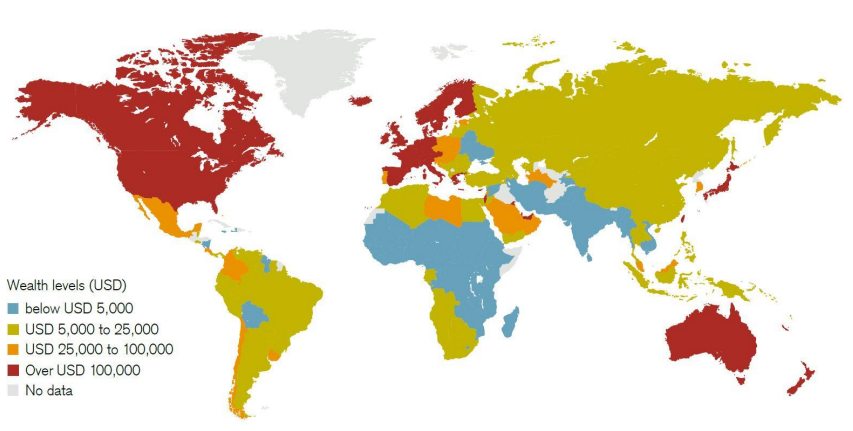
Source: Credit Suisse - Global Wealth Report 2014
From 2013 to 2014 global wealth grew 8.3%, $20.1 trillion, and is the largest increase since 2007. Total global wealth has risen every year since 2008 and is now 20% above its pre-crisis peak. Leading the wealth increase is the United States, home to 34.7% of global wealth. Most of the world's ultra high net worth individuals can be found in the United States, followed by China, Germany and the United Kingdom (see chart below).
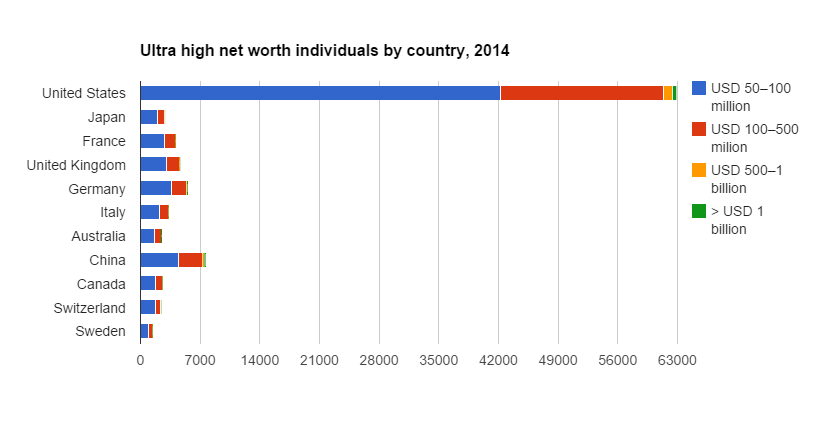
Own elaboration, data from Credit Suisse - Global Wealth Report 2014

However, Credit Suisse analysts also showed that overall wealth in the US has grown at a faster pace than incomes, warning that it is a trend that could point to recession. Stating that "For more than a century, the wealth income ratio has typically fallen in a narrow interval between 4 and 5. However, the ratiobriefly rose above 6 in 1999 during the dotcom bubble and broke that barrier again during 2005-2007. It dropped sharply into the "normal band" following the financial crisis, but the decline has since been reversed, and the ratio is now at a recent record high level of 6.5, matched previously only during the Great Depression. This is a worrying signal given that abnormally high wealth income ratio have always signalled recession in the past"

A critical view of the TPP

Trade agreement that upsets

The Trans-Pacific Partnership (TPP) is a regional free-trade agreement between the United States and some pacific countries. It threatens local economies self-determination over big corporations and any hope of a green trade deal that could ultimately do more to reduce carbon emissions. Critics have described the TPP as NAFTA on steriods (stoptpp.org) because of its focus on giving legal power to multinational corporations over nation states and their citizens. The proposed TPP is now, however, running into difficulties as the public learns more about it.

What is TPP?
TPP is a proposed regional free-trade agreement that as of 2014 includes twelve countries throughout the Asia-Pacific region (see map below). These countries combined represents an economic power of more than 40% of the worlds GDP, making the TPP the largest economic trade agreement to date. The agreement started with discussions in 2005 and should have finished by 2012 but was delayed because of major controversies and outrage due to leakages of secret documents around Intellectual Property and Environment Chapters in the proposed agreement by WikiLeaks. The push for this kind of an trade agreement probably started as a alternative way to WTO negotiations after 12 years of stagnation, partly due to well-organized public resistance in many countries. At the moment U.S. corporate interests are driving the agenda of the TPP (The Guardian).  It is according to many commentators no coincidence that leftist Latin American governments and China has been left out of the agreement.


Controversy
There has been extremely little transparency regarding the TPP negotiations. Few people have had access to the draft agreement and outermost secrecy has been in place. Large corporations and lobbyists, however, have been able to see chapters of the document. Thus when WikiLeaks first revealed parts of the TPP draft in November of 2013 many people and citizens rights groups got very upset. One part of the TPP which consist of giving corporations the right to directly sue governments for regulations that infringe upon profits or potential profits may explain why the TPP negotiators tried to hide the details from public awareness (Guardian, 2013). Because they knew it would evoke strong opposition, given the value people place in national sovereignty. Other parts of the draft, which have been leaked, includes:

Intellectual Property (IP) Chapter
The IP Chapter covers topics from pharmaceuticals, patent registrations and copyright issues to digital rights. Experts say it will affect freedom of information, civil liberties and access to medicines globally. The latest 77-page document is a working draft from the negotiations in Vietnam, dated 16 May 2014. The IP chapter of TPP would, if signed, effectively let corporations monitor citizens online activities, cut off peoples Internet access, delete content, impose fines and pursue stronger criminal regulations related to online copyright (ComputerWorld). It would end up instituting very controversial laws such as SOPA and PIPA that would restrict internet freedoms and free speech to the benefit of corporations. Overly protective patent laws on medicines and biological seeds etc. would also increase health care costs and farming practices and thus have a major impact on public health and food security, especially in poorer nations. 

Environment Chapter 
The environmental chapter in the TPP does not require nations to follow legally binding environmental provisions or other global environmental treaties. Pollution controls could vary depending on a country's domestic circumstances and capabilities. The chapter shows how trade above all is promoted, beyond environmental goals and values, basically stating that local environmental laws are not to obstruct trade or investment between member countries. Furthermore there is an emphasis on “...flexible, voluntary mechanisms, such as voluntary auditing and reporting, market-based incentives, voluntary sharing of information and expertise and public-private partnership”, but that even such measures should be designed in a manner that “...avoids the creation of unnecessary barriers to trade” (WikiLeaks). At a time of worldwide environmental challenges (including species die-offs, dangerous pollution of the oceans and climate change) people would expect that trade could be a tool to protect the planet, not hasten ecological collapse. 

Conclusion
According to Noam Chomsky, the MIT professor, the TPP is not about "free trade" at all. He says “These are extreme, highly protectionist measures designed to undermine freedom of trade. In fact, much of what’s leaked about the TPP indicates that it’s not about trade at all, it’s about investor rights” (Huffington Post). Simply put, this proposed agreement protects corporations over citizens and profits over the environment. If signed, this agreement could further exacerbate economic inequalities and environmental degradation in many nations.