Showing posts with label bubble. Show all posts

When the music stops

Heading for the next financial crisis?

When it comes to the topic of economics there are few trustworthy academics who know what they are talking about. However, an excellent one is prof. Steve Keen at Kingston University. He uses dynamic models and includes banks and credit/debt as key parameters to understanding financial crises. Something neoclassical economists totally ignore, which is ridiculous of course.

In one of Steve's latest blog posts, at debtdeflation.com, we find this interesting slide showing countries with rapid credit growth and accumulation of private sector debt since 2008. According to Keen these are the future debt-zombies, with a debt ratio of over 150% of GDP. Sweden (brown line) is among the worst of all countries and headed for a crisis. With private debt soaring to 237% of GDP and growing 15% of GDP per year it becomes clear that this is unsustainable and will have to end. Changes in the massive property bubble in Sweden will likely be a key indicator to the coming downturn. The new mortgage repayment requirements may function to slow down credit growth, and if so, most likely popping the bubble. We can't  predict when the crash will happen but that it will happen is a sure thing. 

Source: Steve Keen, presentation on growing private sector debt and financial crises
As for the US we can see in the chart below how credit growth picked back up again in 2010 after some deleveraging (2008-2009) but has once again started a downturn. A pattern similar to Japan's zombie-economy with rising and falling credit leading to recessions and ever more financial trickery from central banks.


Source: Steve Keen, presentation on inequality, debt and credit stagnation
This will affect the unemployment levels as, Keen shows in the chart below, there is a strong correlation between changes in credit and unemployment rates. More than 45 million Americans, about 20% of the population, are already on food stamps. According to shadowstats, real unemployment in America is at 23% as of May 2016, not 4.7% as the government claims. Not counting people who have stopped actively looking for a job, cherry picking data, is very dubious and has lead many mainstream media pundits to scratch their head as to "why so many americans are on food stamps?". 


Because there is so much misinformation and propaganda regarding the true state of affairs most people will be surprised when the next crisis hits. They will be angry as to why politicians have not informed them of the dangers and will be even less happy when the government asks for more tax money to once again bail out the banks. But certain homogenous societies may still be stable despite such hardships, as is the case with Japan. While others may experience uprisings and mayhem. 

Taking action to protect yourself and your community, getting out of debt, is all one can do at this point. Governments around the world are so blinded by their addiction to credit growth that they will do anything to keep the bubble going. Even if it only increases the income gap between the rich and the poor. Getting out of debt and investing in alternative energy sources and food production is the safer bet. And something we should all do to protect our families and future generations.

Currency war could pop the Swedish housing bubble

"You cannot permanently pit an absurd human convention, such as the spontaneous increment of debt [compound interest], against the natural law of the spontaneous decrement of wealth [entropy]" - F. Soddy (Cartesian Economics, p. 30).
Credit: Brocken Inaglory CC BY-SA 3.0

Currency war and deflation

The Swedish Central bank (Riksbank) have cut the repo rate to -0.35% and bought another 30 billion SEK in government bonds in the belief that this will stave off deflation (i.e. import inflation). Which it won’t, since the global economy has taken a downturn and it looks like most economies now are facing recession or depression due to the deflationary collapse of commodities, capital spending and global trade. Most intelligent people know that GDP growth is over, since we live on a finite planet, and the reason for this latest bubble had to do with private sector borrowing to inflate consumption rather than productivity increases in the real economy. What professor Didier Sornette at ETH Zurich calls “The illusion of the Perpetual Money Machine” (2012).

Original Meadows et al. (1972) modified by Ragnarsdóttir et al. (2015)

Housing bubble ponzi scheme

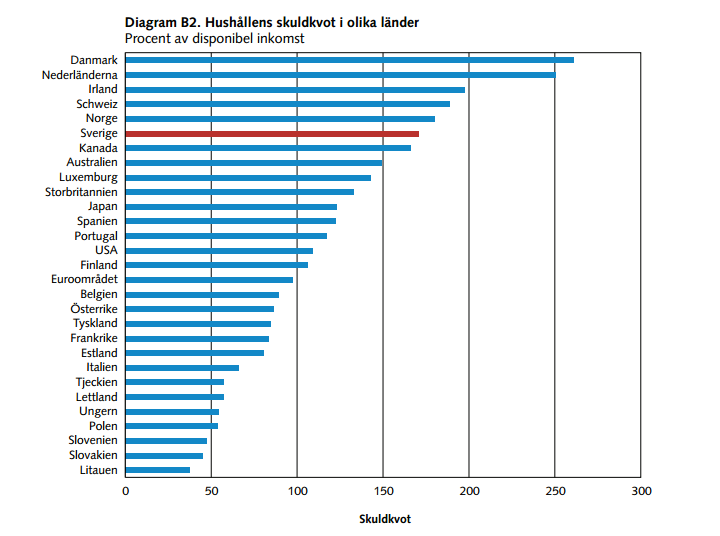
The Riksbanks policy will not win over deflation (there are no winners in a global currency war), however, it will fuel the already overheated housing market in Sweden, with a risk of popping this bubble. The ultra-loose monetary policy will encourage Swedish households to take on more debt, despite them being overburdened by debt already. Household debt to disposable income is currently at 172% (see diagram). One can compare this to the famously over leveraged American households before 2008 which topped out at 130% of disposable income.

Household debt to income for various countries in 2014. Source: Riksbank (2015)
There should be plenty of people around today that actually remember the devastating property crash of the early 1990s, but it seems like most people have a short memory. In the early 90s the government had to step in and nationalise the banks while increasing public spending to keep the economy alive in the midst of soaring unemployment. It took at least a decade for the economy to recover and the state to restock its finances after that.
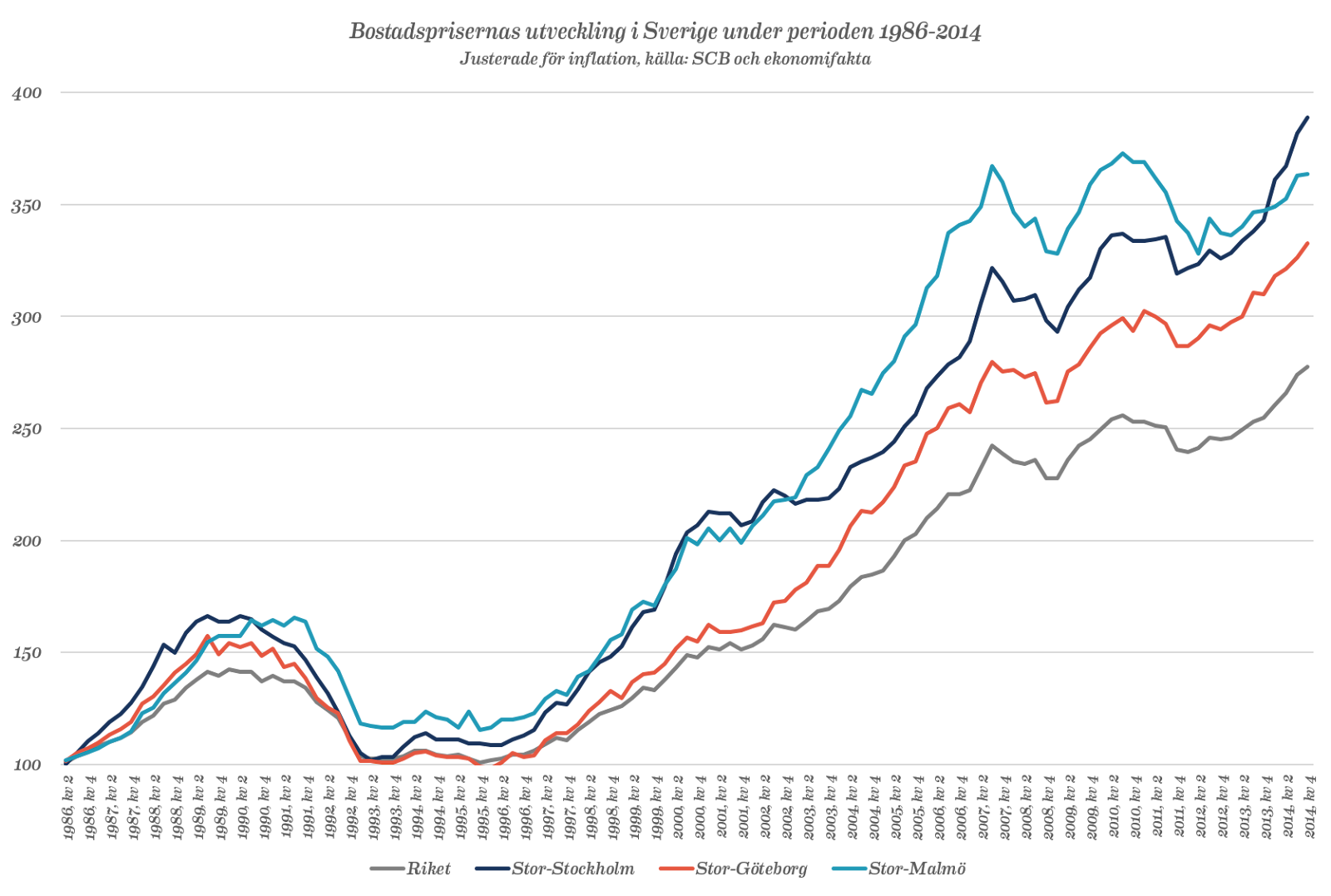
Property price index in Sweden (1986-2014) adjusted for inflation. Country average (grey), Stockholm (black), Göteborg (red), Malmö (blue). Credit: Rika Tilsammans
Sweden’s present housing boom started right (2000) after the recovery from the crisis in the 1990s. The boom was set off by low interest rates and a massive expansion of the financial sector with increasingly lower standards for issuing credit/loans. This have driven up prices to extreme levels, mainly in Stockholm, Göteborg, and Malmö, effectively forcing more people to borrow to afford housing in the inner cities. Property prices have been rising 8-9% per year on average for almost 20 years. During the last 12 months, prices have risen by 12% (average price per m2 SEK 32,692).
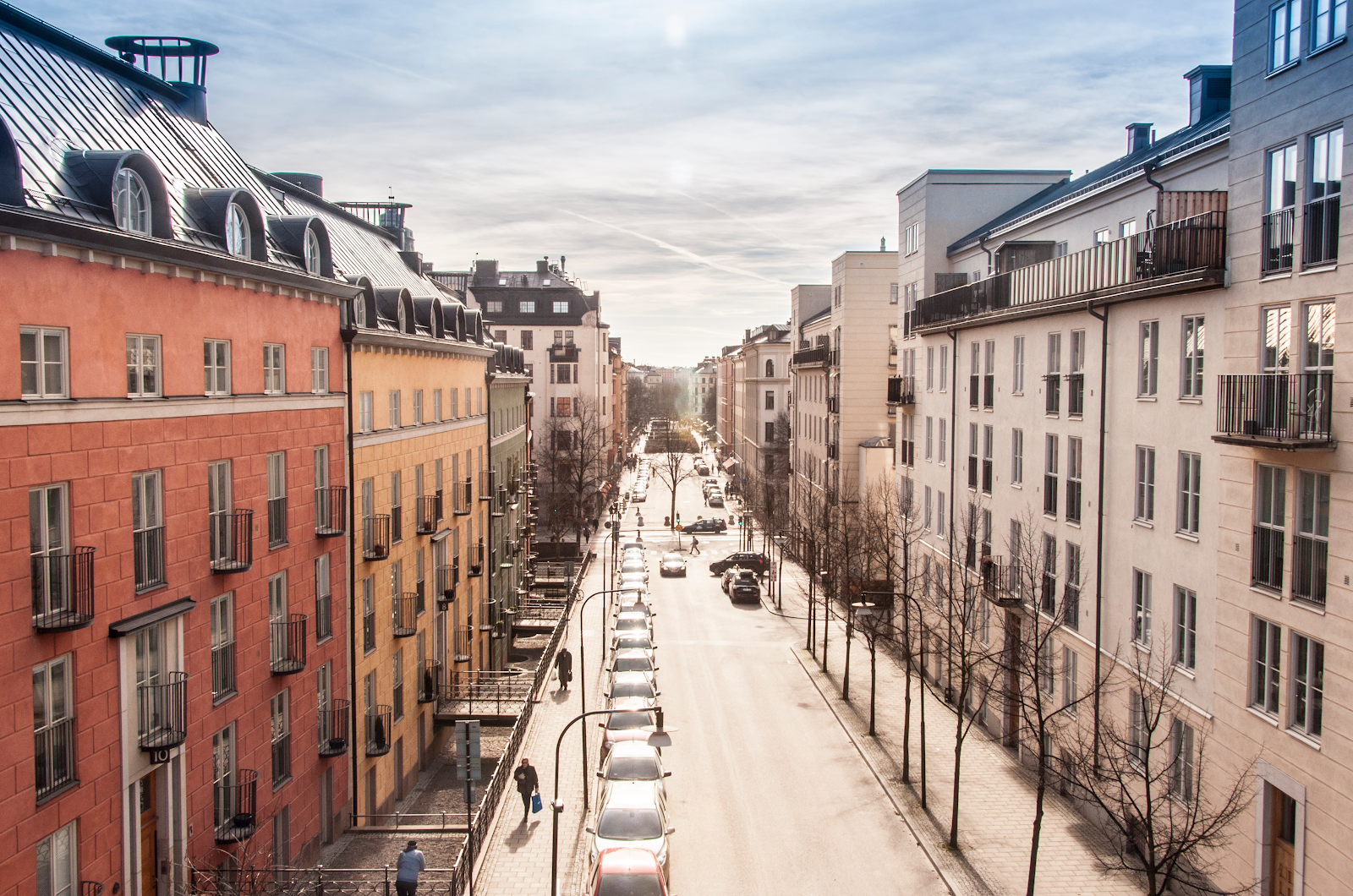
Sankt Eriksområdet, Stockholm. New Urbanism. Credit: 199pema (CC-BY-SA 3.0)
Even after 28 years of queueing it is impossible to get a rental flat in Stockholm. So plenty of people, or rather their parents, take on loans of SEK 1-3 million to buy a flat as small as 20-40 m2. Of course not everyone can afford to do that, so it's mostly the rich kids that stay in the city centre, in Södermalm, where all the other hipsters are. No integration there! Most of these youngster don’t have any savings. The only thing they have is their flat, speculating that asset prices will rise, seeing it as an “investment”. But of course it’s not real wealth, it doesn’t contribute to the real economy in any way, all it does is inflate property prices further.

Now, finally, mainstream media and Swedish authorities have started issue warnings about the housing bubble and a potential crash. Of course it’s too late to avoid it now. I guess everyone just love rising housing prices, no wonder since it's private and household debt that has driven GDP growth over the last decade in Sweden. So much for Anders Borgs famous “Swedish growth miracle”! Borrowing consumer demand from the future through credit creation is not equal to creating real wealth, it just implies we will be poorer (can consume less resources) in the future. After all, we live on a finite planet.

Bubble Watch

Central bank folly continues

It's been six years since the 08 financial crash that almost wrecked the world economy. Governments claim that the crisis is since long over but central bankers are still pulling on all levers, now governing market behaviour,  in trying to reach their inflation targets. But unemployment is still at all time highs in Europe and sanctions aimed at Russia have also hurt many European businesses. Over-indebtedness is the problem but central banks believe that the solution is to borrow more, not less. They have tried this method for several years now, Japan for the last 20 years, and the only thing that has happened is that economic inequality has risen dramatically. Thats what happens when you have a zero sum game i.e. running out of cheap resources to produce a surplus. In this case savers are punished and debtors are rewarded. So people with pensions are the first to lose, and banks/people with massive loans the first to gain. 

This week the Swedish central bank (Riksbanken) announced negative interest rates of -0.25%, in the belief that "doing more of the same will yield a different result". This comes after the European Central Bank (ECB) announced its new quantitative easing (QE) program on January 22nd. Since then, only three months ago, we now see a massive formation of bubbles with warning signals showing up in European Equities and Global Fixed Income. At least according to the March report from the Financial Crisis Observatory. 56% of all the European Stoxx Equities Sector Indices gives clear warning signals, a month ago that was 0%. The market is overvalued and turned red almost in an instant. However, it is very difficult to anticipate market movements in these global markets that are guided by central banks' over the top measures. It is not free market capitalism any longer, but rather, central bank folly that governs the market. 

The US dollar strengthening is global and warning signals can be seen in many currency pairings, for example FX US dollar/Swedish krona. While the Euro and the Russian Rouble has continued momentum downwards. Energy, softs and metals, show negative (undervalued) bubble signs which probably imply weak global demand. The massive increase in warning signals in European Fixed Income is largely due to the size, purchasing 220% of the total net issuance over 1 year, of the ECBs QE announcement. After a 15% rise in 2 months, 56% of all European sector indices show clear bubble signals. This is important to note, especially since the implied Vol, risk perception index, has dropped instead of risen. In the case of Sweden it has now become even cheaper to borrow money, which will fuel the housing bubble and probably end in tears at some point in the not to distant future. Similarly to what happened in the early 90s.

Cauwels, P. & Sornette, D. (March, 2015)