Showing posts with label crony capitalism. Show all posts

When the music stops

Heading for the next financial crisis?

When it comes to the topic of economics there are few trustworthy academics who know what they are talking about. However, an excellent one is prof. Steve Keen at Kingston University. He uses dynamic models and includes banks and credit/debt as key parameters to understanding financial crises. Something neoclassical economists totally ignore, which is ridiculous of course.

In one of Steve's latest blog posts, at debtdeflation.com, we find this interesting slide showing countries with rapid credit growth and accumulation of private sector debt since 2008. According to Keen these are the future debt-zombies, with a debt ratio of over 150% of GDP. Sweden (brown line) is among the worst of all countries and headed for a crisis. With private debt soaring to 237% of GDP and growing 15% of GDP per year it becomes clear that this is unsustainable and will have to end. Changes in the massive property bubble in Sweden will likely be a key indicator to the coming downturn. The new mortgage repayment requirements may function to slow down credit growth, and if so, most likely popping the bubble. We can't  predict when the crash will happen but that it will happen is a sure thing. 

Source: Steve Keen, presentation on growing private sector debt and financial crises
As for the US we can see in the chart below how credit growth picked back up again in 2010 after some deleveraging (2008-2009) but has once again started a downturn. A pattern similar to Japan's zombie-economy with rising and falling credit leading to recessions and ever more financial trickery from central banks.


Source: Steve Keen, presentation on inequality, debt and credit stagnation
This will affect the unemployment levels as, Keen shows in the chart below, there is a strong correlation between changes in credit and unemployment rates. More than 45 million Americans, about 20% of the population, are already on food stamps. According to shadowstats, real unemployment in America is at 23% as of May 2016, not 4.7% as the government claims. Not counting people who have stopped actively looking for a job, cherry picking data, is very dubious and has lead many mainstream media pundits to scratch their head as to "why so many americans are on food stamps?". 


Because there is so much misinformation and propaganda regarding the true state of affairs most people will be surprised when the next crisis hits. They will be angry as to why politicians have not informed them of the dangers and will be even less happy when the government asks for more tax money to once again bail out the banks. But certain homogenous societies may still be stable despite such hardships, as is the case with Japan. While others may experience uprisings and mayhem. 

Taking action to protect yourself and your community, getting out of debt, is all one can do at this point. Governments around the world are so blinded by their addiction to credit growth that they will do anything to keep the bubble going. Even if it only increases the income gap between the rich and the poor. Getting out of debt and investing in alternative energy sources and food production is the safer bet. And something we should all do to protect our families and future generations.
Wealth inequality on the rise

Global Wealth 2014

According to 2014 Global Wealth Report, by Credit Suisse, world wealth has reached a record $263 trillion but is now even more concentrated at the top. The richest 1 percent of the worlds 7.3 billion people have accumulated even more wealth, now owning more than 48% of global wealth. The authors of the report warns that growing inequality may spark a recession, as high disparity leads to economic friction.

Wealth distribution - Rising Inequality

Few household characteristics vary across individuals as much as income and wealth. This has been the case throughout much of human history, with wealth ownership often equating with land holdings, and wealth more often acquired via inheritance or conquest. But a combination of factors caused wealth inequality to trend downwards in high income countries during much of the 20th century, suggesting a new era. However, that downward trend has now stalled, and started going into reverse.

Since the 1980s wealth distribution have developed differently in a number of countries. In some countries, especially the US and the UK, inequality has risen sharply. This increase has taken place from a level that was already high in relation to others before it started. In countries like Sweden and Finland, increases have also been substantial but here from internationally low levels that are much higher but remain among the lowest (Roine and Waldenström, 2014).

According to Credit Suisse 2014 report, a person that owns $3,650 (including equity of their home) is today considered to be among the wealthiest half of global citizens. A person owning more than $77,000 is considered to belong to the top 10% and a person owning $798,000 to belong to the top 1%. 

“Taken together, the bottom half of the global population own less than 1% of total wealth. In sharp contrast, the richest decile hold 87% of the world’s wealth, and the top percentile alone account for 48.2% of global assets” (Credit Suisse, 2014 pp.99). 

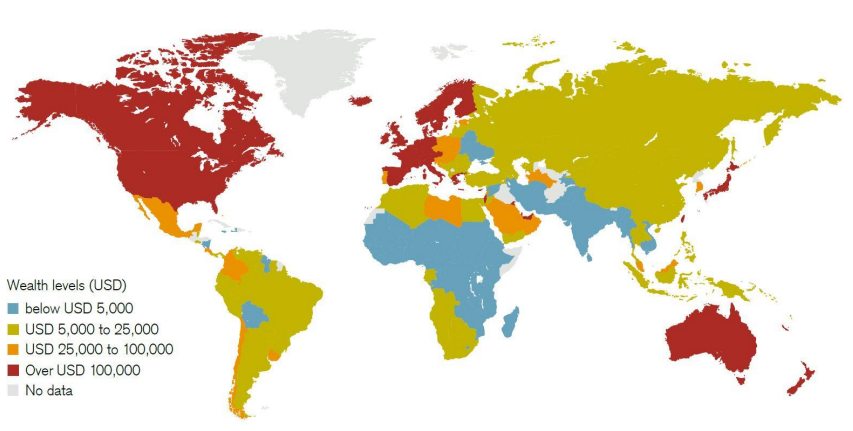
The richest nations, with over $100,000 wealth per adult, are found in North America, Western Europe and among the rich Asia-Pacific and Middle Eastern countries. They are headed by Switzerland ($587,000), Australia (431,000), Norway ($359,000), United States ($348,000), Sweden ($333,000), France ($317,000) and the United Kingdom ($293,000). See map below.

Source: Credit Suisse - Global Wealth Report 2014
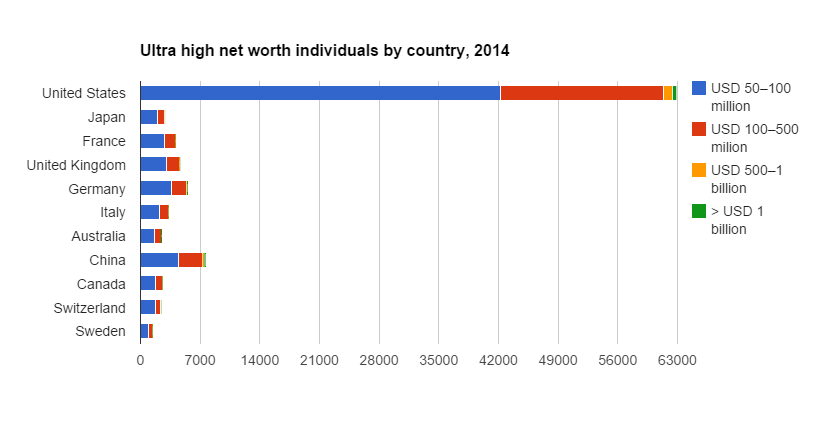
From 2013 to 2014 global wealth grew 8.3%, $20.1 trillion, and is the largest increase since 2007. Total global wealth has risen every year since 2008 and is now 20% above its pre-crisis peak. Leading the wealth increase is the United States, home to 34.7% of global wealth. Most of the world's ultra high net worth individuals can be found in the United States, followed by China, Germany and the United Kingdom (see chart below).
Own elaboration, data from Credit Suisse - Global Wealth Report 2014

However, Credit Suisse analysts also showed that overall wealth in the US has grown at a faster pace than incomes, warning that it is a trend that could point to recession. Stating that "For more than a century, the wealth income ratio has typically fallen in a narrow interval between 4 and 5. However, the ratiobriefly rose above 6 in 1999 during the dotcom bubble and broke that barrier again during 2005-2007. It dropped sharply into the "normal band" following the financial crisis, but the decline has since been reversed, and the ratio is now at a recent record high level of 6.5, matched previously only during the Great Depression. This is a worrying signal given that abnormally high wealth income ratio have always signalled recession in the past"

TTIP trade deal and it's impact on democracy

Trade agreement being negotiated behind the scenes

In my last post I had a critical look at the trans-pacific partnership (TTP). And so to be fair and also bring this issue closer to home I will in this post have a look at the Transatlantic Trade and Investment Partnership (TTIP). TTIP is very similar to TTP, a proposed regional free-trade agreement, but between the European Union and the United States. Proponents of TTIP argue that it would result in multilateral economic growth, while critics argue that it would increase corporate power and make markets more difficult to regulate for public benefit. Like TPP this trade agreement has been delayed by leaked draft documents, due to it's secretive nature, but could be finalized by the end of 2014.

Corporate Control

Similar to the case of TTP a very controversial clause in the TTIP is the Investor-state dispute settlements (ISDS). The ISDS would allow corporations to sue governments, for any government action (at any level, including local government level) that limits a corporation's future profits. One example of how the ISDS clause in TTIP would impact countries can be found in the case of the Swedish, part state owned, energy company Vattenfall suing the German government over the issue of terminating nuclear power plants. Vattenfall demands payouts of 4,7 billion euros (Der Spiegel), and has caused outrage in Germany. Other examples includes tobacco companies suing the Australian government over health labeling of cigarettes, and fracking companies suing the Canadian government over environmental protection. The original justification for introducing ISDS in trade agreements was for trade deals with countries where the judicial system was weak in protecting foreign investors. But this is not the case with either the EU or the US. According to the latest UN report on the topic, ISDS cases has increased from 0 in 1992 to 514 in 2012.

Responses by civil society

There is now a growing civil society resistance to TTIP and ISDS inclusion in the TTIP negotiations. Last month there were 450 protest actions across 24 member states (The Greens Europe). The European NGO Finance Watch writes about ISDS that "the very principle of such a mechanism is anti-democratic, because it allows investors to challenge legitimate regulations and other rules that have been created and voted by democratic institutions with a view to protecting their citizens". Corporate Europe Observatory (CEO) has reported that of 560 lobby encounters that the European Commission trade department held to prepare the negotiations, 520 (92%) were with business lobbyists, while only 26 (4%) were with public interest groups (CEO). That must be considered corporate capture. A large number of European scientists have also voiced concern over ISDS legal nature, quote "there is little evidence linking the conclusion of the Treaties to increased flows of foreign direct investment, and there is little evidence that they contribute to other development goals, such as encouraging good governance" (University of Kent). And a recent study from Tufts University has concluded through modelling that TTIP could lead to: net loss in exports for the EU, a net loss in GDP, and a loss in employment of some 600 000 jobs, and the author conclude by stating that "In the current context of austerity, high unemployment and low growth, increasing the pressure on labor incomes would further harm economic activity" (Capaldo, 2014).

Impact on environment, health and food standards

Many environmental organisations fear that the TTIP will ignite a "race to the bottom" regarding environmental regulations in the EU, so that they come to resemble the US far weaker regulatory system. Most likely the TTIP will accelerate the privatization of public goods and services such as National Health systems. This could have tremendous effects on public health. And many analysts agree that TTIP would allow big food corporations to avoid food safety regulations and undermine sustainable agricultural practices in the rush for profits and trade. For example, the US has much weaker standards on animal welfare, ecosystem protection and GMO labeling. These are serious citizen concerns that has not been sufficiently addressed by governments wishing to take part of the TTIP.


Conclusion

Trade unions, consumer groups, environmentalists and digital rights activists are opposed to increasing corporate rights over sovereign nations. Almost all (centre-)left groups in the European Parliament have voted against ISDS. So have the French Assemble and the Dutch Parliament. In Sweden, however, both the moderates (M) and social democrats (S) are positive to the TTIP (ETC, 2013). The current prime minister, Stefan Löfven, has stated that he welcomes the TTIP but that "social justice issues should be included" (ibid). This is a paradox since the (S) representative Mikael Damberg in a leaked document to Cecilia Malmström, the EU commissioner for trade, has signed a letter pushing for ISDS inclusion in TTIP (TTippen.se). The most troubling issue is perhaps how much of the negotiations have been kept secret from public and governmental scrutiny, similar to the TPP. Moreover it seems that countries have become so desperate for economic growth that they are willing to throw everything they worked for, in terms of environmental and health regulation, out the window. I am also surprised that conservatives don't seem to react to this issue as much as the left, one might think that they should be even more concerned with national sovereignty.