.png)

A more humane response to the refugee crisis
 |
| Source: UNHCR (2015) |
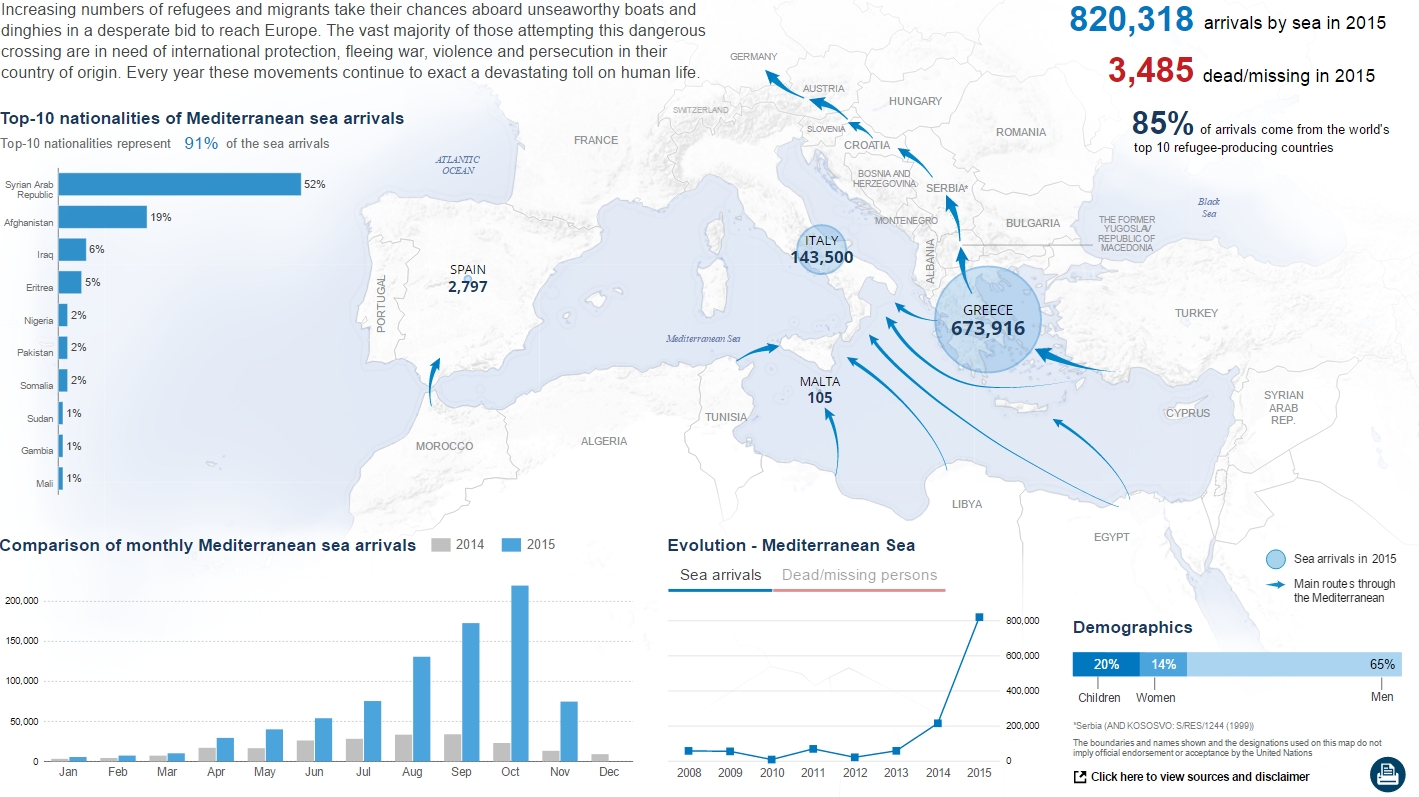
There are around 20 million refugees in the world out of 60 million displaced persons, according to UNHCR. During the period January-November 2015 some 820,318 refugees has arrived to Europe by sea and 3,485 have died or are missing. A full 65% of arrivals are men, mostly from Syria and Afghanistan. Most refugees have arrived in Greece to later make their way towards Germany and Sweden, through Macedonia, Serbia, Croatia, Slovenia, and Austria.
What we see in the Mediterranean is a humanitarian crisis of huge proportions and it needs to be treated as such. Telling refugees they can have a permanent residentship while not establishing boundaries (capacity and which people to prioritize) or approving visas for safe travel through Europe is not a humane policy. Countries like Germany and Sweden have had to revise their policies (e.g. giving temporary asylum and increasing border controls) because it’s creating so much confusion and encouraging the growth in human trafficking and thus increasing the death toll on the sea.
We have to understand that many refugees trying to reach Europe over the Mediterranean are often men with some money searching for better opportunities than they currently can find in e.g. Turkey or Lebanon. One reason for this is because the world’s rich countries have not funded the UN’s humanitarian agencies which are now on the verge of financial bankruptcy (The Guardian, 2015). This year the World Food Programme had to cut food rations to 1.6 million Syrian refugees, warning that this leaves many vulnerable to recruitment by extremist groups (The Guardian, 2015). Less humanitarian help in places of conflict has in turn lead to larger migration flows. Deteriorating conditions in Lebanon and Jordan have become intolerable for many of the 4 million people who has fled Syria, driving the latest waves of immigration towards north-west Europe.
A humane policy would not reward only young men with the money to cross the sea. Instead it would determine the right to asylum based on needs, e.g. the sick or orphans, and give them a visa to safely travel into Europe. A more humane policy with increased funding to UN’s humanitarian agencies will also safeguard that social tensions don’t spin out of control in Europe, so that the refugees that get to come feel safe and welcome while people that want to stay in the region can do so without starving, turning to crime or violence.
A more humane policy by the rich EU is to provide resources (food, water, healthcare, family planning service, ecological restoration, education etc.) to vulnerable countries in the MENA region. Europe has long been a centre that has sucked in natural resources from the world's poor in exchange for worthless fiat and unpayable debts. Now it’s time to repay some of those resources, in the interest of peace and stability in the region.
 |
| Credit: Ekathemerini |
According to the Guardian article, quote: “The Syria regional refugee response plan is only funded to 35% of the $1.3bn needed to support refugees, both in the camps and by providing resilience funding for the countries hosting them” which is a disgrace, wealthy countries complaining about a refugee crisis but being unwilling to fund the response in the region.
The article goes on to state: “In August, a multi-million dollar shortfall forced the World Health Organisation to close down 184 health clinics across 10 of Iraq’s 18 districts, in an area that has seen severe fighting and massive internal displacement. The cuts have left 3 million people without access to healthcare. The World Health Organisation is trying to raise $60m to fund healthcare in Iraq but so far only $5.1m has been given by donors. Dr Michelle Gayer is director for emergency risk management at the WHO. She told the Guardian that the gap between the desperate need in countries such as Iraq and current funding levels risked permanent damage to public health across whole populations” (The Guardian, 2015)
The article goes on to state: “In August, a multi-million dollar shortfall forced the World Health Organisation to close down 184 health clinics across 10 of Iraq’s 18 districts, in an area that has seen severe fighting and massive internal displacement. The cuts have left 3 million people without access to healthcare. The World Health Organisation is trying to raise $60m to fund healthcare in Iraq but so far only $5.1m has been given by donors. Dr Michelle Gayer is director for emergency risk management at the WHO. She told the Guardian that the gap between the desperate need in countries such as Iraq and current funding levels risked permanent damage to public health across whole populations” (The Guardian, 2015)
There are plenty of young unemployed people in Europe that wants a job so why don't governments fund UN's programs that could make use of young talents at the same time as it helps vulnerable communities in the MENA region. That could actually help lower the risk of extremism spreading, as opposed to military intervention which only creates extremism. Better yet, take money from defence budgets and put it into aid if there "isn't enough funding" at the moment. Have we learned nothing from our previous failures?


 Posts
Posts

