Showing posts with label nuclear. Show all posts

Predatory Militarism on the Rise

IT IS 3 MINUTES TO MIDNIGHT Doomsday Clock. The Bulletin

Responses to resource scarcity

Throughout history, different societies have opted for different “solutions” to energy scarcity and collapse. Some might try to adapt to this new socioeconomic reality (Cuba 1990s), others may protect the elite at the expense of the general population (North Korea 1990s), while some may turn to external aggression and predatory militarism (Japan 1918-45) (Friedrichs, 2012). Predatory militarism is, according to Friedrichs, the result of desperation and temptation to gain resources through military means. In the Japanese case, the element of desperation prevailed. In the 1930s Japan started its aggressive military campaigns against China in attempts to prevent fuel starvation and external dependence on strategic resources. However, ironically this predatory militarism instead lead Japan to become increasingly dependent on importing critical commodities (oil) from the US (about 70-80% of gasoline). So when the US put in place a trade embargo (1941) Japan started looting oil from Borneo, Sumatra and the East Indies. And we all know what happened after that. In short, Japan tried gain critical resources from other countries, prompted by the potential of fuel starvation, which lead them to scrap free trade policy and to radicalise a strategy of predatory militarism to secure access to energy.

Worrying Trends 2015

Countries prone to military solutions like the US and Russia seems to have followed a Japanese-style strategy of predatory militarism.The US (and NATO) involvement in the Middle East to secure access to oil by military force is a clear example of this. We also see a worrying trend of potential US involvement in the South China Sea, as well as China’s use of its military power to secure oil and gas in Central Asia. However, it seems unlikely that China will stray further than that in terms of military force, instead they have been making trade deals with Iran and Russia for oil. China will probably hesitate to anger the US which has a much stronger military than China, but the country may become increasingly desperate for more energy as its population continues increasing while demanding reductions to coal pollution. I am more concerned about what the US might do next. Since 2001 the US have been in constant warfare, and for no benefit of the people of those countries (Afghanistan, Iraq, Libya, Syria, Yemen, Pakistan) or the countries receiving all the migrants from these war torn regions. Then we have Russia's invasion of Ukraine (or support of separatist movements as some like to call it), to secure the flow of natural gas, and now its involvement in Syria. This shows signs of major geopolitical instability in the oil rich Middle East and in Europe due to global scarcity of energy, and an escalating power play between NATO and Russia over "what's left".

October – Outlook from a Swedish perspective

On the military side of so called strategic deterrence we have seen an increase in military drills in our neighbourhood. During the summer both NATO and Russia conducted naval exercises in the the Baltic Sea. Now, during the fall, drills have intensified both in Russia, Belarus, and on NATO territory. Both naval and air forces have been deployed to show “might” on both sides. However, it is on the nuclear side of the deterrence strategy where most activity have been going over the last couple of months. It is likely that Iskander with nuclear capability is located in Kaliningrad and that the US has started to upgrade their capability with the new B61 nuclear bombs for fighters at German, Italian and Turkish air bases. At least according to credible Swedish commentators. Furthermore, the UK has voiced a wish to join NATO:s exercises on nuclear escalation (i.e. in the case of transitioning from conventional weapons to high alert for nuclear weapons deployment).
File:Nuclear weapons.png
Credit: WikiCommons


The Russian intervention in Syria has increased the likelihood of confrontation. Perhaps not intentional but the risk of unintended consequences, with potentially catastrophic results, getting out of hand has risen. Russian rocket launches from the Caspian Sea was, according to most experts, a demonstration of power for mainstream media and the domestic audience back home. But because the robotics system, similar to Iskander, can launch both conventional ammunition as well as nuclear this illustrates a serious upper hand that Russia has gained in terms of tactical and potentially mid range weaponry. It is, however, yet unclear if the images shown were real or potentially tampered with. The propaganda war between Russia and the West has reached such high levels that it's becoming increasingly difficult to know what is actually going on down on the ground.

For Sweden this escalation of tension between NATO and Russia is very troublesome, especially since exercises have been occurring on and around our borders. We don’t really have any defence to speak of and so popular support for joining NATO is increasing in Sweden, a similar trend is visible in Finland. Experts over here are mostly concerned with the unpredictability of Russia, which is very good at hiding its true intentions and preparations. The larger issue, however, is the political confusion over Russian statements and lack of insight into Kremlin's actual behaviour. The West’s analysis of Russia have been wrong all along and there has been little focus on the actual geopolitical consequences on the ground. This is of course a consequence of the whole propaganda war going on and the increasing inability of the government to solve complex problems.

Furthermore, there is very low public support for NATO and military interventions in Europe, which probably annoys the hell out of US "diplomats". Few soldiers have been mustered in Europe and the few who are in service are not ready for combat. Most Europeans don't want to get involved with either Russia or the US, but if they have to chose, well, Russia supply almost all of Europe's natural gas and oil so… yeah… I think you know the answer. 

As for other European countries turning to the predatory strategy we have seen some of that in terms of the nuclear powers (France, the UK, Italy) engagement in the Middle East. It is unclear what these countries may do under pressure, any large-scale military response inside Europe seems unlikely, but then again, history has shown that any liberal democracy can turn into an authoritarian military machine when conditions turn really ugly. The current economic crisis and hardship for people in southern Europe could perhaps lead to extremists rising to power again if there is another major economic blow (which looks like it's on its way now with the global economic slowdown). Even here in Sweden I see a trend towards people voting for the Sweden Democrats (far right wing) in pure frustration over the current government's incompetence. Of course, the problem is not so much political as it is a resource problem but most people don't see the connection. And so on and on the debate goes, generating more irrational political behaviour, which in turn angers the public even more.

Despite all these worrying signs in our close proximity our dear politicians, here in Sweden, have not been able to come to any agreement about funding emergency preparedness and response. So we are basically helpless if there is a conflict in our neighbourhood and will have to rely on Finland and other countries to help us out. Or perhaps we would simply hope that there is nothing of value to Russia and NATO here, we have no oil, coal or natural gas. 

In search of alternative energy technologies

Greater energy availability corresponds with greater quality of life. Source: Lambert et al. (2013)

Alternative energy technologies

Economic progress and wealth of society strongly depends on the best choice of energy supply techniques. Like with any living organism, societies needs energy to perform work. Before the industrial revolution we relied on horsepower, wood, wind and human labor. These forms of energy were, however, very inefficient because of their low energy density. It was not until we discovered coal and invented the stream engine that the revolution started and societal metabolism went up. Since then, humanity has been addicted to fossil fuels to propel our societies forward. Now, however, its becoming a real problem because the Earth is not as big as we thought. Fossil fuel extraction and pollution on a massive scale have caused our climate to change and we are running into limits of what the Earth can provide in terms of cheap and abundant natural resources. So we look to alternative technologies for solutions to this predicament. But as we know from the German case this issue is not without its challenges. We need a measurment that that can establish what alternative are most effective in terms of providing a net surplus of energy to society while reducing greenhouse gas emissions. 

Energy return on energy invested

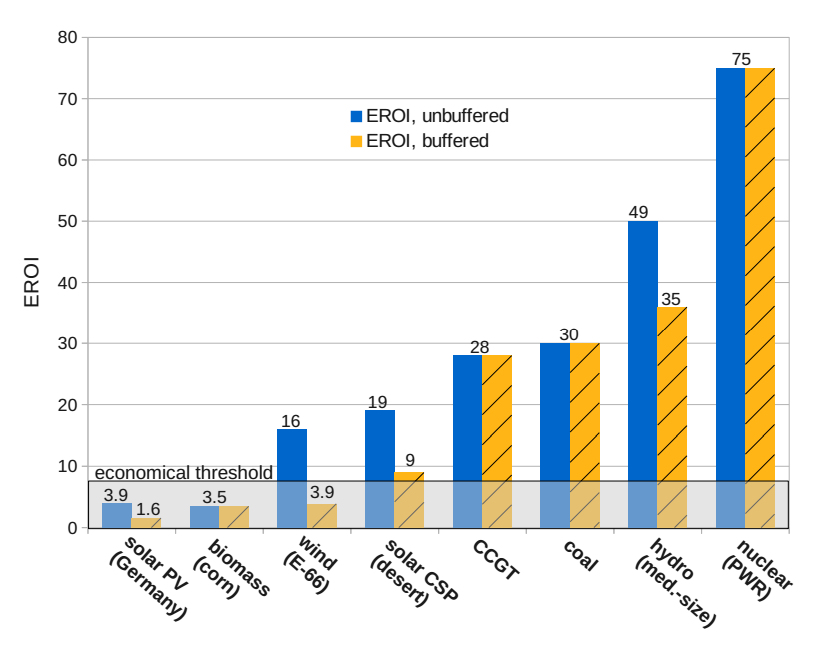
The energy return on (energy) investment (EROI) is an important measure that describes the overall life-cycle efficiency of energy supply techniques, independent of economical and political considerations. The EROI answers the simple question “how much useful (net) energy do we obtain for certain effort to make this energy available” (Weißbach et al. 2013). As we know, energy and matter are never consumed or generated but always just converted. There is always a flow of materials (fuel, materials for construction, maintenance) driven by the “invested” energy with the result of making the “returned” energy available. This means that to calculate net energy of a particular supply technique, also known as carrier, one has to include all the energy it takes to produce electricity - from the extraction of resources to the construction and maintenance of the plant, as well as expected lifetime. Furthermore, because many so called renewable carriers are intermittent they usually require back-up plants or storage that can buffer for when they aren't generating enough electricity at times when people need it. Weißbach et al. 2013 have chosen to include this in their EROI analysis, few others do. Break-even has an EROI of 1. But that would be pointless as you would have a plant but couldn’t run it. The higher the EROI the higher the return on investment.

As the graph above shows, solar photovoltaics and biogas from corn require so much energy that there is very little net energy provided to society, you put in 1 and get 3.9 or 3.5 back (even worse if you include the buffering). That’s not enough to run a complex society on. Wind onshore and hydropower, however, perform much better and give a return of 19 and 49 respectively. Natural gas and coal fired power plants give 28 and 30 in net energy. And nuclear has a value of 75, calculated with a 60 year lifetime. Solar thermal in the Sahara would also give enough net energy to be useful.

Energy Money Return on Investment

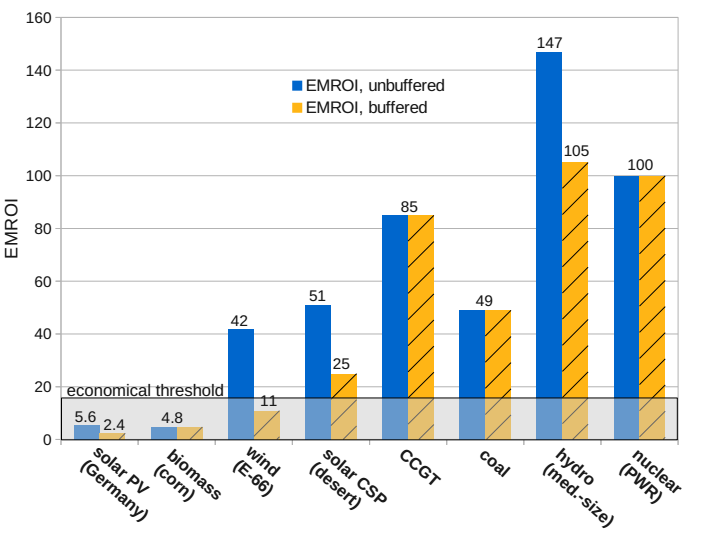
Now that we know which electricity producing technologies offer most in terms of net energy we can turn to monetary cost. But first note that not all energy is created equal. Electrical energy is very useful, because it can immediately do work. Heat and chemical energy are less useful because it's harder to get work out of them. By calculating the exergy, the available energy to do work, equivalent we can get energy money return on investment (EMROI). This is done by weighting both the energy inputs and energy output by a factor of 3 when the energy type is electrical. As shown in the graph below.

Because all these carriers produce electricity as output, but not all inputs are electric, the EMROI of all sources is higher than their EROI. This is one step further towards monetizing the EROI by allowing for the greater monetary value of electricity compared to other energy types. We can see that hydro, nuclear, natural gas and solar in the desert have high EMROI. However, EMROI is just a “best case” scenario for monetary return on investment. Note that the economic threshold has gone up to. The idea is that in e.g. the US, a kWh of energy cost about 10 cents but it produces about 70 cents worth of GDP, a ratio of 7 to 1. If we do the same computation in exergy terms, the ratio is 16 to 1. That means the fully monetary return on investment of exergy, for the economy as a whole, is 16. A similar ratio can be seen for other countries which leads to the conclusion that the thresholds are 7 for EROI and 16 for EMROI, assuming OECD-like energy consuming technology. For lower developed countries thresholds might be smaller, thus making also less efficient energies like biomass economic.

Greenhouse Gas Emissions

By looking at historical development rates of low-CO2 electricity production among different high-income countries we can try to figure out what techniques have worked well previously. Below is a chart showing OECD countries population size and generation of kWh per capita per year.

Renewables (left) and nuclear (right). Source: Davour et al. (2014)

Overall we can see that only a few countries have succeeded to build low-CO2 electricity production with a rate of 300kWh/cap/year, which is the needed improvement speed to stay below the Kyoto Protocol 2 C degrees limit. One should note that no country have made it above the 300kWh/cap/year without the help of nuclear. We can see that Swedish nuclear development reached the highest level of 700 kWh/cap/year. Mean development rate only reached 120 kWh/cap/year between 1982 and 1992. When it comes to renewable electricity production, Denmark has the highest with about 160 kWh/cap/year. Closely followed by Sweden. Spain and Germany reached levels of 120 kWh/cap/year. We can see that Sweden has a top position in development rate of low-CO2 electricity production, both with nuclear and renewable energy. If the rest of the world would implement nuclear at the same rate as Sweden did, it would take 25 years to replace all existing fossil fuels (Davour et al. 2014). It is very improbable that this will happen, and perhaps isn't recommendable, but the example show how important the inclusion of nuclear into the energy mix is for future low-CO2 electricity production.

Discussion

This is just one out of many studies that have looked at EROIs for various energy carriers. Because there is no universally accepted methodology one should be careful about taking any numbers for granted until reading the literature. These numbers are however in line with other studies, except in the case of nuclear. Previous studies have shown extremely varied numbers for nuclear. This could be because, since the 1980s when EROI measurements began, EROI for nuclear has been rising rapidly as the industry has switched from gas-diffusion enrichment of uranium to centrifuge (which is 35 times more energy efficient). The World Nuclear Association projects that there will be no more diffusion enrichment anywhere in the world by 2017. Moreover, there are other processes and a next generation of nuclear power plants, called Gen-IV designs, that don’t use enrichment at all which would give them much higher EROI. And Gen-IV models can't have a melt-down. The Chinese have 300 engineers working on a liquid-cooled thorium reactor right now. So if you wondered why climate scientists like James Hansen are pro-nuclear, this is one reason.

Data from Davour et al. 2014

Yes wind is fine if it can be grid-buffered against a non-fossil generating source and heavily subsidised. And yes we would need more hydro but many of the worlds rivers are already utilized and it can have massive effects on ecosystems and the hydrological cycle. 

So if we want to eliminate fossil fuels from electricity production and if we want to manage that transition without wrecking the economy, nuclear may have to be part of the energy mix. I therefore think that we should support our Swedish scientists in their wish to develop a Gen-IV lead-cooled test reactor that would reuse nuclear waste, minimizing the half life from 100 000 to 1000 years, sparing future generations the worries (Davour et al. 2014). Unfortunately the Swedish government has not been able to make any clear decisions regarding our future energy system, and the future of nuclear research, despite the fact that many Swedes accept nuclear power and don't want to see eary decomission.