Showing posts with label peak debt. Show all posts

Converging crises - Synchronizing failure

Climate mayhem, falling net energy and debt deflation

We are in for another global oil supply crunch from 2018 onwards that many experts say will trigger another severe economic recession if not depression. A fragile global economy, with a massive debt overhang, cannot handle too high oil prices. A large portion of most countries budgets, and individuals budgets as well, are spent on fossil fuel energy. That's why rapid price increases (over $60 per barrel) crushes demand and flips the economy over into a recession. In turn, leading to the bankruptcy of non-profitable unconventional energy ventures like tar sands and fracking. Thus further reducing supply over the long term.
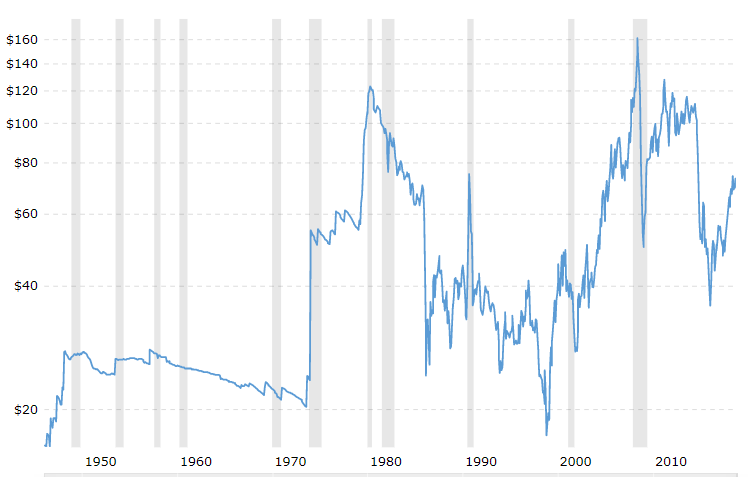

Since the early 1970s global energy costs have steadily increased. Even if oil prices have oscillated with recurring spikes and drops, as the economy tries to adjust, the overall trend is a steady increase. This is due to the fact that extraction has become increasingly difficult and costly, yielding ever lower return on investment. The problem of course is that we built our economies based on cheap energy that yielded relatively high net energy to society. But that is a thing of the past and now we are struggling to afford our current lifestyles. Thats basically why we started this massive global debt bubble, pulling forward future consumption with cheap credit. But costs will eventually have to be paid.

We have now reached a point when all the energy and resources available to society are required just to maintain our existing level of complexity. A phenomenon puzzling many commentators, calling it secular stagnation. All these factors have made the global economy so fragile that even small perturbations from climate change, wars or falling credit could tip the system over into a deflationary spiral. With economic inequalities already increasing, increasing social instability, this is a recipe for disaster. 

No economy will be able to recover unless it transitions to non-fossil fuel energy sources and writes down its debts. And even then net energy will likely be much lower, meaning that society still has to lower its overall consumption of energy and resources. Implying a voluntary measure to reduce organizational complexity in society. Something few previous civilisations managed, perhaps the British did when they dismantled their empire. 

Implication for food security
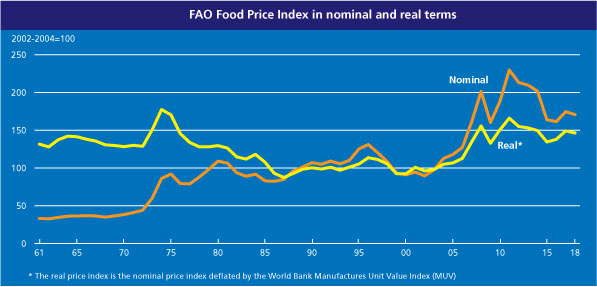


Global food prices have increased steadily since 2005, about the time of global peak oil, now at 1970s highs or above. Further exacerbating the problem is booming populations, freshwater scarcity and climate change. 

Today’s population levels depend on fossil fuels and industrial agriculture. Especially vulnerable to rising food prices are people with low purchasing power and without subsistence farming to fall back on. We know that food price increases that reach 200 on the FAO index have led to riots and unrest.

Many countries in the Middle East are especially vulnerable due to convergence of several different crises. State revenue losses from falling oil exports, due to depleting resources and higher domestic consumption, with a need to cut food and fuel subsidies usually make people very upset. Especially when, as is the case in the region, people have no way of making a living coupled with overexploited water reservoirs and eroded soils. As if that wasn't enough, scorching heat and significant risk of recurrent droughts makes the entire region utterly unsustainable. Without energy they have nothing. The chances for further conflict and wars in the region are high. Massive, continuing, migration flows towards Europe is to be expected. 

The infamous ‘Doomsday Clock’ is again at two and a half minutes to midnight  -  the closest since 1953
Lessons from the Icelandic vs Greek collapse

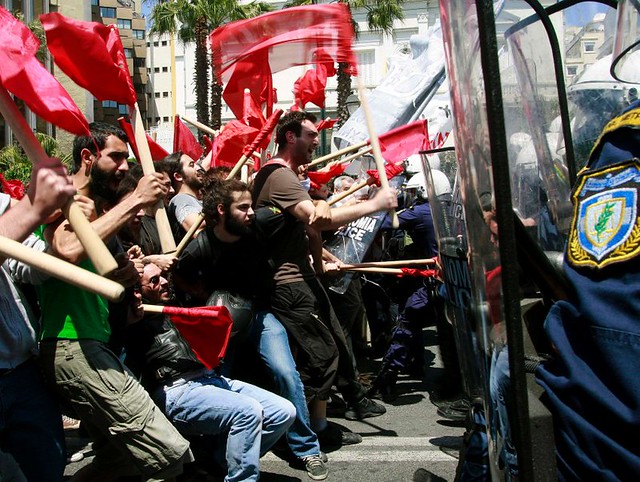
Greek protesters clash with policemen during riots at a May Day rally in Athens May 1, 2010.  Credit: Joanna CC-BY-SA 2.0

Debt = theft from future generations

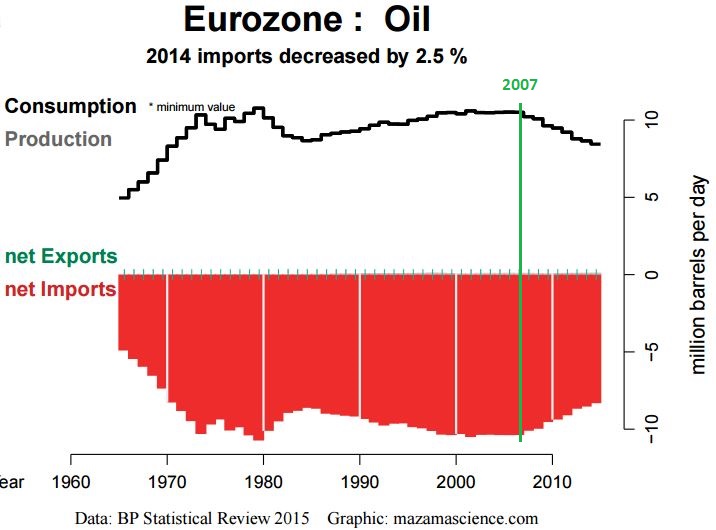
All economic activity requires energy to perform useful work. Without an increasing flow of net energy to society the economy starts to contract. The extraction of finite fossil resources cannot sustain increased growth as depletion and diminishing returns eventually leads to bankruptcy and falling supply.
eurozone.JPG
Shows how the entire Eurozone has been contracting since 2007 as is visible in lower oil consumption.

Monetization based on the assumption that the resource base is endless, which flies in the face of fundamental physics, can only lead to financial collapse. Intermediate stages that we have witnessed since 2008 is the erosion of the middle class, increased wealth inequality and increased numbers of poor people in society. Borrowing of work and resources from the future, through debt fuelled credit expansion, has become completely insane. To the extent that we are eroding the life-support systems that make up the basis for our own long-term survival. It has indebted future generations in ways they can never repay and is a grave intergenerational injustice

Thermodynamic limitations of the physical world don’t even enter the grammar of most economists or central bankers who are wilfully inept to give advice on anything but how to ruin entire nations. The lack of a systems perspective has made the public unaware of the real dangers of a out of control financial system. Economic growth based on credit fuelled debt, which has exploded since the early 1980s, in form of unlimited issuance of government bonds, credit cards without security, sub-prime mortgages or quantitative easing are all just sophisticated ways of sending the bill to the future. 

Its obvious that it's not possible to cure problems that arise from too much of something (debt) by doing more of it (piling on more debt). That's just insanity. If credit costs are larger than income minus other expenses then either the income must increase to balance losses or bankruptcy is the only way out. By now, we know that the pile of debt accumulated is unpayable and so a debt restructuring or debt jubilee is the only way forward. The young generation, especially, need to have their debts forgiven or we will have riots in the streets, political turmoil and an increase in crime rates.

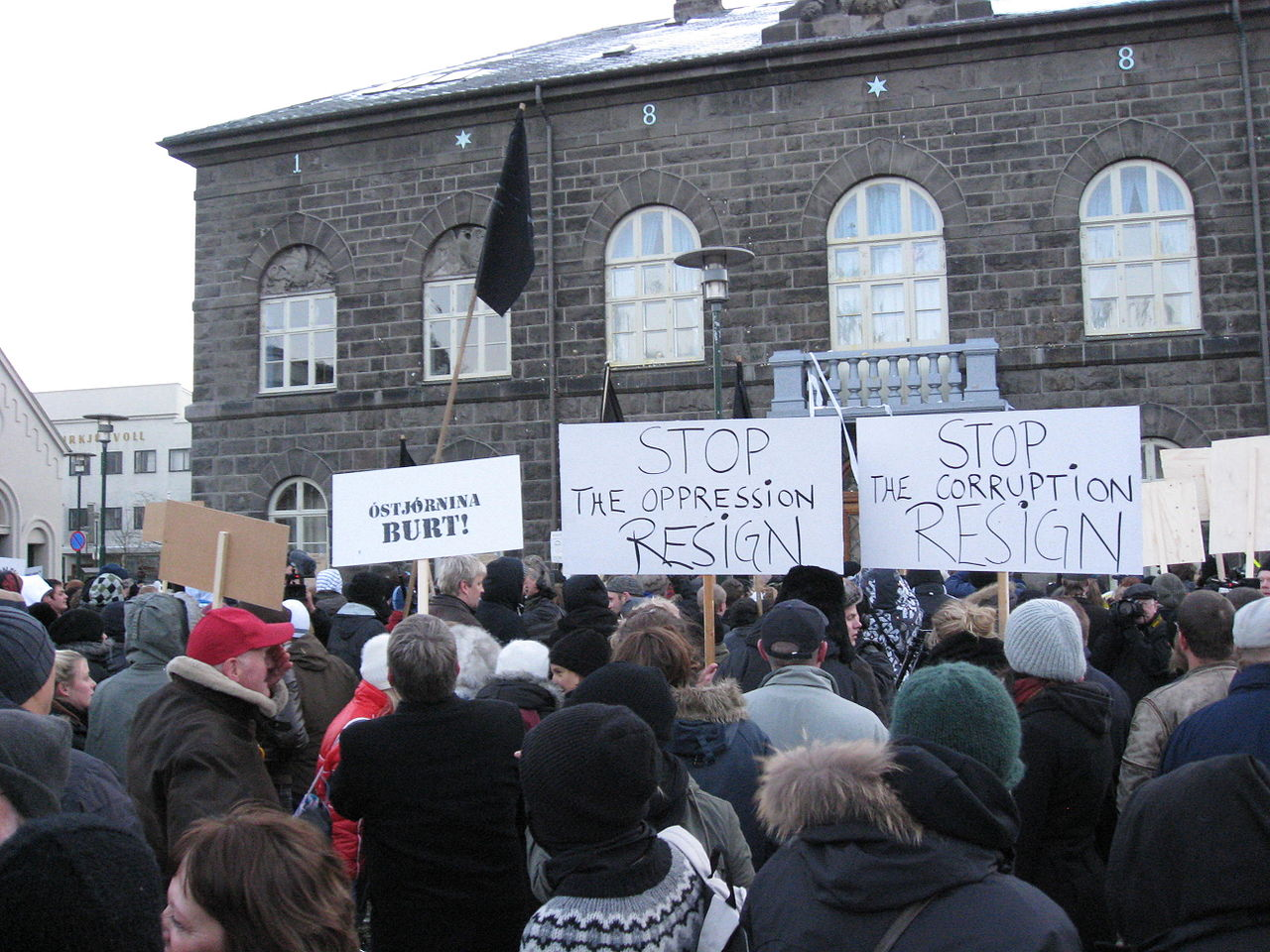
Protesters in front of the Alþingishús, seat of the Icelandic parliament, on 15 November 2008. Credit: Haukurth (CC BY-SA 3.0)

Difference between purely financial and energy-induced collapse

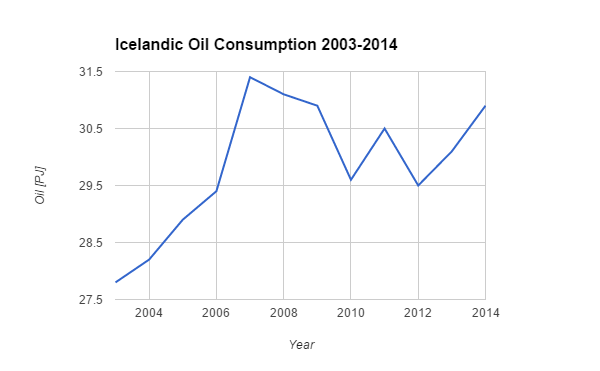
In the fall of 2008 the financial system in Iceland collapsed leading to a closure of the three main banks and a 50% fall in the value of the Icelandic króna. When the banks collapsed they left huge obligations to lenders and customers without coverage. The Icelandic government issued a guarantee for all Icelandic accounts, releasing comparative demands from a large volume of overseas accounts (a net deficit of €3.2 billion after all assets were sold). The government had no way of covering this demand, causing the collapse of the Central Bank of Iceland and the currency. Iceland went bankrupt and loans in foreign currency became unpayable for state, businesses and private persons. The Icelandic people voted no in referendums to repay foreign debts, elected different people in office and jailed bankers for corruption. They basically had to restart the system. However, the real reason that Iceland has not suffered like Greece, for example, is because they were able to keep increasing their oil consumption (from imports) while relying heavily on domestic hydropower and geothermal for electricity production. This is not the case for the PIIGS countries which all were heavily reliant on oil imports that they could no longer afford.
Data from the National Energy Agency in Iceland
Greece cannot afford to import more oil

Many of the driving factors behind the Icelandic banking crisis and the GFC arose from a fundamental systems crisis in our present world. The economic model based on eternal financial and material growth has started to meet limits, where the human civilisation has outgrown the capacities of the planet to support it. Borrowing from the future to cover up this fundamental problem is a short sighted strategy that will come to an end, sooner rather than later. And it also means that the collapse curve will be even steeper as we have depleted more resources without making a transition to renewable energy resources.

Against such limitations, all talk or negotiations are futile, and pretending the dilemma does not exist has only lead to bigger risks with ever more debt - stealing from future generations. Countries may be able to handle a purely financial crisis, like Iceland, but they won't be able to handle a energy-induced financial crisis, like in the case of Greece. It doesn't matter what financial reforms they make as long as they can't afford the energy needed to operate society they will continue to contract. So while debt forgiveness is necessary it's not sufficient in solving Greece's problems.

Limits, desperate times and crazy solutions

Source: Pixabay CCO Public Domain

What about oil?

Oil is like a two edged sword. Considering climate change and ecological degradation we should stop using it tomorrow. Greenhouse gas emissions is only one of the reasons. Another is our usage of oil to make plastic products that now fill the oceans and kills marine life. On the other hand, we have made our civilisation totally dependent upon oil for transportation, food production, medicines and keeping the economy going. Economic growth is basically a function of energy (oil) per capita consumption. Also, in Sweden we import a staggering 50% of all the food we consume, while farmers go into debt or have to close down their farms (which is totally outrageous). If there is a serious oil shock we might not be able to feed our population and people would starve! One report said that we perhaps could eat more horse meat since we currently have 360 000 horses only for recreational use. That is a bizarre proposal for solution. 

I wonder what will happen when credit run dry due to an economic slow down, can we still import the oil we need? Looking at the current situation of falling commodity prices one might think that this would be a good thing. But I'm afraid it could be just the opposite. First of, it is lack of demand that has caused the current falling prices, people are broke and debt saturated, not some myth about "Saudi-America". Second, falling prices means that many commodity companies will face bankruptcy which eventually would mean falling supply. And once supply falls I'm not sure it will be able to come back online again as no one will fund these expensive and risky operations in a economic downturn. So either if there is a shock or we simply cannot afford it, we are very vulnerable to a loss of oil imports.

Limits to growth

Ordinary people are not aware of how precarious our situation really is since government officials have started changing their statistics. Since 2010 they have chosen to exclude GDP per capita measures adjusted for inflation, something that almost no journalist seems to have questioned. What has been seen as a "Swedish miracle" of strong GDP growth compared to rest of Europe, since 2008, has been total fiction that mainstream media fell for without critical analysis. Looking at the numbers, GDP per capita adjusted for inflation, we can see that Sweden actually only grew by 0.3% per year between 2006-2014 (see diagram). Compared to other "developed" nations Sweden places somewhere in the middle, with Poland having strong growth (3,5%/year) while the Greeks have suffered de-growth (-3,1%/year). What also becomes evident is that most of these countries have actually been stagnant or suffered de-growth. Something that is no surprise for those who are aware of the limits to growth, the fact that we live on a finite planet with a limited amount of natural resources and dwindling energy.  
Source: OECD statistics

Political theatre that serves no one

As with most things these days our politicians don't really have a plan for any of the above situations. It seems to be a rule these days that the more serious the situation gets the more they fight about inconsequential things. This becomes evident in the latest budget discussions. The conservatives don't want to raise taxes while the social democrats want to tighten finance but at the same time makes the debt problem even worse!

The central bank has adopted negative real interest rates and supported buying of securities in a desperate attempt to stimulate the economy while the government has presented a budget that is supposed to be financed by raising taxes and lowering government spending. This sends the signal of a totally incompetent government that has no clue of what its doing. These policies will only benefit the people who have financial assets, speculating on houses and stocks, while savers are being punished. Thus, making the debt crisis worse. The private sector has an enormous amount of debt (252% of GDP), way above the stagnant GDP per capita income, which according to one study makes Sweden the number one country with the largest private sector debt in the world.

Source: The Telegraph

Fictive wealth 

It is no wonder that the Swedish people are growing impatient with the political elite, especially when they present a story that does not fit with reality. The self serving myth of the "Swedish miracle" only help worsen the debt crisis at the same time as politicians escape responsibility. Swedish household debt has sky rocketed and now widely exceeds disposable income. The housing bubble reaches new highs for every month. But this is not real wealth, only fictive wealth, no products or services have been created. As most people probably understand, even if they repress it, there cannot be large deviations from the real economy without an eventual correction. It is not hard to figure out how it will end, rapidly growing asset prices in a country where income is stagnant is not sustainable. The hard part is telling when the bubble will pop. So when Swedes say "the Greeks have themselves to blame" then this will surely have to apply to the Swedes also when the crisis hits. All our debt is in the private sector, which is what kills economies, while the Greek debt is in terms of government debt.

A global slowdown   

Signs of deflation are now everywhere. Back in 2008 the central banks of the developed world and China decided to double down on failed policies that had promoted massive debts to accumulate in the private sector, that eventually led to a near implosion of the banking sector. Now here we are 8 years later and with $60 trillion in new debt that has not led to any significant recovery of the real economy, only asset inflation. But there is a limit to how much debt people can and are willing to take on. 
Source: The Telegraph

Now we see global currency markets in disarray, for example the Swedish krona lost 2.0%. The global debt bubble could be bursting leading to tightening financial conditions and a flight to safety into the US dollar. Emerging markets are struggling due to falling commodity prices. China has stumbled and is doing all it can to prevent a stock market collapse. Manufacturing and shipping is way down. And the list goes on, something is definitely happening. 

Desperate measures

Since interests rates are at zero, or negative, central banks have lost this weapon in their toolkit. All the stimulus that piled up even more debt has not led to any substantial recovery in the real economy. No monetary policy in the world can change the fact that we have reached limits. But desperate times have led to even more desperate measures. All G20 nations have put in force so called "bail-ins" which means that the big banks can take depositors savings next time there is a crisis. This is what happened in Cyprus. The EU is pushing Sweden to do the same and most likely we will go along with it, according to some sources it could come into effect by 2016. In other words, no one is safe when the next crisis hits. And all the suffering to come will be due to humanity's inability to understand that infinite growth on a finite planet is impossible and doomed to fail miserably.

Bubble Watch

Central bank folly continues

It's been six years since the 08 financial crash that almost wrecked the world economy. Governments claim that the crisis is since long over but central bankers are still pulling on all levers, now governing market behaviour,  in trying to reach their inflation targets. But unemployment is still at all time highs in Europe and sanctions aimed at Russia have also hurt many European businesses. Over-indebtedness is the problem but central banks believe that the solution is to borrow more, not less. They have tried this method for several years now, Japan for the last 20 years, and the only thing that has happened is that economic inequality has risen dramatically. Thats what happens when you have a zero sum game i.e. running out of cheap resources to produce a surplus. In this case savers are punished and debtors are rewarded. So people with pensions are the first to lose, and banks/people with massive loans the first to gain. 

This week the Swedish central bank (Riksbanken) announced negative interest rates of -0.25%, in the belief that "doing more of the same will yield a different result". This comes after the European Central Bank (ECB) announced its new quantitative easing (QE) program on January 22nd. Since then, only three months ago, we now see a massive formation of bubbles with warning signals showing up in European Equities and Global Fixed Income. At least according to the March report from the Financial Crisis Observatory. 56% of all the European Stoxx Equities Sector Indices gives clear warning signals, a month ago that was 0%. The market is overvalued and turned red almost in an instant. However, it is very difficult to anticipate market movements in these global markets that are guided by central banks' over the top measures. It is not free market capitalism any longer, but rather, central bank folly that governs the market. 

The US dollar strengthening is global and warning signals can be seen in many currency pairings, for example FX US dollar/Swedish krona. While the Euro and the Russian Rouble has continued momentum downwards. Energy, softs and metals, show negative (undervalued) bubble signs which probably imply weak global demand. The massive increase in warning signals in European Fixed Income is largely due to the size, purchasing 220% of the total net issuance over 1 year, of the ECBs QE announcement. After a 15% rise in 2 months, 56% of all European sector indices show clear bubble signals. This is important to note, especially since the implied Vol, risk perception index, has dropped instead of risen. In the case of Sweden it has now become even cheaper to borrow money, which will fuel the housing bubble and probably end in tears at some point in the not to distant future. Similarly to what happened in the early 90s.

Cauwels, P. & Sornette, D. (March, 2015)