Since there has been a major failure of governance and lack of cooperation in the Swedish parliament recently, maybe its time to scrutinize what the public thinks about different topics. In this post I present some statistics from the yearly national survey by the SOM-institute in Göteborg. You can find the report in full
here. Let’s examine if the Swedish public is as divided as our dear politicians.
Swedes are strongly against privatisation of the welfare sector
Since 2007-08 public opinion for privatisation of the public sector has dropped substantially and this could be viewed as a general disapproval of the last government's widespread privatisation reforms as well as a change in opinion after the financial crisis (
Nilsson, 2013). In 2012, around 60% of Swedes were for a not-for-profit proposal in the welfare sector (health care, education, elderly care). Only 16% thought it was a bad idea (see graph). Left-wing voters were strongest for such a proposal while right-wing voters were most against it, but overall most people seem to be against privatisation of the welfare sector
.
No to NATO, yet low confidence in the Swedish military
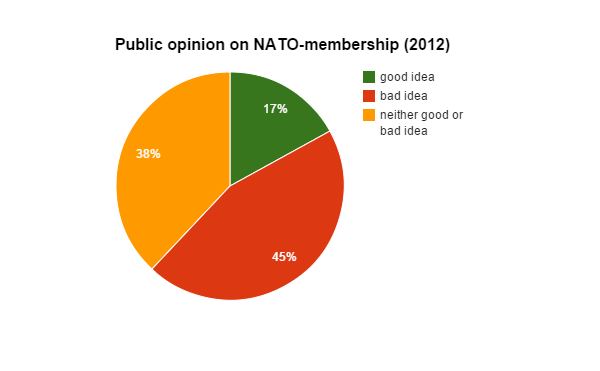
During the last couple of years swedish military capability to protect territorial borders have been increasingly debated. But despite all the critique towards the Swedish Armed Forces, public resistance towards a NATO-membership had not changed much by 2012. In 2012, only 17% of swedes thought a NATO-membership was a good idea and 45% thought is was a bad idea, while 38% said it was neither a good or bad idea (
Bjereld, 2013).
When a debate broke out in January 2013 around the supreme commander stating that the army could only defend Sweden for a week, public opinion shifted a bit. But since no political party made it into a strategic goal or campaigned on the issue, public opinion shifted back (Bjereld, 2013). Ironically, Sweden is basically already a member of NATO since we pay high fees, cooperate and contribute with international forces even if we haven’t signed a full membership. At the same time, Swedish confidence level (share of positive minus share of negative) in the Swedish Armed Forces has decreased continuously since 1994 and hit a low point of -22 in 2008, but have since bounced back and is now at zero (see graph below). Surprisingly, young people (15-29 years) seems to have the biggest confidence in the military, while older people have much lower confidence. Four in ten young swedes want to re-introduce compulsory military service (allmän värnplikt). Support is strongest among Center Party (C), Moderates (M) and Christian Democrats (Kd)- voters which could be interpreted as a failure of/dissatisfaction with previous military and security policy driven by the Alliance (
Ydén & Berndtsson, 2013).
The issue of immigration divides the country
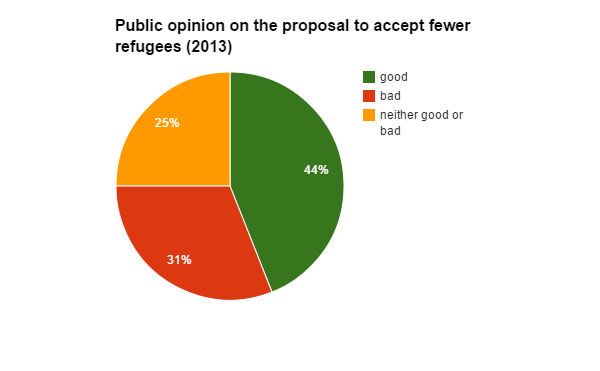
Immigration opinion in Sweden from a long-term perspective, the last two decades, has become increasingly generous. Opinion has shifted from 65% in 1992 to 44% in 2013 thinking we should restrict immigration of refugees. However, resistance to immigration increased between 2011-2012, according to the
SOM institute. The graph below shows in percentage the swedish opinion (2013) on the proposal of accepting fewer refugees into the country.
At the same time, during the last two decades, Sweden has had two xenophobic parties in Parliament (New Democracy 1991-1994, and the Sweden Democrats 2010-). Immigration sceptical and xenophobic parties successes is an effect of the ability to mobilize voters with negative attitudes towards immigration and refugee acceptance as well as the ability to politicize these attitudes. An important factor to such mobilization could be mainstream media's treatment of the party’s success or questioning and reporting around immigration and refugee related issues. During the fall of 2012 discussions around the Sweden Democrats politics and immigration politics in general were discussed a lot in the media (the term “immigration” got 2 330 search hits during 2012, compared to 1539 hits in 2011. An increase of 50%). Immigration as a political priority among the public also increased from 8th to 4th place between 2011 and 2012. According to Sandberg & Demker (2013), men and people with low education background are most negative towards immigration. The older generation is also a bit more negative than younger people, while the most positive people are located in the larger cities (
Sandberg & Demker, 2013). People who are worried about another economic crisis are and have become increasingly negative towards immigration numbers. But surprisingly, its people who are not worried about their personal finances (middle class or above) that have become more negative in accepting refugees. The largest increase in negative attitudes has been among people over 50 that identify as far right on a left-right ideological scale
.
Swedes are generous but confidence in foreign aid is decreasing
The share of swedes that claim to give money to a charity at least once a month has increased from 27% in 1998 to 36% in 2012 (
Ekengren & Oscarsson, 2013). The global financial crisis that started in 2008-2009 have had an impact on many societal trends but not on swedes tendency to give money to charities. However, a corresponding increase is not seen in charity memberships. Women and the older generation tend to give more than men and younger people. Swedish citizens are thus becoming more generous with giving private funding to charities. However, public opinion on governmental foreign aid, which tend to decrease in time of economic crisis, has become more negative since 2007-08. In 2012, 40% of swedes regarded decreasing foreign aid to developing countries as a bad proposal while 25% thought it was a good idea (see graph below).
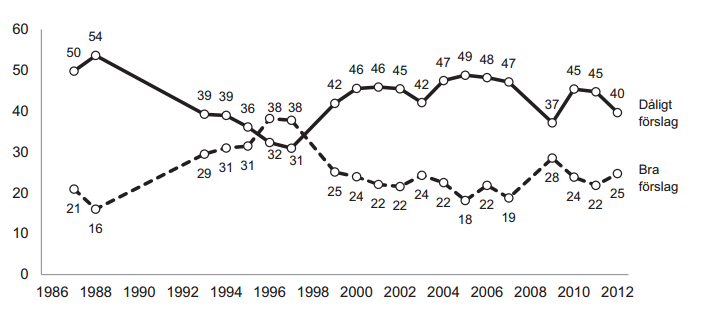 |
| Public opinion on the proposal of decreasing foreign aid to developing countries (1986-2012) in percentages. Bad idea (single line) and good idea (dotted line). Source: Ekengren & Oscarsson (2013) |
Foreign aid to developing countries have stronger support in smaller more liberal parties than among big parties and far right-wing voters. Peoples Liberal party (+9%), Green Party (+8%) and Christian Democrats (+6%) voters are more positive to foreign aid while Social Democrats (-7%) and Moderates (-13%) voters are more negative (1987-2012). The Sweden Democrats voters are much more negative to foreign aid (-25%) (Ekengren & Oscarsson, 2013). Finally, people who identify as religious tend to be much more positive towards charity membership, foreign aid and giving money.
Attitudes towards religion
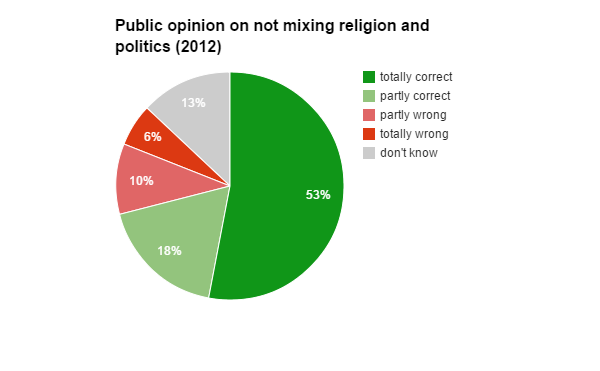
45% of Swedes believe in god and 70% are members of the Swedish Church (Svenska kyrkan). Only 2% claim to muslims. But 82% think that everyone should be free to practice their faith (freedom of religion), and most swedes also agree that one should not mix religion and politics (see chart) (
Bromander, 2013).
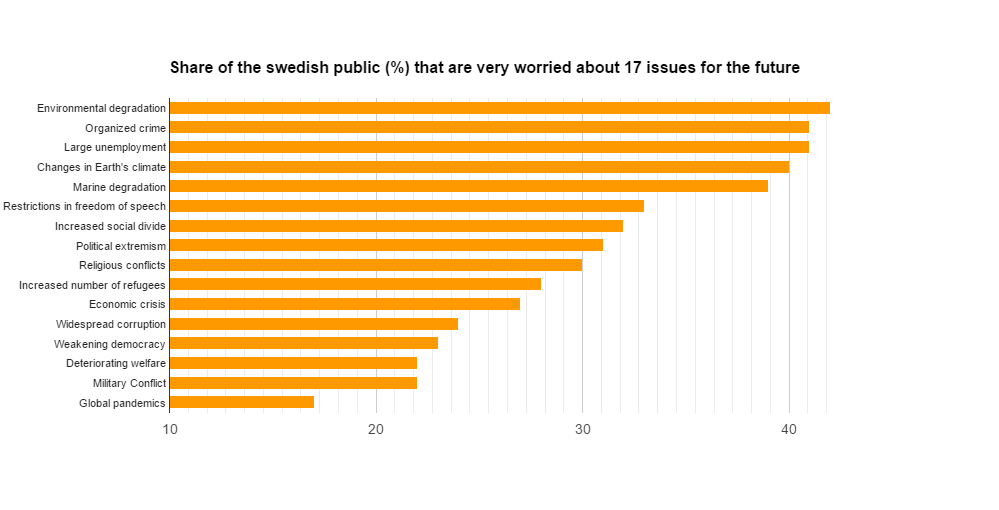
What Swedes worry about most in the long-term
Areas the the public worries most about are mostly related to environmental problems. Environmental degradation (42%), changes in Earth’s climate (40%) and marine degradation (39%) are among the top 5 areas where people feel most worried. However, this is a decrease since the highest values measured in 2007. Worries about organized crime (41%) and large unemployment (41%) have increased since 2011. This could be a reflection of the economic crisis in 2008 and the continuing european crisis as well as increased reporting on crime and violence in the media. Worries about increased amount of refugees also rose, from 19% in 2011 to 27% in 2012 (
Weibull et al. 2013). Also this could be a reflection of increased debate and reporting on immigration issues in media outlets and politics.
.png)




 Posts
Posts

