Showing posts with label recession. Show all posts

The day freedom of speech died in Spain

Source: Pixabay (CCO Public Domain)

New muzzle law in Spain sparks protests

On the 11th of December Spains conservative government passed a new law that goes against basic human rights, including freedom of speech and freedom of assembly. The law which is officially called "Law for the Protection of Citizens' Security" has been renamed the muzzle law by the Spanish public.

On 20th of December thousands of demonstrators took to streets in several large Spanish cities (Barcelona, Bilbao, Madrid, Almeria, Granada, Valencia) to express their anger at the new law which sets huge fines for "offences" such as burning the Spanish flag or demonstrating outside government buildings or other strategic buildings. 

The new law could fine citizens up to €30,000 for disseminating photographs of police officers, €600,000 for participating in demonstrations outside parliament buildings, €600 for insulting police officers and €30,000 for burning the Spanish flag. 

The demonstrators included groups opposed to forced evictions because the law can levy fines of €30,000 for attempting to prevent home repossessions. Some protestors even said that "we are returning to the time of Franco and it is completely unconstitutional, we must protest because we cannot remain silent". Many believe the new law is an attempt by the Spanish government to muzzle protestors over their handling of the deep economic crisis that has gripped the country for several years.

Media Attention

Pieces of news have been reported in international media outlets, many questioning the Spanish governments decision. Here in Sweden, politician Gudrun Schyman has critized Swedish mainstream media for not writing about this important piece of news as well as the lack of public response in Europe, saying "Why is not entire Europe boiling in wild protests against what is happening in a EU country with 46 million inhabitants?"Instead it has been totally quiet when freedom of speech and freedom of assembly died in Spain. What is happening in Spain is shocking and should worry many Europeans, we cannot take our liberties for granted. Who knows, perhaps it will be our turn next time. 
Wealth inequality on the rise

Global Wealth 2014

According to 2014 Global Wealth Report, by Credit Suisse, world wealth has reached a record $263 trillion but is now even more concentrated at the top. The richest 1 percent of the worlds 7.3 billion people have accumulated even more wealth, now owning more than 48% of global wealth. The authors of the report warns that growing inequality may spark a recession, as high disparity leads to economic friction.

Wealth distribution - Rising Inequality

Few household characteristics vary across individuals as much as income and wealth. This has been the case throughout much of human history, with wealth ownership often equating with land holdings, and wealth more often acquired via inheritance or conquest. But a combination of factors caused wealth inequality to trend downwards in high income countries during much of the 20th century, suggesting a new era. However, that downward trend has now stalled, and started going into reverse.

Since the 1980s wealth distribution have developed differently in a number of countries. In some countries, especially the US and the UK, inequality has risen sharply. This increase has taken place from a level that was already high in relation to others before it started. In countries like Sweden and Finland, increases have also been substantial but here from internationally low levels that are much higher but remain among the lowest (Roine and Waldenström, 2014).

According to Credit Suisse 2014 report, a person that owns $3,650 (including equity of their home) is today considered to be among the wealthiest half of global citizens. A person owning more than $77,000 is considered to belong to the top 10% and a person owning $798,000 to belong to the top 1%. 

Taken together, the bottom half of the global population own less than 1% of total wealth. In sharp contrast, the richest decile hold 87% of the world’s wealth, and the top percentile alone account for 48.2% of global assets” (Credit Suisse, 2014 pp.99). 

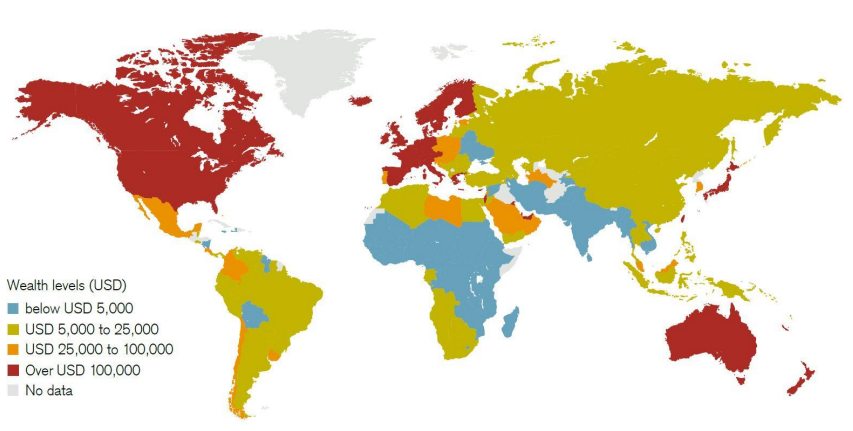
The richest nations, with over $100,000 wealth per adult, are found in North America, Western Europe and among the rich Asia-Pacific and Middle Eastern countries. They are headed by Switzerland ($587,000), Australia (431,000), Norway ($359,000), United States ($348,000), Sweden ($333,000), France ($317,000) and the United Kingdom ($293,000). See map below.

Source: Credit Suisse - Global Wealth Report 2014
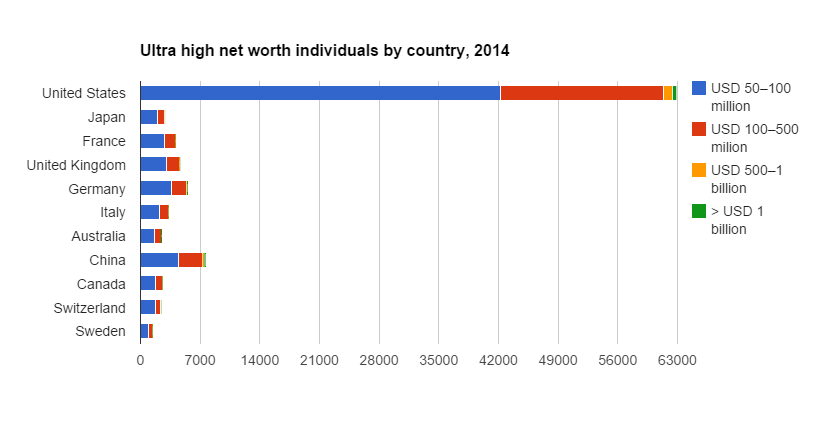
From 2013 to 2014 global wealth grew 8.3%, $20.1 trillion, and is the largest increase since 2007. Total global wealth has risen every year since 2008 and is now 20% above its pre-crisis peak. Leading the wealth increase is the United States, home to 34.7% of global wealth. Most of the world's ultra high net worth individuals can be found in the United States, followed by China, Germany and the United Kingdom (see chart below).
Own elaboration, data from Credit Suisse - Global Wealth Report 2014

However, Credit Suisse analysts also showed that overall wealth in the US has grown at a faster pace than incomes, warning that it is a trend that could point to recession. Stating that "For more than a century, the wealth income ratio has typically fallen in a narrow interval between 4 and 5. However, the ratiobriefly rose above 6 in 1999 during the dotcom bubble and broke that barrier again during 2005-2007. It dropped sharply into the "normal band" following the financial crisis, but the decline has since been reversed, and the ratio is now at a recent record high level of 6.5, matched previously only during the Great Depression. This is a worrying signal given that abnormally high wealth income ratio have always signalled recession in the past"