Showing posts with label refugees. Show all posts

Extreme weather - the "New Normal"


Mother Nature Strikes Back

Yes it's true that an El Niño period usually brings about certain weather extremes, however, the 2015/2016 El Niño has broken all records in terms of strength i.e. heat being released into the atmosphere from the oceans. This is to be expected as the climate is getting warmer from all the carbon pollution that has altered the chemistry of the planet. Climate change acts as a multiplier effect, increasing the frequency or amplitude of extreme weather events.

I'm sure most people have read the terrible news about the massive wildfires in Alberta or the flash floods in Germany, France and West Virginia. Few, however, may have heard about the deadly heat waves in India, floods in Pakistan or failing harvests in South Africa.

Sometimes it's hard to get a grip on what climate change will do to our environments and livelihoods. It can feel distant in time or abstract. But changes are already occurring and we have to start adapting now or more people will have to flee and become climate refugees.

These two videos give a good overview of some of the extreme weather events that have struck nations around the world lately and why it's happening. It should give us all pause, make us understand the urgency of tackling and responding to a rapidly changing climate.


Melting Arctic, Mangled Jet Stream and Massive Forest Fires


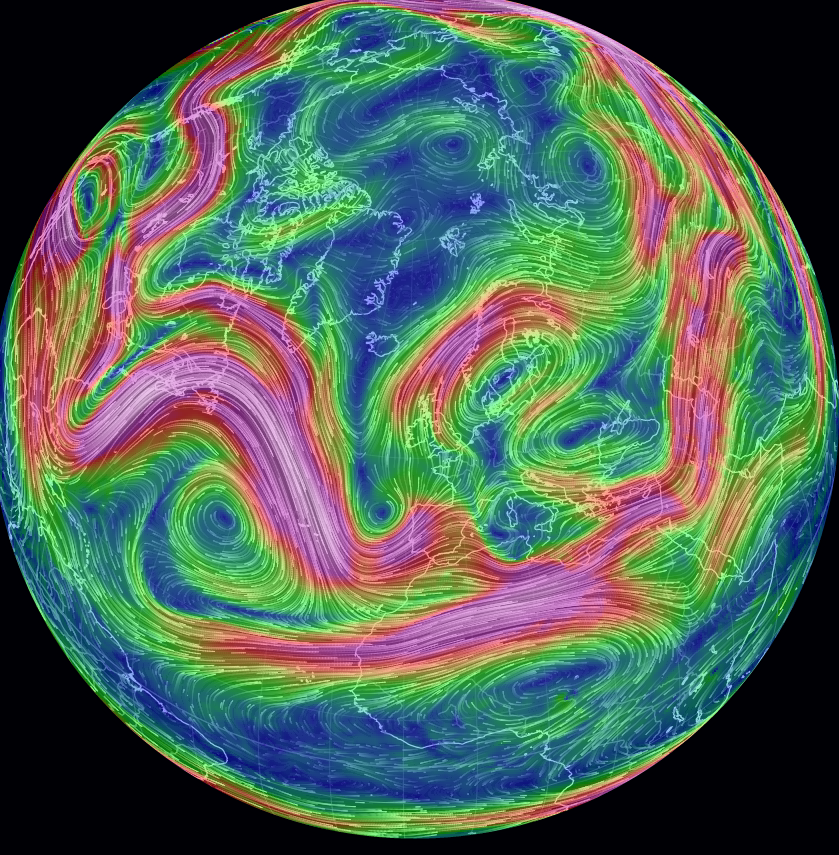
Jet streams consists of bands of very strong winds which move weather systems around the globe. These have been relatively stable until recently due to a decrease in temperature gradient between the equator and north pole. Below is a satellite image of a mangled jet stream, using Earth Nullschool, creating blocking patterns that makes weather system seem “stuck”. For example, here in southeast Sweden we are experiencing record warm May temperatures (20-25 C), little rain or wind with a high risk of forest fires.  


Jet stream pattern over Europe, with warm air “stuck” over Scandinavia
.
A similar situation but much worse is occurring in Canada where massive forest fires have driven 88,000 canadians out of their homes in Fort McMurray. These people are now climate refugees and more damage is yet to come as the fire is now moving towards Alberta’s tar sand fields and could double in size due to strong winds and dry conditions. The fire cover an area as large as Hong Kong.


.
Melting Arctic sea ice causes more heat to be absorbed by the darker surface of the ocean, especially in late spring when the sun is really strong. The extra heat is then also transferred into the atmosphere. When this happens the lower layers of the atmosphere warms and expand, pushing up the higher layers and causing the jet stream to bulge. As the sea ice disappears and the atmosphere in the Arctic warms the airflow in the jet stream is more likely to loop and bulge, causing blocking events.

High pressure systems over Greenland can have the effect of blocking polar jet stream flow over part of the North Atlantic […] causing the jet stream to split into branches and bringing about all kinds of severe weather events as a result.according to Dr. Edward Hanna from the University of Sheffield.

Researchers are worried that these type of blocking events of high pressure systems over Greenland can lead to rapid melt of the ice sheet as well as causing extreme weather events over the northern hemisphere.

FrostByte, E Hanna: The Jet Stream and Greenland Warming from Climate and Cryosphere on Vimeo.

8 key trends Spring 2016

Coastal permafrost collapsing. Source: USGS Alaska Science Center
I have been away from blogging for a while but decided to try and pick it back up today. So much has happened this spring that I haven't been able to write about so I decided to pick out some key trends/headlines that I found most important.

1 - Civil war in Turkey!? Turkey houses some 2.6 million Syrian refugees, out of the more than 4.7 million Syrians who have fled their country’s civil war. Turkey is also currently engaged in the conflict in Syria fighting (US supported) Syrian kurds more than ISIS due to fears of escalating internal conflict. But the Turkish strategy backfired as three suicide bombings in three cities killed 150 people and shocked the nation. Experts now fear that the Turk-Kurd conflict inside Turkey could turn into a full blown civil war if hostilities keep increasing. Erdogan is supposed to have asked Obama to halt support to the Syrian kurds YPG which has close historic ties with the Turkish kurds, PKK. However, that has not happened since the YPG is fighting ISIS, and so the confusing war in Syria continues while another one is brewing in Turkey.

2 - Extreme February Temperature Anomaly shows worrying signs of a potential non-linear response to continued global warming, but probably due to a strong El Niño. According to NASA scientists the average global temperature in February was about 0.5 degrees Celsius warmer than the previous record set in 1998 and 1.35 degrees above the 1951-80 average. The average global atmospheric CO2 level reached 402.59 ppm, according to NOAA. Vietnam, Zimbabwe and Fiji suffered major economic losses from February droughts and storms as reported by Wunderground.   

3 - How the refugee crisis turned out to be a major preparedness crisis. A prime minister that was invisible when the crisis erupted. A director-general that played golf and ran marathons. Prognoses which were completely wrong, greatly underestimated the number of refugees. Total lack of coordination and pressing decisions that were put on hold. The Swedish government's handling of the refugee crisis has been a complete mess. Politicians kept denying the  facts until there were no more beds, no more supplies and no willingness to comply. And so they had to change policy. On the 4th of January border patrol with ID-control between Denmark and Sweden was enforced, delaying all traffic with some 20-60 minutes every day. According to the Immigration Office some 81% of refugees lack any kind of identification papers when they arrive. It is still too early to tell the consequences of such major mismanagement of a country.


4 - The Panama Papers Scandal shows just how widespread and pervasive tax evasion and government corruption is at the moment, from prime ministers to global banks. The leaked 11.5 million files includes nearly 40 years of data (1977-2015) on offshore secrecy and and includes names of high-level politicians, such as the president of Argentina and Iceland's prime minister etc. I'm surprised there has not been a bigger outrage over this topic, but then again, maybe because it was somewhat expected in our grossly unequal society.


5 - Negative Interest Rates madness continues despite its ineffectiveness. The only thing that has changed here in Sweden in regards to this topic is that people are piling up ever more private debt, or going bankrupt, with a major increase among 18-25 year olds. The housing bubble is still going strong and our dear politicians are already backing on implementing harsher mortgage repayment requirements decided upon in 2015. Perhaps it's because they realize they might prick the bubble or the fact that so many now rely on an income generated by flipping property. 

Brilliant economist Steve Keen writes in FORBES that Sweden rank as top 3 on highest risk for a debt crisis within the next one to three years. Looking at the graph below it becomes rather obvious that the current credit growth trend is unsustainable.
Source: Steve Keen, FORBES

6 - The Great Barrier Reef is currently undergoing the worst mass bleaching event on record, according to Australia's national coral bleaching taskforce. As a marine biodiversity hotspot this is a major threat to species conservation. Many corals will die, without them lots of species will lack a habitat and nursing ground for young ones. As such it's hard to ascertain the scale of devastation, even though the immediate effects already seem dire. 

Source: Coral Reef Watch, NOAA

7 - Marine heat waves last longer and cover larger areas due to global warming (extra strong during El Niño years), devastating marine life. An example of such is "the Blob" that emerged off the Pacific Northwest in 2014. Sea life outside the US west coast has suffered greatly, with stranded sea lions, increase in whale deaths and entire beaches full of dead shrimp. Marine life has been hit hard by this double whammy. 

8 - The American Election - it's just tragic. I'm so tired of reading about Trump I could puke. I can't imagine what would happen if Trump is elected and we have him and Putin trying to get along. Scary.

A more humane response to the refugee crisis

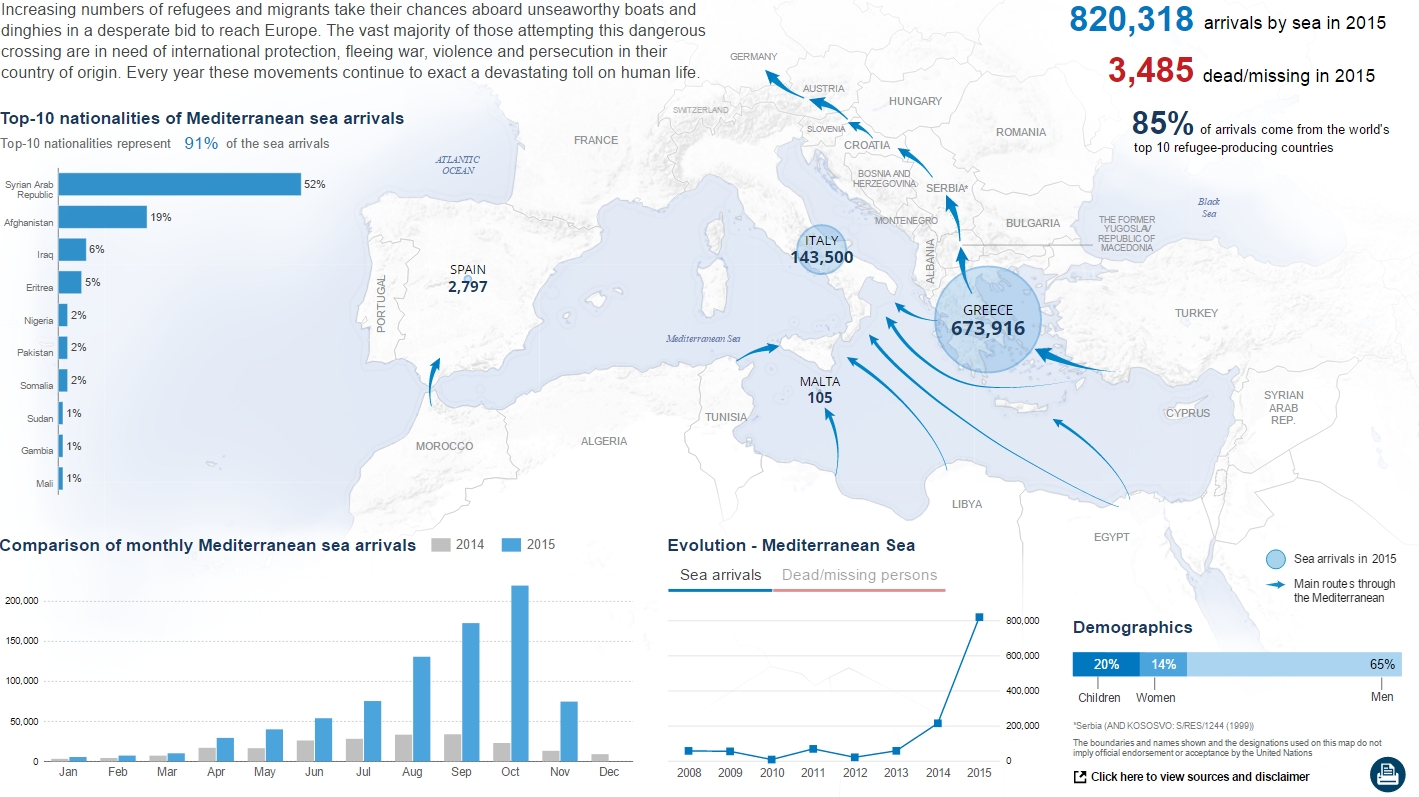
Source: UNHCR (2015)
There are around 20 million refugees in the world out of 60 million displaced persons, according to UNHCR. During the period January-November 2015 some 820,318 refugees has arrived to Europe by sea and 3,485 have died or are missing. A full 65% of arrivals are men, mostly from Syria and Afghanistan. Most refugees have arrived in Greece to later make their way towards Germany and Sweden, through Macedonia, Serbia, Croatia, Slovenia, and Austria. 

What we see in the Mediterranean is a humanitarian crisis of huge proportions and it needs to be treated as such. Telling refugees they can have a permanent residentship while not establishing boundaries (capacity and which people to prioritize) or approving visas for safe travel through Europe is not a humane policy. Countries like Germany and Sweden have had to revise their policies (e.g. giving temporary asylum and increasing border controls) because it’s creating so much confusion and encouraging the growth in human trafficking and thus increasing the death toll on the sea. 

We have to understand that many refugees trying to reach Europe over the Mediterranean are often men with some money searching for better opportunities than they currently can find in e.g. Turkey or Lebanon. One reason for this is because the world’s rich countries have not funded the UN’s humanitarian agencies which are now on the verge of financial bankruptcy (The Guardian, 2015). This year the World Food Programme had to cut food rations to 1.6 million Syrian refugees, warning that this leaves many vulnerable to recruitment by extremist groups (The Guardian, 2015). Less humanitarian help in places of conflict has in turn lead to larger migration flows. Deteriorating conditions in Lebanon and Jordan have become intolerable for many of the 4 million people who has fled Syria, driving the latest waves of immigration towards north-west Europe. 

A humane policy would not reward only young men with the money to cross the sea. Instead it would determine the right to asylum based on needs, e.g. the sick or orphans, and give them a visa to safely travel into Europe. A more humane policy with increased funding to UN’s humanitarian agencies will also safeguard that social tensions don’t spin out of control in Europe, so that the refugees that get to come feel safe and welcome while people that want to stay in the region can do so without starving, turning to crime or violence.

A more humane policy by the rich EU is to provide resources (food, water, healthcare, family planning service, ecological restoration, education etc.) to vulnerable countries in the MENA region. Europe has long been a centre that has sucked in natural resources from the world's poor in exchange for worthless fiat and unpayable debts. Now it’s time to repay some of those resources, in the interest of peace and stability in the region.

Credit: Ekathemerini
According to the Guardian article, quote: “The Syria regional refugee response plan is only funded to 35% of the $1.3bn needed to support refugees, both in the camps and by providing resilience funding for the countries hosting them” which is a disgrace, wealthy countries complaining about a refugee crisis but being unwilling to fund the response in the region.

The article goes on to state: “In August, a multi-million dollar shortfall forced the World Health Organisation to close down 184 health clinics across 10 of Iraq’s 18 districts, in an area that has seen severe fighting and massive internal displacement. The cuts have left 3 million people without access to healthcare. The World Health Organisation is trying to raise $60m to fund healthcare in Iraq but so far only $5.1m has been given by donors. Dr Michelle Gayer is director for emergency risk management at the WHO. She told the Guardian that the gap between the desperate need in countries such as Iraq and current funding levels risked permanent damage to public health across whole populations” (The Guardian, 2015)

There are plenty of young unemployed people in Europe that wants a job so why don't governments fund UN's programs that could make use of young talents at the same time as it helps vulnerable communities in the MENA region. That could actually help lower the risk of extremism spreading, as opposed to military intervention which only creates extremism. Better yet, take money from defence budgets and put it into aid if there "isn't enough funding" at the moment. Have we learned nothing from our previous failures?

Mass Migration of all Species

Migration is a response to a changing environment

When soils become eroded, fresh water scarce, landscapes deforested, the air polluted and climate unstable, species either adapt, move or go extinct. Because the climate is changing so rapidly most species have a hard time adapting to new conditions. Evolution would have to occur 10,000 times faster than it typically does in order for most species to adapt and avoid extinction. And so they move instead, along with the shifting climatic zones. According to a 2011 study, species are now moving to higher elevations at a rate of 11.1 meters per decade and to higher latitudes at an average of 16.9 kilometres per decade

Life cycle events like mating, blooming and migrating that follow seasons are also changing. Mismatches in timing of births and food availability will inevitably lower population sizes of many species while pests and pathogens thrive due to warmer temperatures. Even if some species are able to migrate there are still many hinders (cities, high-ways etc.) on their way to territories where the competition for food will be tough. Highly specialised species and those who already live in the most northern regions might go extinct. For example, many Arctic species like the caribou, arctic fox and snowy owl are losing their habitat and the food they depend on at a rapid pace.
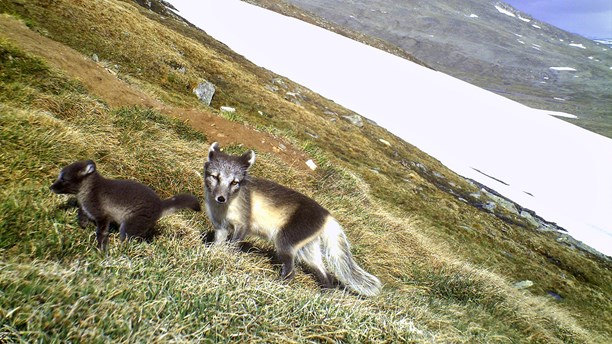
From having been almost extinct in Sweden, some 15 years ago, the arctic fox may be on its way back, but only due to support feedings and a return of lemmings. Credit: TT

Human mobility and Conflict

Human population mobility is not that different. For many of the poorest people of the world mobility is sometimes the only adaptive strategy available. Most sub Saharan African countries are finding it difficult to cope with existing climate stress, not to mention future climate change. Extreme weather events such as floods, droughts and storms have a direct impact on human migration patterns while long-term changes such as desertification and deforestation can lead to declining living standards that indirectly pushes people to move. Already at +0.85°C warming, since pre-industrial times, we see a drastic increase in the number of displaced people.

Furthermore, when essential resources become increasingly scarce or costly tensions rise and conflict can break out. In Syria a devastating drought forced millions of farmers to abandon their fields in search of alternative livelihoods in the city. And when food prices spiked in 2008 and 2011, along with oil prices, food riots and civil unrest broke out in a number of countries where people spend a large part of their income on food. Some of these conflicts have turned into full on wars which further reinforces migration.

People on the move

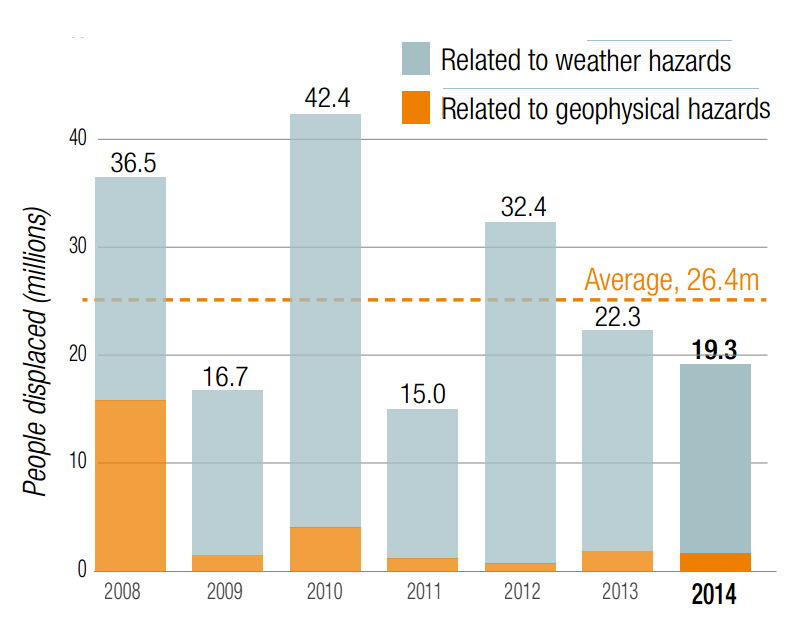
According to the Internal Displacement Monitoring Centre (IDMC) some 26.4 million people have been displaced by disasters (geophysical and weather related events) every year since 2008. The likelihood of being displaced by disaster today is 60% higher than it was in the early 1970s. The number of displaced people from natural disasters spiked during the strong El Niño years of 1997/98 which does not bode well for this winter and next year, with a similarly strong El Niño now taking shape. Losses from natural disasters and conflict increasingly outpaces the adaptive capacity of a growing number of people around the globe who are forced to relocate permanently. According to UNHCR, one in every 122 humans are now either a refugee, internally displaced or seeking asylum. The number of conflicts have increased during the last decade and 15 newly erupted or reignited conflicts have broken out since 2010.
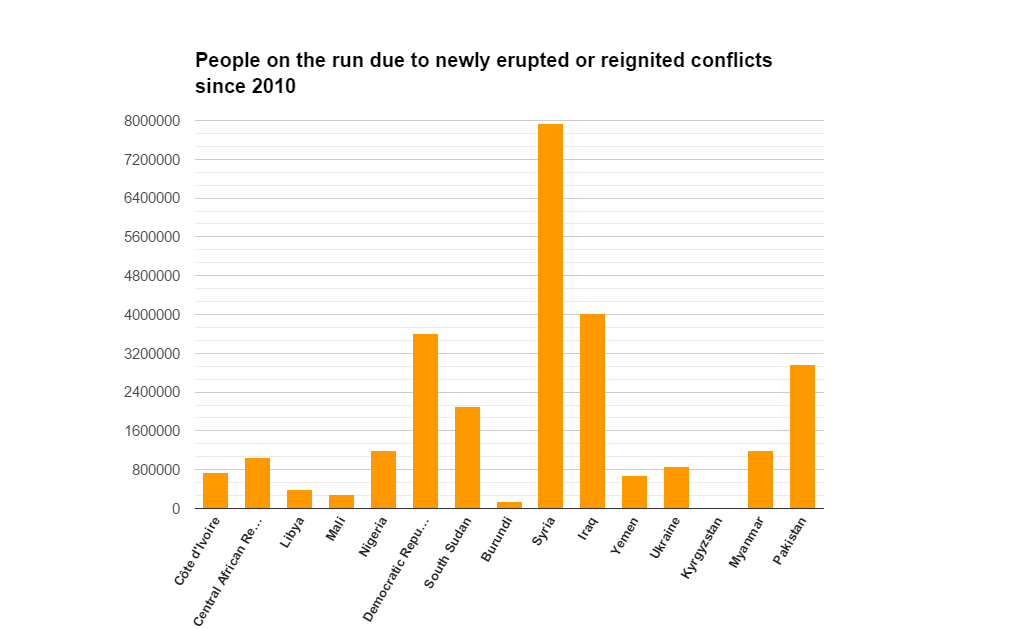
Shows total people of concern (refugees, asylum-seekers, internally displaced, returnees, stateless,
and others of concern to UNHCR) in 15 countries as of 2014.
Based on UNHCR - Global Trends 2014: World At War
The conflict in Ukraine together with 502,500 people crossing the Mediterranean and the large number of Syrians in Turkey (1.59 million) has lead to a doubling of refugees in Europe between 2013-2014, according to the UN Refugee Agency. While Germany and Sweden accepted the biggest volume of asylum seekers the largest proportion of refugees are located in Turkey and the Russian Federation.

Earth to humanity

Most people in Europe, and elsewhere, are currently focused on issues of immigration with endless political debates and moral outrage in mainstream media. People think that we are experiencing a political crisis but it's much worse than that. Migration is only a symptom of the real underlying predicament - limits to growth in a finite world. As long as society tries to grow its population and economic activity we will continue to experience mounting social and ecological stresses, for example in form of: increasing inequality, disruptive climate change, mass migrations, hunger, epidemics etc. These pressures are warning signals that indicate overshoot, this is a fact, and yet we refuse to talk about limiting population growth or downsizing our economy (i.e. lowering our energy per capita consumption).

Irreversible change in carrying capacity means that a return to their homeland will be impossible for many refugees. Since ecological deficit is a global phenomenon, millions of ecorefugees will be seeking new locations. But very few places will have the biocapacity necessary to take them in without undermining their own ecological capital. Are there any lifeboats (nations) in suitable condition to accept ecorefugees on a long-term basis? 

If we have a quick look at different country's biocapacity as measured by the ecological footprint network we can see that Canada, Australia, Scandinavia, Russia, Latin America and parts of southern Africa still have (in theory) the ecological capacity to host more people. While most countries located around the equator are in serious overshoot. However, not all countries are in overshoot for the same reasons, for example, the UK is a tiny country in landmass and have to rely on imports for pure survival while the US has plenty of land and could in theory support itself but not with current per capita over consumption.
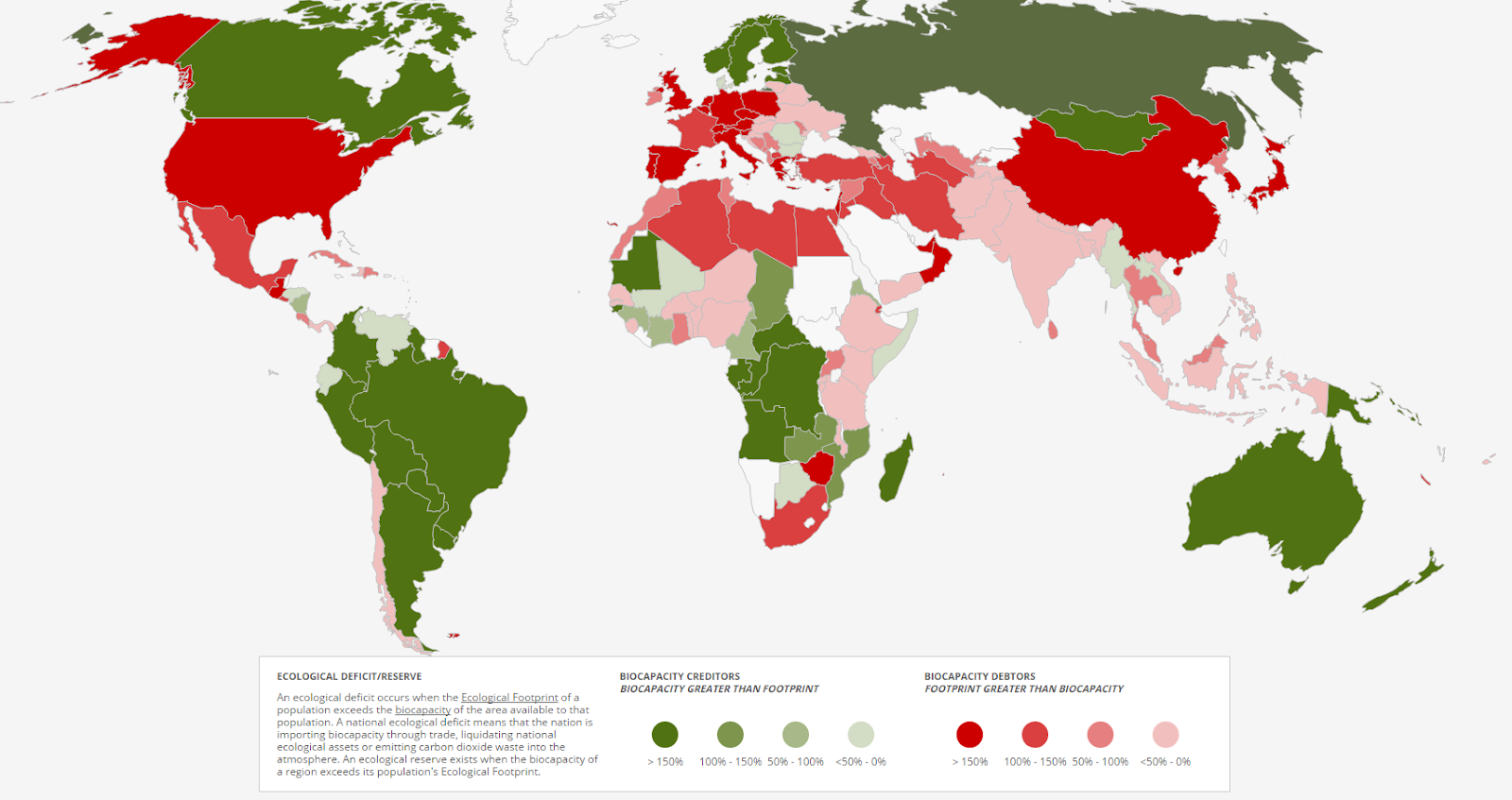
Green indicates ecological credit and red indicates ecological deficit.

Accepting limits

Eventually, resource depletion and biophysical stresses will grow so large that the economy and population will have to contract. This view is based on scientific evidence of population dynamics in a closed natural system. We can always hope for the best, but we better prepare for the worst, like any prudent risk manager would.

As most people probably have noticed by now, there is very little real wealth generation in today’s economy. Most of the economic activity these days consist of wealth transfers, from the poor and the middle class to the financial elite. This is why we see such huge and widening gaps between rich and poor (80 people own 50% of all global wealth). When the resource pie isn't growing anymore then one person's gains will always imply another ones loss, it's a zero-sum game.

Absent abundant, cheap energy (especially oil) the economy cannot grow and more people go broke and become excluded from the marketplace. Only the rich will be able to afford to keep on over consuming. Our society has tried to “paper over” this problem by piling up ever more debt (borrowing purchasing power from the future), but we have now reached a level when people cannot or are unwilling to take on more debt. And this is also why we see falling commodity prices, there just isn’t enough demand. Instead we have debt deflation. In time, depressed commodity prices could lead to falling supply which in turn could be devastating for food production and transportation. All the while pollution is growing and climate change becomes more severe.

Meanwhile, in Europe, social unrest and political extremism is on the rise once again. The so called “refugee crisis”, however, is neither temporary or political in nature. Ideologies like left or right-wing doesn’t matter anymore, only those who accept ecological limits and those who don't. We are simply too many people on a planet with a limited amount of natural resources and unstable climate. Now we have to share what’s left of the Earth’s riches, and people do not like it. Especially not the rich.

Welcome to +1℃ warmer Earth

+2℃

This is the limit to average global temperature rise that the world has decided we should not cross this Century in order to prevent dangerous climate change. Some think of it as the safe limit despite many scientists warnings that we should really stay below 1.5℃ since two degrees would most likely have devastating consequences (Hansen et al. 2013; Hansen et al. 2015).

+1℃

This is the amount of average global warming that we are now (2015) experiencing, according to the latest data from NASA. The recent reading is the first to show a consistent break at 1℃ above 1880s levels and is a scary milestone towards the catastrophic 2℃ we really want to avoid.

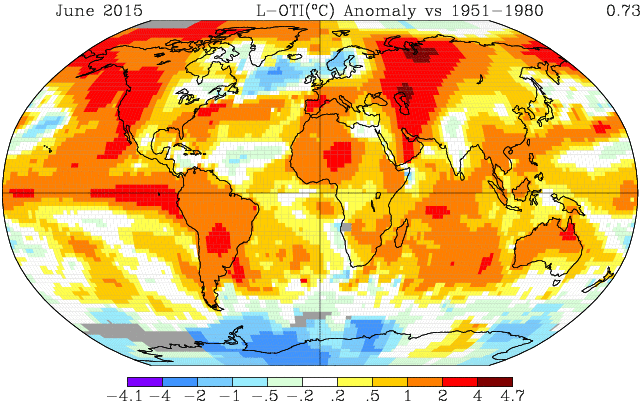
NASA’s geographic temperature anomalies for a record hot June in 2015. Source:NASA GISS.

The map above shows June temperature anomalies. We can see that there are large areas of 2-4℃ (orange-red) above average readings, mostly located in the Northern Hemisphere. Alaska, western Canada and western Asia has the highest readings. On average we can also see that most of the globe is at least 1℃ above normal, the exceptions being parts of the Atlantic ocean south of Greenland, Scandinavia and the South pole. This illustrates how one degree warming actually means a lot of different conditions around the globe. We have had heat waves in India and Pakistan, massive forest fires in western US and Canada and record breaking heat in parts of South America. But I’m afraid that most Swedes can only think of the rainy summer we are currently experiencing, which runs opposite to the global trend.

For those who don’t think +1℃ is such a big deal, lets look at some climate refugee statistics. Only 40 years ago, Earth’s climate was more stable with less extreme weather, when average temperatures were only 0.5℃ cooler than today. Mainly because there was less available heat energy to pump up storms and melt the polar regions, which is now impacting global wind patterns. We now live in a more dangerous world with a climate system more prone of producing extreme and disruptive weather events.

According to the Internal Displacement Monitoring Agency (IDMA) every person on Earth is now on average 60% more likely to be forced out of their homes by natural disasters, compared to 1975 (population growth accounted for). This is a staggering increase! Over the past 7 years some 158 million people have been forced to flee their homes due to natural disasters. In 2014, 92% of the total or 17.5 million people were forced to flee due to extreme weather events. The typhoons and floods in the Philippines and India ranking as the worst. Between 2008-2014, floods (55%), storms (29%), Earthquakes (14%) and extreme temperatures (1%) were the most common natural hazards leading to displacement. East Asia and the Pacific, which are densely populated developing regions, have been worst impacted.
Since 2008, an average of 26.4 million people have been displaced from their homes each year by disasters brought on by natural hazards, equivalent to one person displaced every second. Source: IDMC 2015