Historically low groundwater levels in southeast Sweden

Photo: Liselotte Tunemar, SGU

A dry spring in the southeast

Measuring stations in Böda on Öland, Gotska Sandön and in Ronneby show record low groundwater levels that normally would only occur during August-September. According to Geological Survey of Sweden, groundwater levels in this region have been dropping continuously for the last five years. However, cyclical variations of high and low groundwater levels of 11-12 years are not uncommon. 

Without large amounts of rainfall in April, before the growing season starts, groundwater levels will not be able to return to normal and communities may experience problems of water availability. Shallow wells are most affected by low groundwater levels as they risk drying out. In low lying coastal areas there is also a risk of saltwater intrusion. Out of 9 million 1.2 million people in Sweden rely on groundwater from private wells. 

Restrictions on irrigation on Gotland came into force already on 1st of April since the region want to avoid heavy restrictions during the summer when tourism is booming. Gotland municipality has also decided to build a desalination plant that should be operational this summer according to NyTeknik. Desalination is however a very energy intensive and expensive process but perhaps the brackish Baltic water is less costly to desalinate.


Groundwater levels above normal in blue and way below normal in red. Source: SGU (2016)
It is likely that southeast Sweden will increasingly face problems of groundwater scarcity while the rest of the country will experience higher groundwater levels as a consequence of climate change.

Spring has so far been unusually warm which means an earlier growing season and migration of birds. March was warmer than average in the entire country, with 3-4C above average  in parts of middle and northern Sweden.
Source: SMHI

8 key trends Spring 2016

Coastal permafrost collapsing. Source: USGS Alaska Science Center
I have been away from blogging for a while but decided to try and pick it back up today. So much has happened this spring that I haven't been able to write about so I decided to pick out some key trends/headlines that I found most important.

1 - Civil war in Turkey!? Turkey houses some 2.6 million Syrian refugees, out of the more than 4.7 million Syrians who have fled their country’s civil war. Turkey is also currently engaged in the conflict in Syria fighting (US supported) Syrian kurds more than ISIS due to fears of escalating internal conflict. But the Turkish strategy backfired as three suicide bombings in three cities killed 150 people and shocked the nation. Experts now fear that the Turk-Kurd conflict inside Turkey could turn into a full blown civil war if hostilities keep increasing. Erdogan is supposed to have asked Obama to halt support to the Syrian kurds YPG which has close historic ties with the Turkish kurds, PKK. However, that has not happened since the YPG is fighting ISIS, and so the confusing war in Syria continues while another one is brewing in Turkey.

2 - Extreme February Temperature Anomaly shows worrying signs of a potential non-linear response to continued global warming, but probably due to a strong El Niño. According to NASA scientists the average global temperature in February was about 0.5 degrees Celsius warmer than the previous record set in 1998 and 1.35 degrees above the 1951-80 average. The average global atmospheric CO2 level reached 402.59 ppm, according to NOAA. Vietnam, Zimbabwe and Fiji suffered major economic losses from February droughts and storms as reported by Wunderground.   

3 - How the refugee crisis turned out to be a major preparedness crisis. A prime minister that was invisible when the crisis erupted. A director-general that played golf and ran marathons. Prognoses which were completely wrong, greatly underestimated the number of refugees. Total lack of coordination and pressing decisions that were put on hold. The Swedish government's handling of the refugee crisis has been a complete mess. Politicians kept denying the  facts until there were no more beds, no more supplies and no willingness to comply. And so they had to change policy. On the 4th of January border patrol with ID-control between Denmark and Sweden was enforced, delaying all traffic with some 20-60 minutes every day. According to the Immigration Office some 81% of refugees lack any kind of identification papers when they arrive. It is still too early to tell the consequences of such major mismanagement of a country.


4 - The Panama Papers Scandal shows just how widespread and pervasive tax evasion and government corruption is at the moment, from prime ministers to global banks. The leaked 11.5 million files includes nearly 40 years of data (1977-2015) on offshore secrecy and and includes names of high-level politicians, such as the president of Argentina and Iceland's prime minister etc. I'm surprised there has not been a bigger outrage over this topic, but then again, maybe because it was somewhat expected in our grossly unequal society.


5 - Negative Interest Rates madness continues despite its ineffectiveness. The only thing that has changed here in Sweden in regards to this topic is that people are piling up ever more private debt, or going bankrupt, with a major increase among 18-25 year olds. The housing bubble is still going strong and our dear politicians are already backing on implementing harsher mortgage repayment requirements decided upon in 2015. Perhaps it's because they realize they might prick the bubble or the fact that so many now rely on an income generated by flipping property. 

Brilliant economist Steve Keen writes in FORBES that Sweden rank as top 3 on highest risk for a debt crisis within the next one to three years. Looking at the graph below it becomes rather obvious that the current credit growth trend is unsustainable.
Source: Steve Keen, FORBES

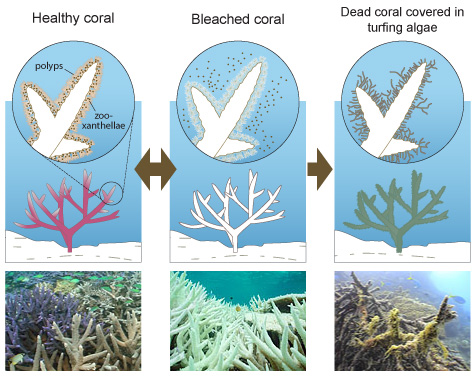
6 - The Great Barrier Reef is currently undergoing the worst mass bleaching event on record, according to Australia's national coral bleaching taskforce. As a marine biodiversity hotspot this is a major threat to species conservation. Many corals will die, without them lots of species will lack a habitat and nursing ground for young ones. As such it's hard to ascertain the scale of devastation, even though the immediate effects already seem dire. 

Source: Coral Reef Watch, NOAA

7 - Marine heat waves last longer and cover larger areas due to global warming (extra strong during El Niño years), devastating marine life. An example of such is "the Blob" that emerged off the Pacific Northwest in 2014. Sea life outside the US west coast has suffered greatly, with stranded sea lions, increase in whale deaths and entire beaches full of dead shrimp. Marine life has been hit hard by this double whammy. 

8 - The American Election - it's just tragic. I'm so tired of reading about Trump I could puke. I can't imagine what would happen if Trump is elected and we have him and Putin trying to get along. Scary.

How energy and information flows shape civilizations

Cycle of adaptive change

Adaptive cycle from Resilience Alliance modified based on Van der Leeuw (2012)
In systems ecology there is a useful heuristic model - The Adaptive Cycle - that attempts to map out cyclical change in social-ecological systems. The concept builds on observations of ecosystem and social change over time. In the original picture the y-axis stood for potential (or capital) and the x-axis said connectedness. But in this figure I have swapped out those for energy and information as the constraints of the system. This is not my idea but based on Sander E. van der Leeuw (2012) article "Global systems dynamics and policy: Lessons from the distant past" where he applies resilience thinking to social change over time, drawing on knowledge from the past.

As depicted above, in the first phase of the adaptive cycle, exploitation, society and its environment grow based on a particular form of organization that permits an increase in energy flow in exchange for an increasingly coherent institutional structure, that in turn increases its impact on the environment over time. In this phase, when resources are abundant, every individual has a chance to make something of her/his situation, and so the culture is one of individualism. However, during this time the system suppresses structural innovation and institutional change because the dominant paradigm is thought to be so effective that there is no reason for innovation.

Eventually, however, the growth curve levels off and the system’s effectiveness and growth ceases. Enter the conservation phase. The limits of expansion become apparent and society “defends itself” (state of denial) by becoming more fixated on rules and hierarchies as a consequence of the need to deal with increasing levels of conflict over resources. Bottom-up change is slowly replaced by “top-down” power over people. Fundamental change is not implemented because the system as a whole is still aligned on the pre-existing dynamics.

In the next phase, release, resources are suddenly freed up once the system reaches a tipping point and the existing structure collapses. The immediate result of that is a complete lack of institutional structure, true chaos in which the system can transform in many different ways, but none of the potentials are clear enough to give a sense of direction. People turn against how the system was structured but also show an inability to understand. Which in turn lead to a ‘fatalist’ attitude, like during the Dark Ages in Europe. 

The fourth phase is that of reorganization, a time of experiments with different forms of organization on a very local scale. Real innovation becomes possible and necessary, and small communities flourish and gather support based on an egalitarian perspective. Eventually smaller communities organize into larger structures and growth starts again. And so the cycle repeats, according to theory. 

A time of crisis

I believe that we are currently in the very last stages of the conservation phase, passed the tipping point, and now headed towards the release phase. In terms of resource depletion, it is clear we have reached our peak of extraction and we are now left with huge increases in costs of providing basic services, like freshwater, food and energy. We see an increase in conflict over limited resources, state failure and attempts to regulate and control ordinary people. The massive global debt bubble is unpayable but governments are unwilling to implement structural reform. Short term political considerations trump the long-term viability of society. Most people do not understand the full complexity of the processes going on around us. The fragmented worldview has been institutionalized through academia working in silos and only focusing on one narrow subject at a time. And don't get me started on neoliberal economics, which is simply unscientific. In society in general we have witnessed an explosion of trade in material goods and services that are utterly useless. The need is no longer for innovation to meet existing challenges, but simply to create ‘value’ to maintain the growth of the world economy (like a cancer). This is a time of crisis, when people lose faith in the system and it collapses. At the same time, people do not understand why things are getting worse and instead look for someone to blame. But the problem is not religion, ethnicity, or gender, its structural. The entire system is flawed, and will collapse.

Zero self-sufficency

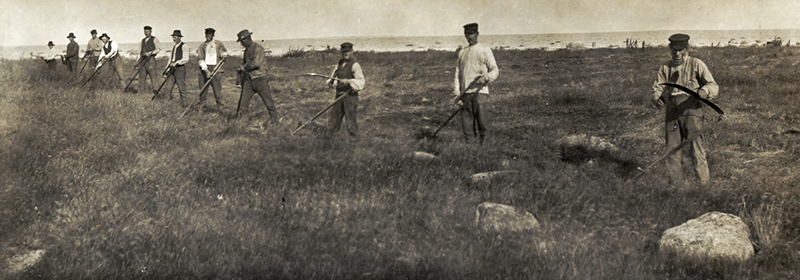
Slitkalar på Fitn, July 1908. Nordiska Museet

Hard to put a number of food security

Politicians, journalists and pundits have for many years used the number of 50% regarding Sweden’s self-sufficiency in agriculture. A new investigation from the agricultural magazine ATL, however, shows that this number without a doubt is incorrect. A protracted crisis with blockaded imports would result in a catastrophe.

Sweden has made itself vulnerable to shocks and disturbances in international trade by outsourcing production of basic commodities and relying on imports. The precarious global geopolitical situation have brought the question of self-sufficiency back on the political agenda. 

In 2002 the last reserves and warehouses with foodstuffs in case of a national emergency were dismantled. Ten years later we read in a report from LRF that about half of all the food Swedes consume comes from imports. People have therefore assumed that Sweden has a self-sufficiency level of 50%. 

But the relationship between imported and domestically produced food only shows a theoretical potential. Current stocks would only last for a maximum of 3 weeks if there is a true crisis. There are no warehouses with food and chemicals for water purification and our largest packaging plant was shut down last year, according to Therese Frisell at the National Food Agency. 

In other words, Sweden is not self-sufficient at all. According to Frisell our capacity is at zero. This is due to that Sweden is heavily reliant on imports for industrial agriculture, for example oil, fertilizers and protein for animal feed.

Researchers at the Swedish University of Agricultural Sciences together with the Swedish Civil Contingencies Agency claim that farmers can produce food in a time of crisis but that this would require a large scale transition. Farmers would have to rely less on machines, switch from cereals to root crop and from pigs and chickens to uncultivated pasture meat. Farmers can not do it alone, they would need extra manpower. And if the transition fails, Sweden would likely not be able to support its growing population. People would starve.

Pestilence - Deadlier than war

"Everybody knows that pestilences have a way of recurring in the world; yet somehow we find it hard to believe in ones that crash down on our heads from a blue sky" ‒ Albert Camus, The Plague, 1948
The only top predator left to infect

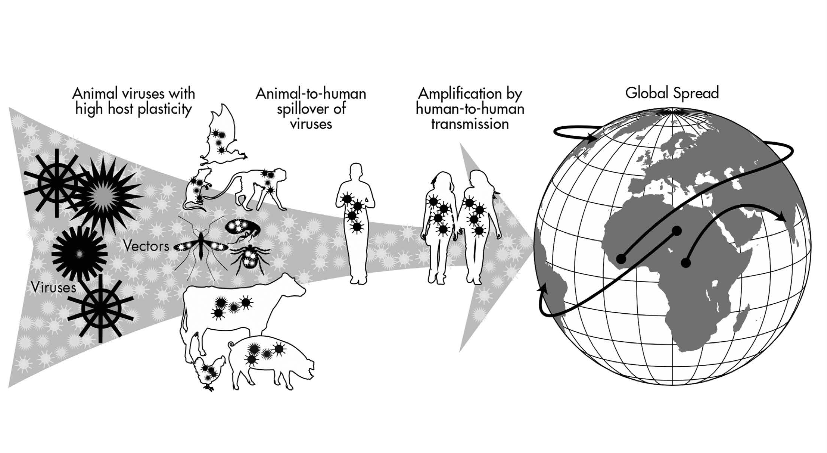
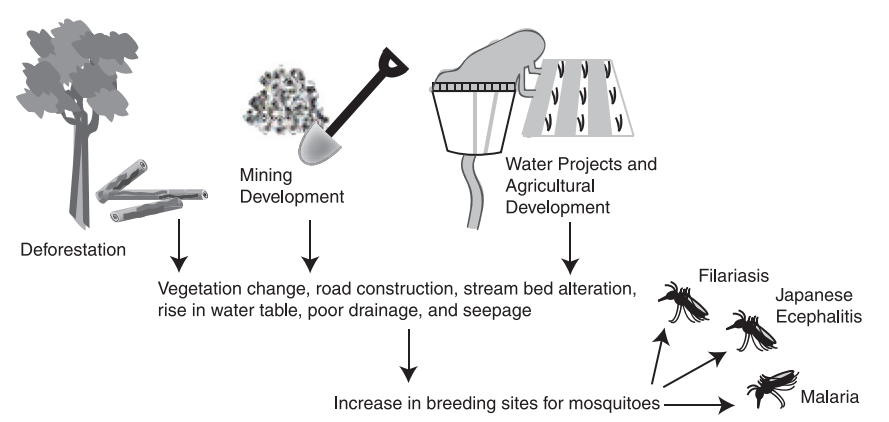
When humans start putting extreme pressure on local ecosystems, through for example overpopulation and deforestation, communities become more susceptible to emerging or novel zoonotic diseases as natural habitats disappear and exposure to pathogens increases. Several of today’s most pervasive diseases originally stemmed from domestication of livestock some 10,000 years ago. For example, tuberculosis, measles, and smallpox emerged following the domestication of wild cattle. Many pathogens that are currently passed from person to person, including influenza, Ebola and HIV, were formerly zoonotic but have mutated and adapted to human hosts. Today, wild animals are significantly more likely to be a source for animal-to-human spillover of viruses than domesticated species. According to one recent study, wild rodents are the most common source (58%) of spillover of zoonotic viruses, followed by primates and bats. Wildlife habitat destruction or encroachment, changes in surface waters, industrial monocultures, chemical pollution, uncontrolled urbanization, migration, international travel and trade have all increased the risk of disease spread in humans and the potential for a pandemic.
Toxic Cocktail

We know that our highly interconnected global society is very vulnerable to disruptions in food, water and energy supply. Another threat to the continuation of our civilization is global toxification. The 30 million tonnes a year global output in synthetic chemicals has left no living creature on Earth without these chemicals in its organs. The full impact of the chemical soup we are all living in whether we are a whale or a human are yet unknown. However, we know that the emergence of widespread antibiotic resistance is likely to cross paths with our exhausted immune systems compromised by chemical contamination, and the fact that with such high population density in many urban areas we are increasingly vulnerable to pandemics.
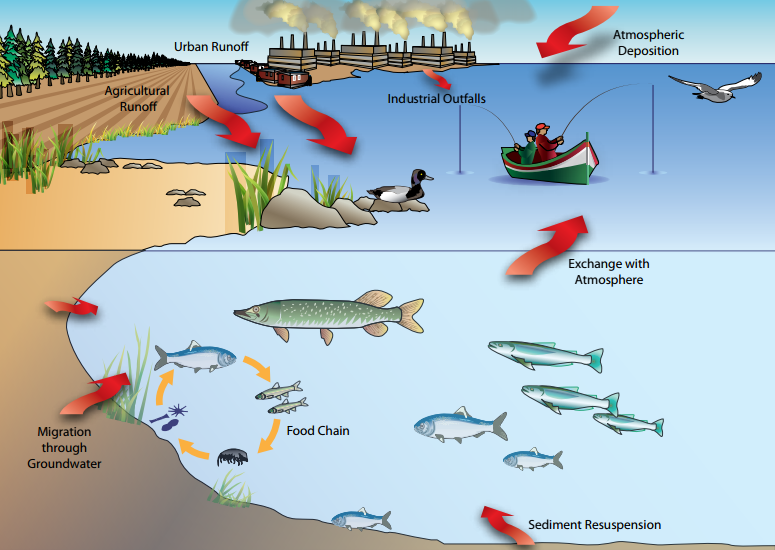
Exposure of fish and wildlife in urban regions due to continuous release of Endocrine Disrupting Chemicals in oceans and to the atmosphere.Source: WHO, 2012

Antibiotic Resistance

The fact that some antibiotics no longer work in people who need them to treat infections is now a major threat to public health, according to WHO. Over the last 30 years, no major new types of antibiotics have been developed.

According to a recent study published in the journal Lancet Infectious Diseases, scientists in China have discovered significantly increased levels of bacteria resistant to the antibiotic colistin in pigs. The drug is a last line of defense against a host of bacterial infections, many of which are common in people. Researchers have linked the growing prevalence of “super-germs” to the overuse of antibiotics in food animals. The drugs, used predominantly in the Chinese livestock industry, can keep animals healthy in an industrialized food process, but their use over time can embolden the very bacteria they were designed to fight against. In 2005, the European Union banned the use of antibiotics in livestock for non-medicinal purposes, but the drugs are still widely used across the continent, and are rampant in the agricultural industry in the United States. As people in wealthier regions run out of effective antibiotics, they come to share the lot of people in poorer regions who can’t afford them to begin with. In April 2014, the WHO declared that the problem “threatens the achievements of modern medicine. A post-antibiotic era — in which common infections and minor injuries can kill — is a very real possibility for the 21st century.”

Historical Pandemics


The Plague
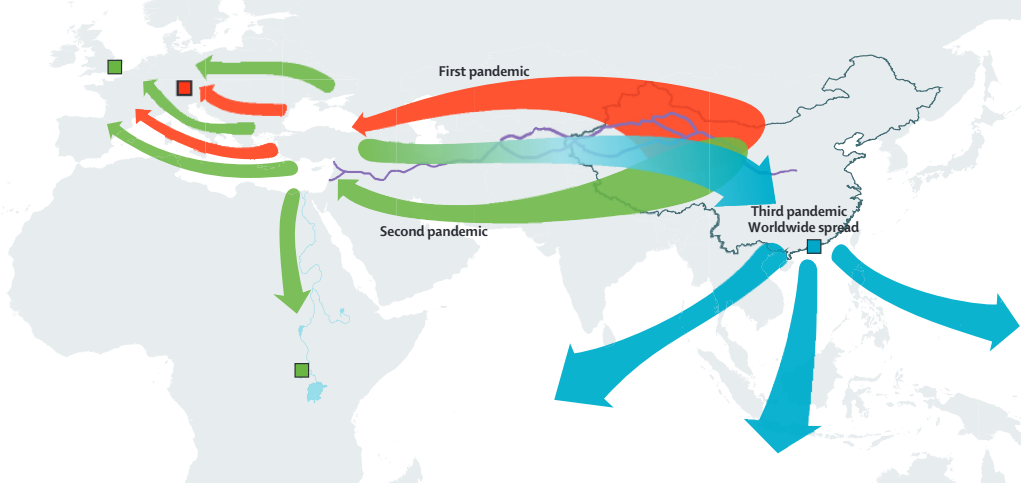
The bacterium Yersinia pestis carried by fleas on rodents has caused at least three human plague pandemics, the Justinian Plague (6–8th centuries), the Black Death (14–17th centuries) and third Plague (19–20th centuries). In 541 A.D., the Justinian Plague caused 5,000 deaths per day in Constantinople, killing an estimated 25 million people globally. It spread from central Asia or Africa across the Mediterranean into Europe and may have contributed to the end of the Roman empire, marking the transition from the classical to the Medieval period. The Black Death arrived in the Eastern Mediterranean in 1347 and struck Italy, southern France with vehemence in 1348, came to England at the end of that year and spread northwards reaching Scandinavia in 1350. 

Larger cities were the worst off, as population densities and close living quarters made disease transmission easier. Cities were filthy with poor sanitation, infested with lice, fleas, and rats, and subject to diseases related to malnutrition and poor hygiene. Where the plague raged, it raged for a couple of months and then spent itself. The Black Death killed an estimated 100 million people over 7 years. Religious fanaticism in the wake of the Black Death lead to the persecution of groups such as Jews, friars, foreigners, beggars, lepers and Romani, as Europeans thought that they were to blame for the crisis. Subsequent outbreaks of this disease occurred in 8–12 year cycles for two centuries after the initial epidemic, with estimated mortality of 15–40%. The emergence of these plague pandemics might be tightly linked to climatic instability as all were preceded by periods of exceptional rainfall and ended during periods of climatic stability.
Hypothetical scenario for the geographic spread of Yersinia pestis. Source: Wagner et al. (2014)

The Spanish Flu
In 1918-19, the Spanish flu (H1N1) killed roughly 100 million people and infected 500 million people while affecting working age people (15–54 year olds) most severely. WWI was raging at the time and governments tried to control the public by limiting free speech. The pandemic was known as Spanish flu because Spain was not at war, had a more free press, and could report on the illness. Most of Europe had a censored press. In the U.S. the Sedition Act 1918 was passed, extending the Espionage Act of 1917 to cover a broader range of offenses, notably speech and the expression of opinion that cast the government or the war effort in a negative light. The 1918–1919 influenza pandemic swept across countries during a time when patriotism was more important than truth. Thus, intimidation and propaganda were part of the communication culture. People heard from authorities and newspapers that everything was going fine, but at the same time, bodies were piling up.
Emergency hospital during 1918 influenza pandemic, Camp Funston, Kansas.
Source: Otis Historical Archives Nat'l Museum of Health & Medicine (CC-BY 2.0)


War and disease

According to the WHO, previous to the conflict in Syria, more than 90% of Syrian children were vaccinated against disease like measles and polio. Since the fighting in Syria began almost 5 years ago, half of all health workers have left the country, medical supplies are scarce and most facilities are in decay. Some 20 million people have fled their homes in the MENA region. Countries like Jordan and Lebanon are under immense pressure as demand on services for health, water and sanitation have increased exponentially. The low immunization rates among those living in and fleeing from conflict zones, endangers the lives of people across the entire region. The recent outbreak of polio in Syria led to its resurgence in Iraq, which had been free of the disease for 14 years, and in 2013, Jordan experienced a new outbreak of measles. In Yemen there has been an upsurge in cases of measles and dengue fever due to lack of basic health care and collapsed water and sanitation facilities. WHO estimates show that 2.6 million children under 15 years of age in Yemen are at risk of measles; 2.5 million under 5 are at risk of diarrhoeal disease and another 1.3 at risk of acute respiratory infections.

Second order effects
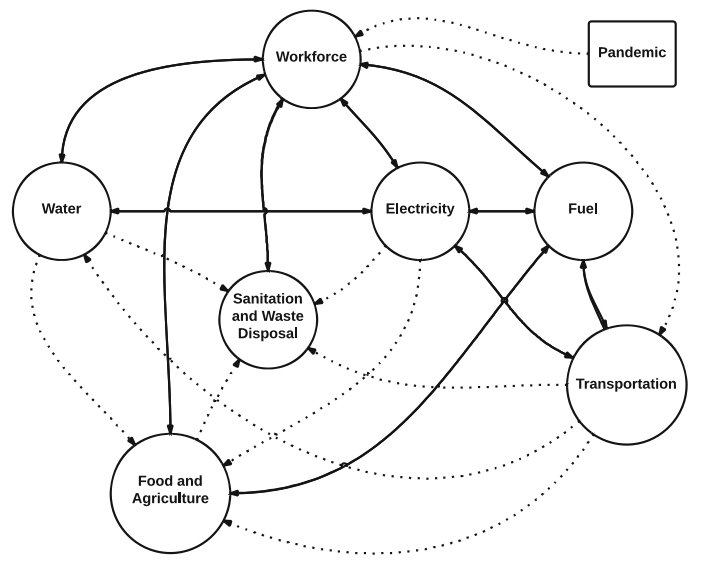
Limiting the disruption of critical infrastructures during a pandemic is important for the survival and health of society (i.e., electricity, water, and food) as most medical and public health responses to a pandemic depend on these infrastructures. The food system’s dependence on the transportation system creates a major vulnerability. On average, food travels 2092 km (1,300 miles) from farm to fork. The global food system functions in a just-in-time economy where food inventories are intentionally kept at such low levels that food arrives just in time for consumption. Since inventories are kept very low, there is vulnerability to unanticipated variations in flow. Increasing stocks of food costs money and decreases profits, therefore, agricultural businesses are reluctant to build food security resilience via stockpiling. The Ebola epidemic that began in 2014 has caused severe food shortages in West Africa. As of November 2014, the World Food Program estimated that 460,000 additional individuals became food insecure in Liberia, Sierra Leone, and Guinea as a result of production and trade reductions. According to a recent study, a severe pandemic with <25% reduction in labor availability could create widespread food shortages in the US. This likely applies to other countries as well, especially those with insufficient resources and food production at home. 

Brace for impact: Super El Niño


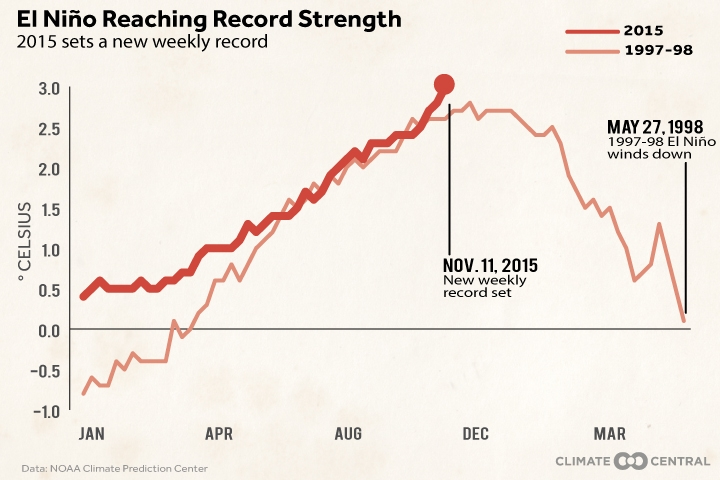
As I have mentioned in a previous post, 2015/16 El Niño period have shown signs of becoming stronger than the devastating 1997/98 El Niño. Now weekly measurements are showing that it indeed has passed the record high of 1997/98 with temperatures in the central Pacific of 3°C above normal. November is likely to be strongest month of the El Niño season that lasts until spring next year.

The ongoing El Niño has already caused a number of serious impacts globally. For example, warmer waters have lead to major coral bleaching events and according to the UN, 11 million children are at risk from hunger, disease and lack of water in eastern and southern Africa, while 2.3 million people in Central America will need food aid as El Niño exacerbates a prolonged drought.

Regional Impacts


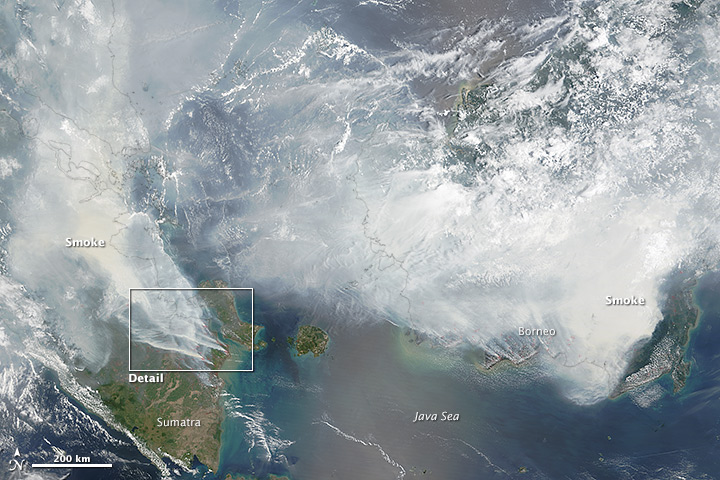
South East Asia: Dryer conditions in Southeast Asia has helped fuel massive peatland wildfires in Indonesia. This has caused dense haze to cover many parts of Indonesia and neighbouring countries with serious health impacts for local populations and has released a huge amount of greenhouse gasses to the atmosphere, making Indonesia a major contributor to climate change.


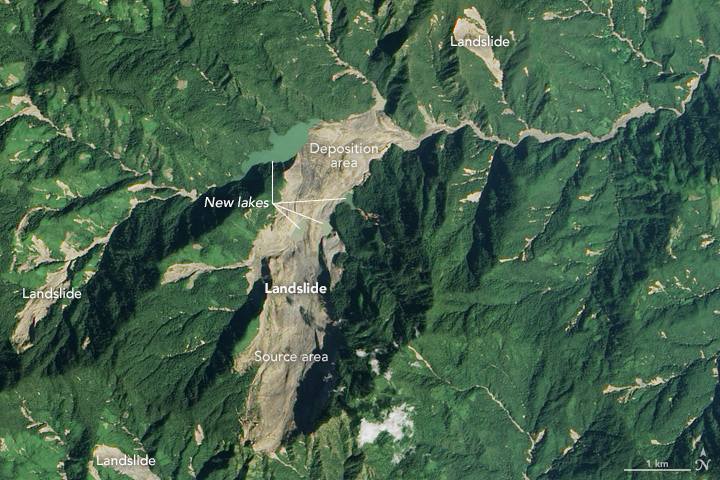
South Asia: Lack of precipitation in India due to changes in the southwest monsoon has also caused dryer conditions and risk of drought with potentially serious impacts on farmers and subsistence livelihoods. Especially since India suffered a deficient monsoon, lack of precipitation, last year as well. Meanwhile in Myanmar (Burma) a Tropical Storm drenched the western region and caused a massive landslide. More than 17,000 homes were destroyed, 46 people were killed, and hundreds of thousands of people were affected by the storm.


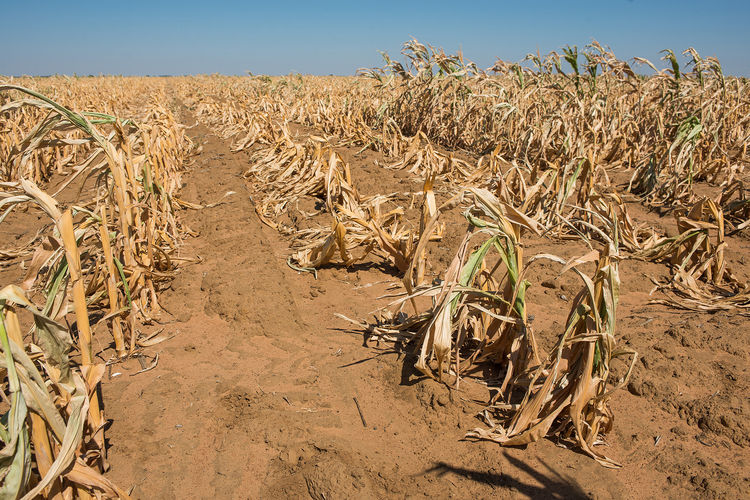
Southern Africa: A number of countries in southern Africa are reporting below average rainfall leading to drought conditions and fears of food insecurity. South Africa is in the midst of its worst drought since 1982, with 2.7 million households facing water shortages and farmers that cannot plant crops because of lack of precipitation. Some cities have implemented water restrictions, drastically reducing the amount of water residents can use. Regional prices for staple foods like maize meal, bread, eggs and chicken are up several percentage points. “When the maize crop goes down, the circumstances for social unrest go up … This is exactly how the Arab spring in the Middle East started, said Louis Meintjes, president of the Transvaal Agriculture Union.


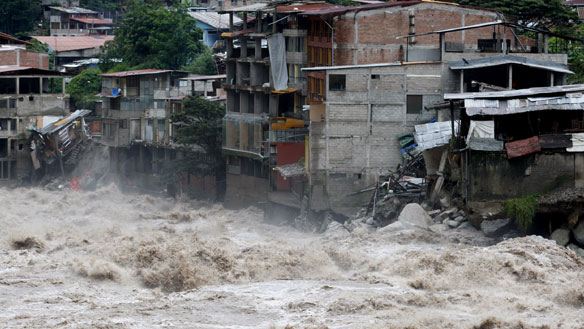
South America: Ecuador and Peru has suffered from flooding, extensive erosion, mudslides with loss of lives and infrastructure as well as damage to food supplies. Peru has declared a state of emergency as the country prepares itself for the worst weather system in over 60 years. Eastern Brazil is experiencing a major drought, driven by population pressure and deforestation, that could be worsened by dryer El Niño conditions. Satellite data shows the southeast of Brazil losing 56 trillion liters of water in each of the past three years - more than enough to fill Lake Tahoe. Water rationing, power blackouts and empty reservoirs in parts of the country have become a reality. More than 11,000 forest fires have been observed in the Amazonas province of Brazil this year, a 47% increase over the same period last year, according to the National Institute for Space Research. The storms that usually keep the jungles of southern Mexico and Central America wet shift northward to the southern US during strong El Niño winters. According to the World Food Program, 3.5 million people in Guatemala, Honduras and El Salvador need food aid due to drought and crop failures.


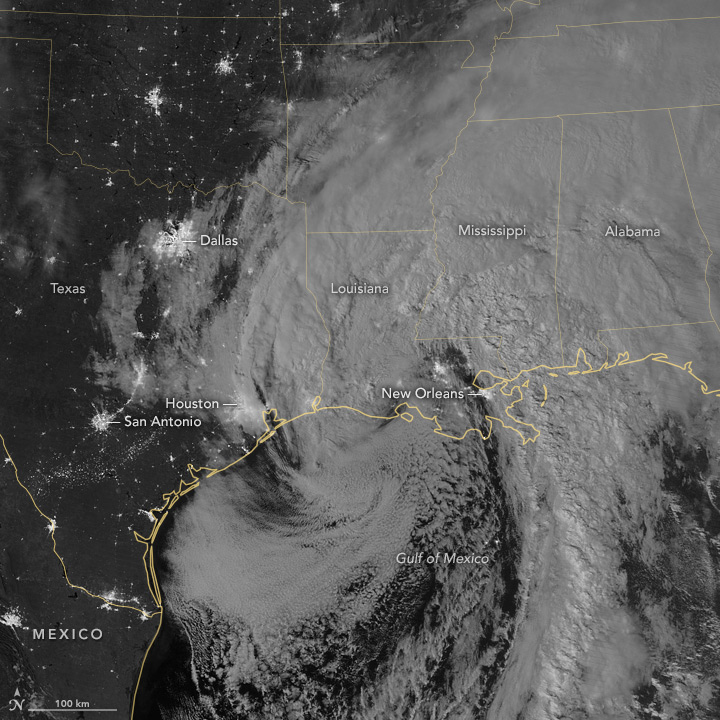
North America: According to NOAA, almost 95% of U.S. coral reefs will have been exposed to ocean conditions that can cause corals to bleach by the end of the year. El Niño has also contributed to a very active tropical cyclone season in the Western North Pacific and Eastern North Pacific. Hurricane Patricia, which made landfall in Mexico on 24 October, was reportedly the most intense tropical cyclone in the western hemisphere ever recorded. While category 5 Hurricane Patricia weakened rapidly after hitting the rugged terrain along Mexico’s Pacific coast, remnants of the storm combined with other weather systems over the Gulf of Mexico to produce heavy downpours and widespread flooding in Texas and Louisiana

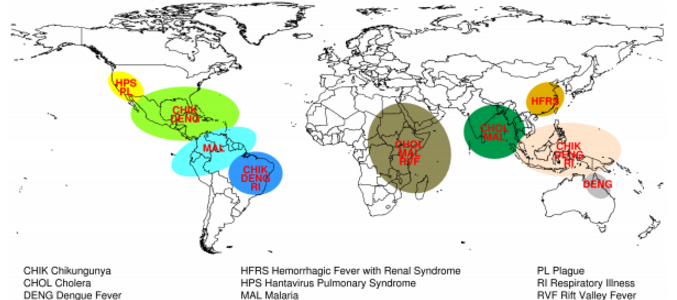
El Niño conditions and disease risk

The development of these conditions also has important implications for global public health. Multiple epidemiological studies have linked El Niño events with increased incidence of disease outbreaks.


Disease
Region
Climatic influence
Cholera
Great Lakes region, Bangladesh, India (coastal), Sri Lanka, Peru
Warmer water temperatures promote bacteria proliferation; flooding causes contamination of water sources.
Dengue
Indonesia, Thailand, Pacific Islands, Australia (Queensland), Mexico, United States (southern), Colombia, Ecuador (coastal)
Water storage promotes mosquito vector breeding; elevated temperatures reduce the incubation period.Elevated rainfall promotes mosquito breeding.
Hantavirus
China (eastern), United States (southwest)
Elevated rainfall increases food availability for rodents which expands populations and may promote contact with humans.
Leishmaniasis
Brazil (eastern), Costa Rica, Colombia
Warmer temperatures or dry conditions may favor sand fly vectors or contribute to waning human immunity (e.g., via malnutrition or temporarily suppressing disease transmission).
Malaria
China (Anhui Province), India/Pakistan (Punjab), Sri Lanka, Colombia, Peru, Venezuela
Elevated rainfall promotes mosquito vector breeding and survival.
Plague
Madagascar, United States (western)
Heavy rains increase food availability for populations of susceptible rodents; cooler temperatures may increase infectious flea abundance.
Rift Valley Fever
East Africa
Flooding of dry mosquito vector habitats promotes hatching of infected eggs, vector breeding and survival.
Respiratory Illness
Southeast Asia/Indonesia
forest fires cause air pollution that may increase risk of respiratory infection