Is complex life such that exists with animals on Earth rare in the Universe? If so why don't we make sure not to trash our only home? A panel of experts, including Don Brownlee, Roger Carasso, Robin Hanson, Mark Jacobson, Derrick Jensen, David Klein, Bill McKibben, Guy McPherson, Bill Patzert, Gary Snyder, Jill Stein, Peter Ward, and Josh Willis discuss these topics.
A great documentary about life on Earth and the human growth dilemma.
Greenland melt pond. Credit: Michael Studinger, NASA GSFC, 2008
Hot in the North
So far April has been amazingly warm, today I had to water my plants due to lack of rain. It's probably the first time I had to water outside so early in the spring. There have even been warnings about the risk for grass fires.
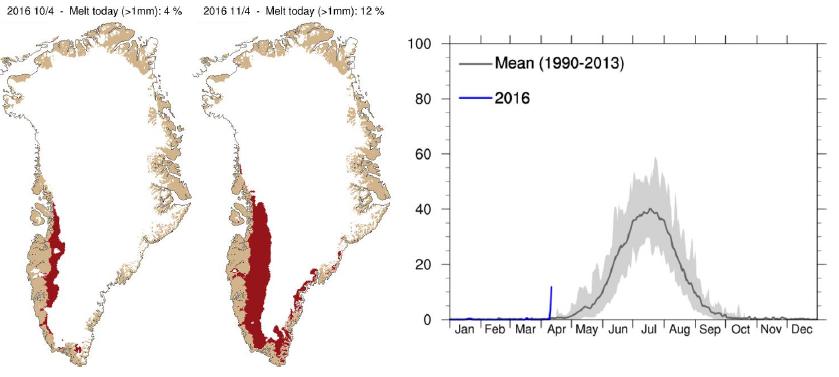
If it's this hot at 60°N one has to wonder how the Arctic is faring. According to the Arctic Sea Ice Blog Greenland experienced an early melt event this Monday, with 12% of the ice sheet that had more than 1 mm of melt. Greenland’s usual melt season runs from early June to September. Looking at the graph below I realize how extreme that event was.
Maps showing areas where melting took place on the 10-11th April. Graph shows standard deviation - percentage of total area where melting occurred. Source: DMI, 2016
According to the Danish Meteorological Institute the melt was driven by warm air coming in from the southwest, bringing rain along the coast, similar to what happened in 2012 when later on there was an extreme melt event, 95% of the surface of the ice sheet melted.
Melting ice at the poles is already causing a slowdown of the Atlantic meridional overturning circulation that transfers heat from the tropics to the North Atlantic. The cold blob from freshwater runoff below Greenland is also a source of major storms in the North Atlantic as warm weather crashes with the unusually cold. This has impacts on people's livelihoods in Northern Europe and the US East Coast.
Depending on the doubling time, the amount of time it would take for ice loss from the ice sheets to double, say if it's as short as 10 or 20 years like Hansen has proposed we could come to see several meters of sea level rise already by 2050. Perhaps its not likely but its possible.
Despite the fact that humanity is standing at the edge of total chaos from life threatening problems such as; climate change, severe water scarcity, rapid loss of biodiversity, steadily rising resource costs and erosion of democracy, Russia and the U.S. (NATO) are showing off their guns over the Baltic Sea.
Russian fighter jets flew dangerously close to a U.S. army vessel on international waters outside of Kaliningrad, displaying Russia's dominance over the Baltic Sea according to expert opinion in SVD.
The whole story pisses me off. Firstly, what reason is there to fight over the Baltic Sea if not for resources, mainly oil shipping? Take your fighting somewhere else, we Swedes and Finns just want to be left alone.
Secondly, how can Russia with the collapsed oil prices or the US with a mountain of bad debt afford to be playing with ships and jets willy nilly? It's just a waste of resources that could have been spent on fixing some of the many social or ecological ills that now plague both societies. It's not as if they can afford escalating into an armed conflict, the nuclear threat is still real on both sides.
Thirdly, fearmongering tends to lead people towards stupid decisions. Perhaps Finland and Sweden eventually fully joins NATO (wasting even more resources), or a pilot makes a bad call escalating tensions further.
Instead of facing our resource problems head on it looks like humanity has decided to use physical force when meddling through stops working. A winner takes all type of strategy. But much of Earth's wealth is already plundered so the costs probably overweighs the gains by now.
Geopolitical analysis of Europe/ Middle East/ Russia by Caspian Report. I found it very interesting so I'm posting it here. In short, more geopolitical tension, and armed conflict, in the Middle East with Turkey stepping in as active participant in the Syrian conflict and an increase in nationalistic ideology in Europe. Geopolitical turmoil keeps growing in 2016, as expected in a world of dwindling resources.
Measuring stations in Böda on Öland, Gotska Sandön and in Ronneby show record low groundwater levels that normally would only occur during August-September. According to Geological Survey of Sweden, groundwater levels in this region have been dropping continuously for the last five years. However, cyclical variations of high and low groundwater levels of 11-12 years are not uncommon.
Without large amounts of rainfall in April, before the growing season starts, groundwater levels will not be able to return to normal and communities may experience problems of water availability. Shallow wells are most affected by low groundwater levels as they risk drying out. In low lying coastal areas there is also a risk of saltwater intrusion. Out of 9 million 1.2 million people in Sweden rely on groundwater from private wells.
Restrictions on irrigation on Gotland came into force already on 1st of April since the region want to avoid heavy restrictions during the summer when tourism is booming. Gotland municipality has also decided to build a desalination plant that should be operational this summer according to NyTeknik. Desalination is however a very energy intensive and expensive process but perhaps the brackish Baltic water is less costly to desalinate.
Groundwater levels above normal in blue and way below normal in red. Source: SGU (2016)
It is likely that southeast Sweden will increasingly face problems of groundwater scarcity while the rest of the country will experience higher groundwater levels as a consequence of climate change.
Spring has so far been unusually warm which means an earlier growing season and migration of birds. March was warmer than average in the entire country, with 3-4C above average in parts of middle and northern Sweden.
I have been away from blogging for a while but decided to try and pick it back up today. So much has happened this spring that I haven't been able to write about so I decided to pick out some key trends/headlines that I found most important.
1 - Civil war in Turkey!? Turkey houses some 2.6 million Syrian refugees, out of the more than 4.7 million Syrians who have fled their country’s civil war. Turkey is also currently engaged in the conflict in Syria fighting (US supported) Syrian kurds more than ISIS due to fears of escalating internal conflict. But the Turkish strategy backfired as three suicide bombings in three cities killed 150 people and shocked the nation. Experts now fear that the Turk-Kurd conflict inside Turkey could turn into a full blown civil war if hostilities keep increasing. Erdogan is supposed to have asked Obama to halt support to the Syrian kurds YPG which has close historic ties with the Turkish kurds, PKK. However, that has not happened since the YPG is fighting ISIS, and so the confusing war in Syria continues while another one is brewing in Turkey.
2 - Extreme February Temperature Anomaly shows worrying signs of a potential non-linear response to continued global warming, but probably due to a strong El Niño. According to NASA scientists the average global temperature in February was about 0.5 degrees Celsius warmer than the previous record set in 1998 and 1.35 degrees above the 1951-80 average. The average global atmospheric CO2 level reached 402.59 ppm, according to NOAA. Vietnam, Zimbabwe and Fiji suffered major economic losses from February droughts and storms as reported by Wunderground.
3 - How the refugee crisis turned out to be a major preparedness crisis. A prime minister that was invisible when the crisis erupted. A director-general that played golf and ran marathons. Prognoses which were completely wrong, greatly underestimated the number of refugees. Total lack of coordination and pressing decisions that were put on hold. The Swedish government's handling of the refugee crisis has been a complete mess. Politicians kept denying the facts until there were no more beds, no more supplies and no willingness to comply. And so they had to change policy. On the 4th of January border patrol with ID-control between Denmark and Sweden was enforced, delaying all traffic with some 20-60 minutes every day. According to the Immigration Office some 81% of refugees lack any kind of identification papers when they arrive. It is still too early to tell the consequences of such major mismanagement of a country.
4 - The Panama Papers Scandal shows just how widespread and pervasive tax evasion and government corruption is at the moment, from prime ministers to global banks. The leaked 11.5 million files includes nearly 40 years of data (1977-2015) on offshore secrecy and and includes names of high-level politicians, such as the president of Argentina and Iceland's prime minister etc. I'm surprised there has not been a bigger outrage over this topic, but then again, maybe because it was somewhat expected in our grossly unequal society.
5 - Negative Interest Rates madness continues despite its ineffectiveness. The only thing that has changed here in Sweden in regards to this topic is that people are piling up ever more private debt, or going bankrupt, with a major increase among 18-25 year olds. The housing bubble is still going strong and our dear politicians are already backing on implementing harsher mortgage repayment requirements decided upon in 2015. Perhaps it's because they realize they might prick the bubble or the fact that so many now rely on an income generated by flipping property.
Brilliant economist Steve Keen writes in FORBES that Sweden rank as top 3 on highest risk for a debt crisis within the next one to three years. Looking at the graph below it becomes rather obvious that the current credit growth trend is unsustainable.
6 - The Great Barrier Reef is currently undergoing theworst mass bleaching event on record, according to Australia's national coral bleaching taskforce. As a marine biodiversity hotspot this is a major threat to species conservation. Many corals will die, without them lots of species will lack a habitat and nursing ground for young ones. As such it's hard to ascertain the scale of devastation, even though the immediate effects already seem dire.
7 - Marine heat waves last longer and cover larger areas due to global warming (extra strong during El Niño years), devastating marine life. An example of such is "the Blob"that emerged off the Pacific Northwest in 2014. Sea life outside the US west coast has suffered greatly, with stranded sea lions, increase in whale deaths and entire beaches full of dead shrimp. Marine life has been hit hard by this double whammy.
8 - The American Election - it's just tragic. I'm so tired of reading about Trump I could puke. I can't imagine what would happen if Trump is elected and we have him and Putin trying to get along. Scary.
.png)




 Posts
Posts

