The Great Barrier Reef in Danger


Satellite image of the Great Barrier Reef.
Photo Credit: NASA | Wikimedia Commons
The Great Barrier Reef stretches 2,300 km down the eastern coast of Australia. Covering an area the size of Italy it is the largest coral reef on the planet. With over 1500 species of fish, 600 coral species and 30 different whale and dolphin species, it is one of the most biodiverse and complex ecosystems on the planet.

Two weeks ago I wrote about the mass bleaching event that had struck the Great Barrier Reef due to extra warm ocean waters. Now the aerial and underwater survey results are in and it makes for some very sad reading. Only 7% of the reef remains unaffected, in other words, 93% of the reef has suffered damage from the bleaching event. 

“We’ve never seen anything like this scale of bleaching before. In the northern Great Barrier Reef, it’s like 10 cyclones have come ashore all at once,” says Professor Terry Hughes, convenor of the National Coral Bleaching Taskforce

Map of the Great Barrier Reef showing results of aerial surveys for 911 reefs.
“North of Port Douglas, we’re already measuring an average of close to 50% mortality of bleached corals. At some reefs, the final death toll is likely to exceed 90%. When bleaching is this severe it affects almost all coral species, including old, slow-growing corals that once lost will take decades or longer to return.”

A recent study reports that the Great Barrier Reef is losing its resilience to withstand bleaching events under climate change. This happens when seawater temperatures rise by as little as 0.5 °C, exposing corals to major stress.


I highly recommend watching the tv series "Great Barrier Reef", with David Attenborough as narrator, and exploring more about the reef  and the filming of the series on www.attenboroughsreef.com 

Britain Realises Limits 40 Years Too Late

We don't need more reports

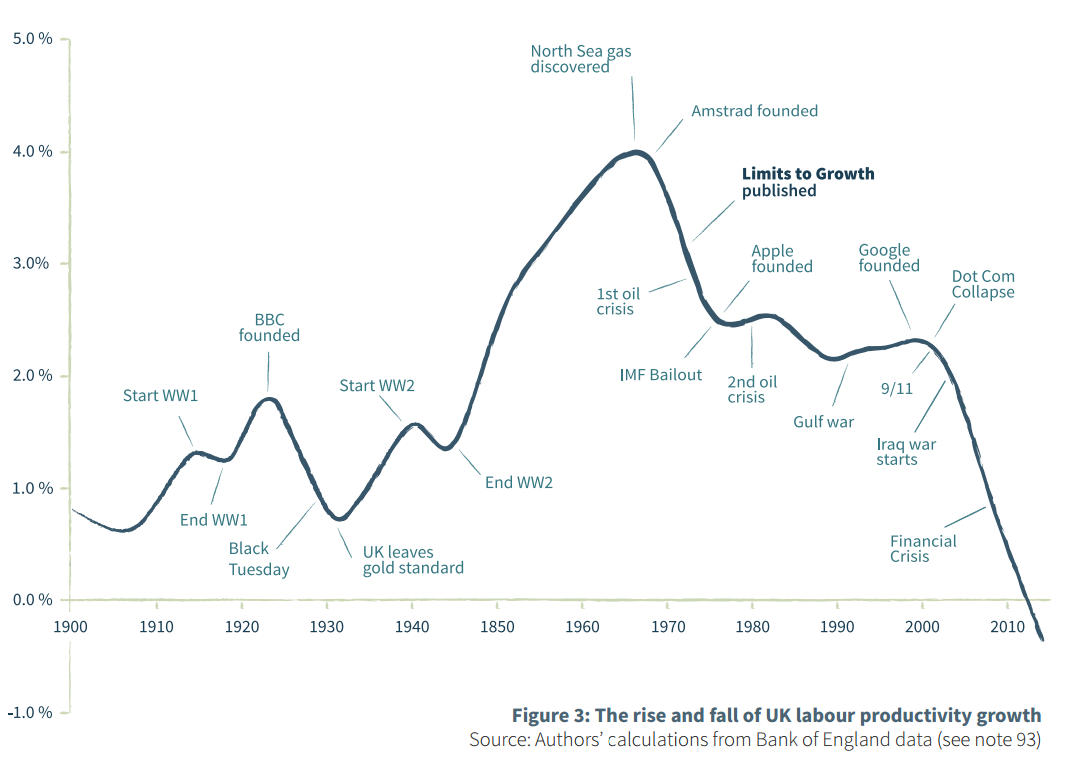
I find it amazing and tragic how organisations and governments keep issuing reports that confirm the dire situation humanity is in with regards to depleting resources, climate change and economic contraction. Latest is a report Limits Revisited: a review of the limits to growth debate commissioned on behalf of British MPs written by Tim Jackson (author of Prosperity without Growth, 2009) that concludes we are headed for “an eventual collapse of production and living standards” in the next few decades, given business-as-usual. 

The report makes for some interesting reading and refers to some very important studies but offers nothing new in terms of scientific insight. It simply restates what previous studies have already confirmed, the global economy is running into resource limits. Going forward we should not expect resource fuelled economic growth but rather contraction.

As for climate change, we are pretty much doomed to failure, for a 66% chance of avoiding 1.5°C warming (the “safe limit”) the world only has 6 years to decarbonise the entire economy. That seems impossible given that fossil fuels cover 80% of global energy consumption and it takes many decades to replace all the current infrastructure.

40 years of inaction

It has been more than 40 years since the Club of Rome presented the Limits to Growth report but absolutely nothing has been done to steer society onto a new “greener” path. Resource depletion and emissions have continued unabated. 

Living sustainably is now impossible and instead we have to focus on bolstering our resilience to coming shocks and disturbances. While I do think we should do everything in our power (e.g. limit the destruction of ecosystems, transition from fossil fuels to renewables, go from global to local economies) to change the way we live on this planet we also have to realise that many so called “solutions” are no longer viable because we waited too long. 

We could have stabilised our population at 3.84 billion in 1972, leaving more space for ecosystems and a larger per capita share of resources for people. We could have replaced much of the infrastructure needed to make a transition to alternative fuel sources by now. But we didn’t do those things. Now, instead, nature is forcing us to live within the planet's limits through the usual mechanisms (e.g. epidemics, starvation, drought). 

The war torn Middle East (e.g. Syria, Iraq, Yemen) is a clear case of overpopulation, depleting resources (freshwater, oil) interacting with climate change (megadrought) and conflict over the remaining resources. These states were fragile to begin with (e.g. high inequality, lack of trust, lack of infrastructure) so even small perturbations were enough to push them over the edge. 

But even countries with a higher degree of resilience from the outset have started crumbling under the pressure of entropy in form of deflation (e.g. Greece, Italy, Japan). The downward trend is global. The collapse process, i.e. reduction in socioeconomic complexity, is already underway.

Rare Earth

Is complex life such that exists with animals on Earth rare in the Universe? If so why don't we make sure not to trash our only home? A panel of experts, including Don Brownlee, Roger Carasso, Robin Hanson, Mark Jacobson, Derrick Jensen, David Klein, Bill McKibben, Guy McPherson, Bill Patzert, Gary Snyder, Jill Stein, Peter Ward, and Josh Willis discuss these topics. 

A great documentary about life on Earth and the human growth dilemma.

The Cross of the Moment from Jacob Freydont-Attie on Vimeo.

Early Greenland Melt

Greenland melt pond. Credit: Michael Studinger, NASA GSFC, 2008

Hot in the North

So far April has been amazingly warm, today I had to water my plants due to lack of rain. It's probably the first time I had to water outside so early in the spring. There have even been warnings about the risk for grass fires. 

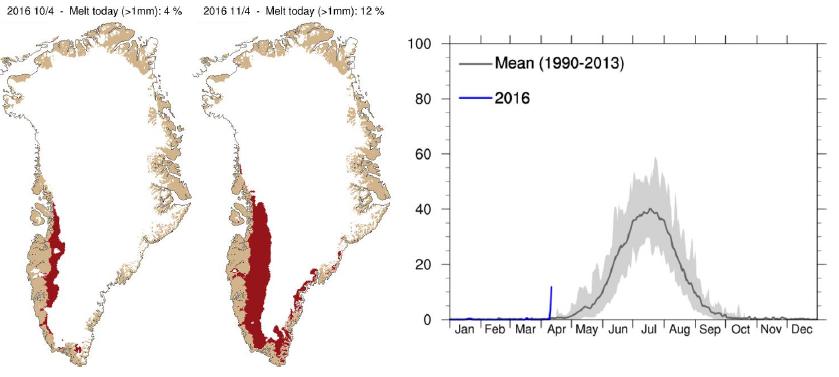
If it's this hot at 60°N one has to wonder how the Arctic is faring. According to the Arctic Sea Ice Blog Greenland experienced an early melt event this Monday, with 12% of the ice sheet that had more than 1 mm of melt. Greenland’s usual melt season runs from early June to September. Looking at the graph below I realize how extreme that event was.


Maps showing areas where melting took place on the 10-11th April. Graph shows standard deviation - percentage of total area where melting occurred. Source: DMI, 2016


According to the Danish Meteorological Institute the melt was driven by warm air coming in from the southwest, bringing rain along the coast, similar to what happened in 2012 when later on there was an extreme melt event, 95% of the surface of the ice sheet melted.

Melting ice at the poles is already causing a slowdown of the Atlantic meridional overturning circulation that transfers heat from the tropics to the North Atlantic. The cold blob from freshwater runoff below Greenland is also a source of major storms in the North Atlantic as warm weather crashes with the unusually cold. This has impacts on people's livelihoods in Northern Europe and the US East Coast. 

Depending on the doubling time, the amount of time it would take for ice loss from the ice sheets to double, say if it's as short as 10 or 20 years like Hansen has proposed we could come to see several meters of sea level rise already by 2050. Perhaps its not likely but its possible. 

Who dominates the Baltic Sea?

Clashing powers with no common sense

Despite the fact that humanity is standing at the edge of total chaos from life threatening problems such as; climate change, severe water scarcity, rapid loss of biodiversity, steadily rising resource costs and erosion of democracy, Russia and the U.S. (NATO) are showing off their guns over the Baltic Sea. 

Russian fighter jets flew dangerously close to a U.S. army vessel on international waters outside of Kaliningrad, displaying Russia's dominance over the Baltic Sea according to expert opinion in SVD. 

The whole story pisses me off. Firstly, what reason is there to fight over the Baltic Sea if not for resources, mainly oil shipping? Take your fighting somewhere else, we Swedes and Finns just want to be left alone. 

Secondly, how can Russia with the collapsed oil prices or the US with a mountain of bad debt afford to be playing with ships and jets willy nilly? It's just a waste of resources that could have been spent on fixing some of the many social or ecological ills that now plague both societies. It's not as if they can afford escalating into an armed conflict, the nuclear threat is still real on both sides. 

Thirdly, fearmongering tends to lead people towards stupid decisions. Perhaps Finland and Sweden eventually fully joins NATO (wasting even more resources), or a pilot makes a bad call escalating tensions further. 

Instead of facing our resource problems head on it looks like humanity has decided to use physical force when meddling through stops working. A winner takes all type of strategy. But much of Earth's wealth is already plundered so the costs probably overweighs the gains by now. 

Geopolitical mess in Central Asia

Geopolitical analysis of Europe/ Middle East/ Russia by Caspian Report. I found it very interesting so I'm posting it here. In short, more geopolitical tension, and armed conflict, in the Middle East with Turkey stepping in as active participant in the Syrian conflict and an increase in nationalistic ideology in Europe. Geopolitical turmoil keeps growing in 2016, as expected in a world of dwindling resources.