Nine Meals Away from Anarchy


Venezuela has rapidly devolved into utter chaos as hyperinflation, black outs and lack of basic goods are having ever more serious effects on its inhabitants. Doctors are fleeing the country, people are looting grocery stores and killing cats, dogs and doves for food. 

Hunger destroys social order as desperate people take desperate steps to secure food for survival. If people go hungry for too long a revolution is likely. 


Relying on a ‘just-in-time’ delivery system in a period of financial collapse is like begging for social upheaveal in my mind. There is no redundancy at all if the food supply chain is interrupted, at most grocery stores keep some 3 days of inventory. After that, people start bartering and looting until the situation becomes so unbarable that they revolt or flee to another country.

Lack of food security is also caused by a shifting climate with more extreme weather events (e.g. stronger El Niño, more severe droughts) leading to crop failures and people flooding into already overpopulated cities. Creating social unrest as unemployment and crime grows. A situation that occured in Syria just before the civil war broke out. 

According to the latest Global Food Security Update (March, 2016) by the World Food Programme we can see (in the map below) how hunger hotspots are concentrated around the equator in very dry regions, in areas of conflict and countries vulnerable to changes in rainfall patterns due to El Niño. 

For example, food insecurity in Syria have reached alarming levels as most people struggle to find food or the money to buy food. Some 13.5 million people in Syria require protection and humanitarian aid. In Yemen, 56% of the population, i.e. 14.4 million people, are food insecure. In South Africa 31.6 million people have been affected by the poor rainy season due to El Niño. Ethiopia is also suffering from El Niño-induced droughts and some 10.2 million people are currently in need of food assistance.
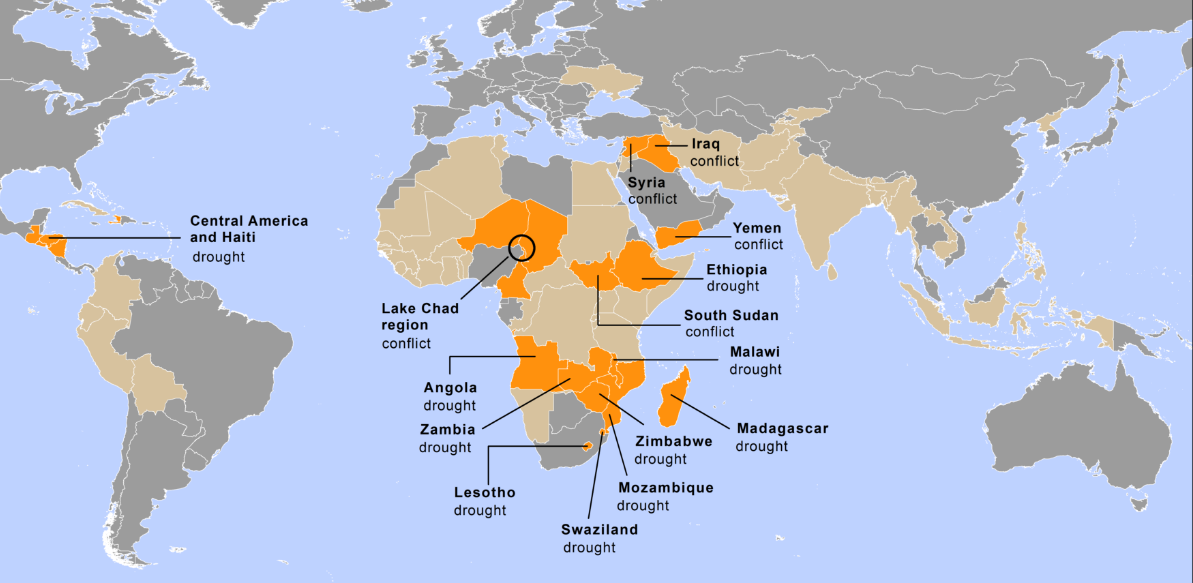
Food Insecurity Hotspots (orange), WFP presence (brown). Source: World Food Programme, March 2016

Many commodity exporting countries relying heavily on oil for government income and spending (e.g. Venezuela, Niger, Iraq, Angola) are suffering major economic problems due to peak production, rising extraction costs and lower market prices. This is true also for countries like Russia, Saudi Arabia, Brazil and Canada. The less diversified a country is the more vulnerable they are to market shocks.
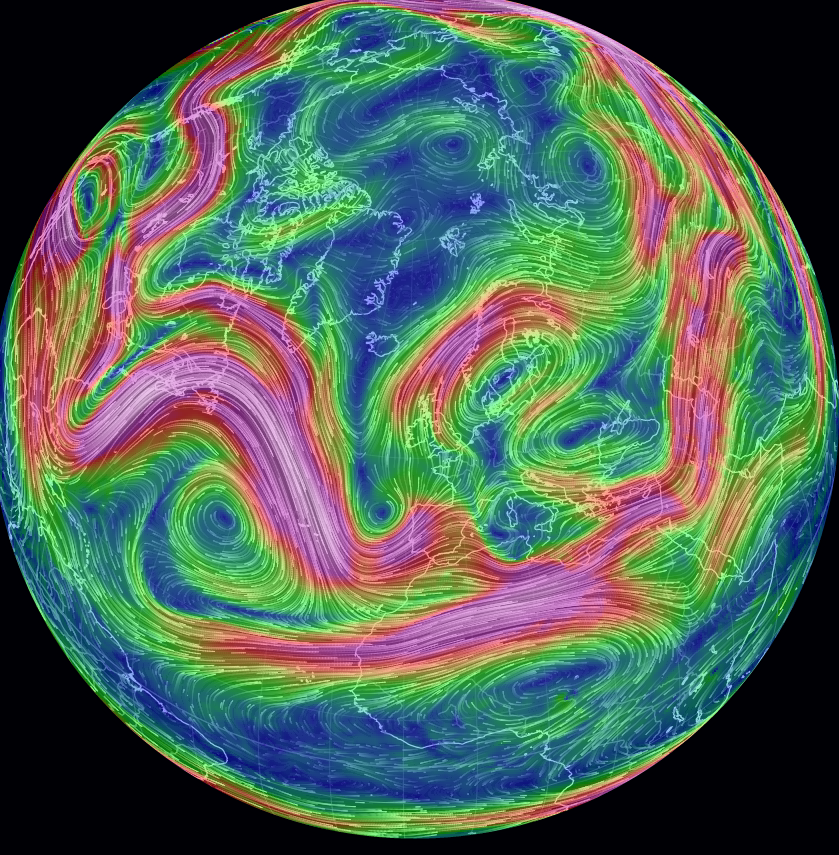
Melting Arctic, Mangled Jet Stream and Massive Forest Fires


Jet streams consists of bands of very strong winds which move weather systems around the globe. These have been relatively stable until recently due to a decrease in temperature gradient between the equator and north pole. Below is a satellite image of a mangled jet stream, using Earth Nullschool, creating blocking patterns that makes weather system seem “stuck”. For example, here in southeast Sweden we are experiencing record warm May temperatures (20-25 C), little rain or wind with a high risk of forest fires.  


Jet stream pattern over Europe, with warm air “stuck” over Scandinavia
.
A similar situation but much worse is occurring in Canada where massive forest fires have driven 88,000 canadians out of their homes in Fort McMurray. These people are now climate refugees and more damage is yet to come as the fire is now moving towards Alberta’s tar sand fields and could double in size due to strong winds and dry conditions. The fire cover an area as large as Hong Kong.


.
Melting Arctic sea ice causes more heat to be absorbed by the darker surface of the ocean, especially in late spring when the sun is really strong. The extra heat is then also transferred into the atmosphere. When this happens the lower layers of the atmosphere warms and expand, pushing up the higher layers and causing the jet stream to bulge. As the sea ice disappears and the atmosphere in the Arctic warms the airflow in the jet stream is more likely to loop and bulge, causing blocking events.

High pressure systems over Greenland can have the effect of blocking polar jet stream flow over part of the North Atlantic […] causing the jet stream to split into branches and bringing about all kinds of severe weather events as a result.according to Dr. Edward Hanna from the University of Sheffield.

Researchers are worried that these type of blocking events of high pressure systems over Greenland can lead to rapid melt of the ice sheet as well as causing extreme weather events over the northern hemisphere.

FrostByte, E Hanna: The Jet Stream and Greenland Warming from Climate and Cryosphere on Vimeo.

Climate-exodus from MENA

Map of the European Migrant Crisis 2015. Credit: Maximilian Dörrbecker (CC BY-SA 2.0)


Researchers from the Max Planck institute have calculated that summer temperatures in the Middle East and North Africa (MENA) could become so hot within the coming 30 years that human habitability is compromised. Hot summer days south of the Mediterranean could see temperatures around 46 °C that, together with all the desert dust and air pollution, could become intolerable and force people to migrate.

More than 500 million people live in MENA, a region that is already experiencing drought problems and conflict over water resources. The number of extremely hot days has doubled since 1970 while population has exploded, leading to overexploitation of groundwater basins. 

In a recent story by Reveal we could read how global leaders are becoming increasingly worried about water shortages. The growing water crisis in the Middle East is thought to have contributed to destabilizing the region, sparking civil unrest and war in Syria and Yemen.

According to a 2009 cable from the U.S. Ambassador in Yemen, “Water shortages have led desperate people to take desperate measures with equally desperate consequences” 

Of course, it doesn't take a genius to figure out that people become desperate when the most vital of resources for survival becomes scarce. The once arid region is turning more and more into a desert, both due groundwater depletion and shifting climatic zones. 

Even if climate change is limited to a global mean temperature increase of 2 °C warming over land will be stronger and extreme temperatures can increase well beyond +2°C. As such, heat waves and water shortages will only worsen over time as carbon emissions rise and unsustainable usage of aquifers continues. 

Climate-exodus expected in the Middle East and North Africa
In the Middle East and North Africa, the average temperature in winter will rise by around 2.5 °C (left) by the middle of the century, and in summer by around 5°C (right) if global greenhouse gas emissions continue to increase according to the business-as-usual scenario (RCP8,5)
The migration flows from the MENA region into Europe and elsewhere will most likely increase in the future as people have no choice but to move from their drying land. 

The Folly of Financial Worship

Humans need clean drinking water, food and energy to survive. These things used to be public goods but we decided, somewhere along the road, to make them private goods. This means that an individual have to make, or inherit, money so she/he can purchase these basic necessities. Those who don’t have money get “weeded out”. This is the human created system that has replaced natural selection. Nowadays it doesn't matter if you are clever, healthy, kind or cooperative as long as you have money. 

Actually money is the wrong term, what a person needs is capital. There are many types of capital but we humans have decided that financial capital is the most important, compared to e.g. social or ecological capital. Again this is because with financial capital we can get other types of capital that we need for our survival and wellbeing. So we accumulate financial capital, as much as we can get, at the cost of degrading other capital bases. We degrade and destroy ecosystems that generate a stable climate, clean water, food and fuel so that over time these resources start to deplete and the cost rises. 

The cost keep rising but the world doesn't pay attention since it’s the most vulnerable that are hit first. It is not until poverty results in death or degradation results in extinction that we start wondering “what is going on?”. We sympathize but feel safe as long as it's happening somewhere else or we have a pile of financial capital to turn to. But what happens if lots of people start deciding that it’s easier to just “move” when rivers dry up, trust breaks down or conflict over remaining resources break out? Syria being a case in point.

Or what happens if the economy takes a beating, perhaps even a sudden crash, that wipes out all your financial capital and/or source of income, what will you do? In some places people can rely on the government, receiving benefits to cover minimum expenses. But what if the crash is so bad that everyone needs benefits at the same time? A healthy government could perhaps manage it. But what if all the government gets in trouble and yours can’t fund the entitlement programs anymore? Now you don’t have a job so you can’t earn money to buy basic goods and the government can’t help you out, you will have to rely on friends and family (community). If that doesn't work perhaps you will move. Greece comes to mind.

The end conclusion is that a growing number of people will have to move as a form of adaptation to rapidly changing socioeconomic or ecological conditions. This, in turn, will create hostility between the “haves” and the “have nots” since there is a limited amount of resources left. The majority are among those who have little since the overall resource pie is shrinking but the minority have more power within the current system since resources are becoming more expensive. This situation will grow worse over time until the majority have had enough. And the a major clash is unavoidable. 

At this point, perhaps, the system that we humans created can be replaced. But some of the social and ecological damage can never be reversed. Whatever happens, we have to be prepared for some very turbulent times.

The Great Barrier Reef in Danger


Satellite image of the Great Barrier Reef.
Photo Credit: NASA | Wikimedia Commons
The Great Barrier Reef stretches 2,300 km down the eastern coast of Australia. Covering an area the size of Italy it is the largest coral reef on the planet. With over 1500 species of fish, 600 coral species and 30 different whale and dolphin species, it is one of the most biodiverse and complex ecosystems on the planet.

Two weeks ago I wrote about the mass bleaching event that had struck the Great Barrier Reef due to extra warm ocean waters. Now the aerial and underwater survey results are in and it makes for some very sad reading. Only 7% of the reef remains unaffected, in other words, 93% of the reef has suffered damage from the bleaching event. 

We’ve never seen anything like this scale of bleaching before. In the northern Great Barrier Reef, it’s like 10 cyclones have come ashore all at once,” says Professor Terry Hughes, convenor of the National Coral Bleaching Taskforce

Map of the Great Barrier Reef showing results of aerial surveys for 911 reefs.
North of Port Douglas, we’re already measuring an average of close to 50% mortality of bleached corals. At some reefs, the final death toll is likely to exceed 90%. When bleaching is this severe it affects almost all coral species, including old, slow-growing corals that once lost will take decades or longer to return.

A recent study reports that the Great Barrier Reef is losing its resilience to withstand bleaching events under climate change. This happens when seawater temperatures rise by as little as 0.5 °C, exposing corals to major stress.


I highly recommend watching the tv series "Great Barrier Reef", with David Attenborough as narrator, and exploring more about the reef  and the filming of the series on www.attenboroughsreef.com 

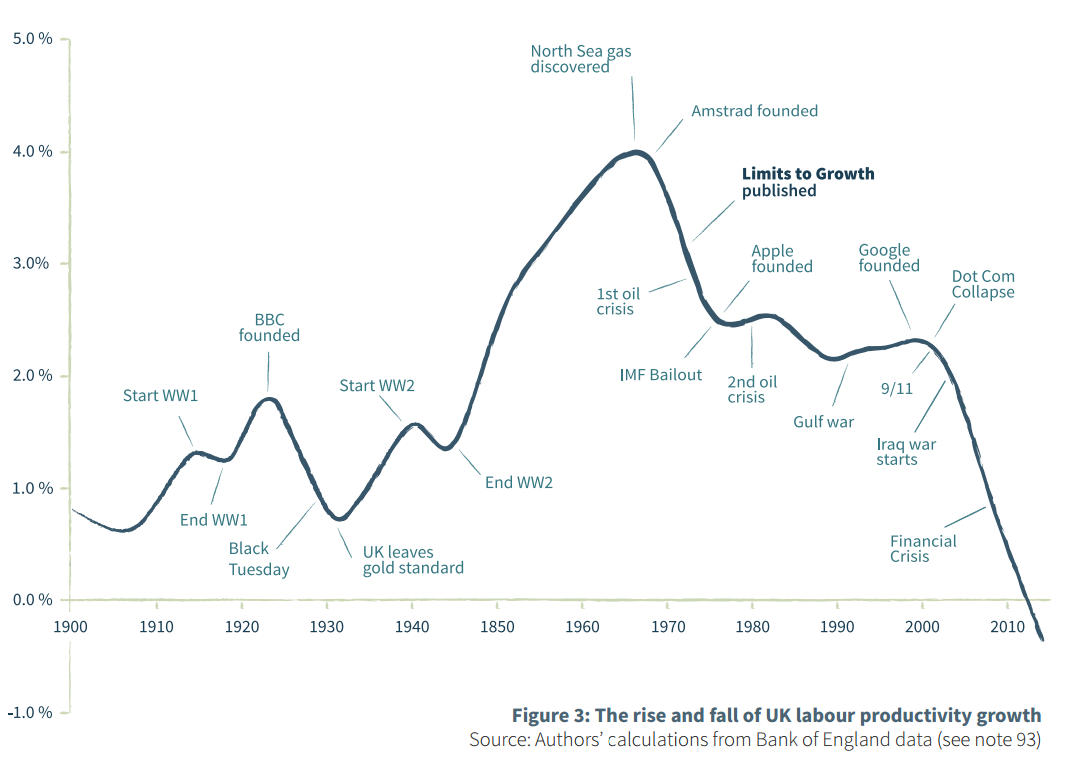
Britain Realises Limits 40 Years Too Late

We don't need more reports

I find it amazing and tragic how organisations and governments keep issuing reports that confirm the dire situation humanity is in with regards to depleting resources, climate change and economic contraction. Latest is a report Limits Revisited: a review of the limits to growth debate commissioned on behalf of British MPs written by Tim Jackson (author of Prosperity without Growth, 2009) that concludes we are headed for “an eventual collapse of production and living standards” in the next few decades, given business-as-usual. 

The report makes for some interesting reading and refers to some very important studies but offers nothing new in terms of scientific insight. It simply restates what previous studies have already confirmed, the global economy is running into resource limits. Going forward we should not expect resource fuelled economic growth but rather contraction.

As for climate change, we are pretty much doomed to failure, for a 66% chance of avoiding 1.5°C warming (the “safe limit”) the world only has 6 years to decarbonise the entire economy. That seems impossible given that fossil fuels cover 80% of global energy consumption and it takes many decades to replace all the current infrastructure.

40 years of inaction

It has been more than 40 years since the Club of Rome presented the Limits to Growth report but absolutely nothing has been done to steer society onto a new “greener” path. Resource depletion and emissions have continued unabated. 

Living sustainably is now impossible and instead we have to focus on bolstering our resilience to coming shocks and disturbances. While I do think we should do everything in our power (e.g. limit the destruction of ecosystems, transition from fossil fuels to renewables, go from global to local economies) to change the way we live on this planet we also have to realise that many so called “solutions” are no longer viable because we waited too long. 

We could have stabilised our population at 3.84 billion in 1972, leaving more space for ecosystems and a larger per capita share of resources for people. We could have replaced much of the infrastructure needed to make a transition to alternative fuel sources by now. But we didn’t do those things. Now, instead, nature is forcing us to live within the planet's limits through the usual mechanisms (e.g. epidemics, starvation, drought). 

The war torn Middle East (e.g. Syria, Iraq, Yemen) is a clear case of overpopulation, depleting resources (freshwater, oil) interacting with climate change (megadrought) and conflict over the remaining resources. These states were fragile to begin with (e.g. high inequality, lack of trust, lack of infrastructure) so even small perturbations were enough to push them over the edge. 

But even countries with a higher degree of resilience from the outset have started crumbling under the pressure of entropy in form of deflation (e.g. Greece, Italy, Japan). The downward trend is global. The collapse process, i.e. reduction in socioeconomic complexity, is already underway.