The probability of dying from chronic illness between 30 and 70 years of age. Credit: NCD Countdown 2030
If you live in the US, China or UK you have a higher risk of dying early from chronic illnesses like cancer, cardiovascular disease, chronic respiratory disease and diabetes than people in Australia, Japan, Spain or Sweden. These are some of the findings in a detailed global analysis of deaths related to non-communicable diseases (NCD). The study is a collaboration between the Imperial College London, World Health Organisation and NCD alliance.
Chronic illnesses are the main cause of premature death for most countries and a larger danger to human health than traditional foes such as bacteria or viruses. Non-communicable diseases kill nearly 41 million people every year, about seven out of ten deaths globally, of which 17 million of these deaths are classed as premature (i.e. before the age of 70).
Overall, women in Spain, South Korea, Japan and Switzerland were least likely to die prematurely from chronic illness while the lowest risk for men were Iceland, Sweden, Norway and Switzerland.
According to the analysis, the situation is stagnating or deteriorating in 15 countries for women and 24 for men. A multitude of factors such as alcohol and tobacco use, pollution, stress and lack of sleep, diets and exercise, early treatment etc could be contributing to increases in chronic illnesses.
In Europe, women in Moldova (17%) and Ukraine (16%) have the highest chance of dying from key NCD and the lowest chance in Spain (6%) and Switzerland (7%). For men i Europe, the highest chance is seen in Russia (37%) and Belarus (35%) and the lowest chance in Iceland (10%) and Switzerland (11%).
The chances for men and women in the US to die prematurely of NCD is worse than in Vietnam, Turkey, Panama, Liberia, Mexico and Angola. In other words, the highest risk among all high-income nations.
A hysteresis window between an environmental condition (heat) and group behavior (degree of infighting) in social spiders as they respond to heat stress. Groups that have been in an agitated state (red) tend to remain agitated, whereas calm groups (blue) tend to remain calm over a common temperature range. Credit: Mesa Schumacher
Complex adaptive systems
We know that there are tipping points in many different complex systems. Although they may be hard to study and exactly define. For example in large systems such as the global economy or climate system. A recent study shows beautifully, in simpler ways, how social animals that lives in communities also have tipping points, before the function of the system changes fundamentally.
In this case the research focused on the communal spider which lay their eggs, spin webs and share their prey in cooperatives colonies, from Massachusetts to Argentina, in relatively cool temperatures. However, only until 31 degrees C, after which they start to attack each other. Suggesting a tipping point where some small perturbation can cause an abrupt and dramatic shift in the behavior of the system.
Reversal is difficult
As ecologists familiar with complex systems all know, once the system crosses the tipping point it will be difficult or perhaps even impossible to return to its previous state even if environmental conditions are reversed. This phenomenon, called hysteresis, implies that a system can have two very different stable states and which state the system is in depends on environmental conditions and its historical dynamics.
Its common that conservation efforts claim that returning to previous environmental conditions in a ecosystem will lead to a recover. However, this is not necessarily true if the system has already crossed a tipping point, in which case you may have to rewind the system to a much earlier set of environmental conditions to drive its recovery. As demonstrated in the studied heat-stressed spiders, turning temperatures down just below 30 degrees C did not alter the behavior of fighting. Not until temperatures dropped down to 28 C degrees did the communal spiders stop fighting again.
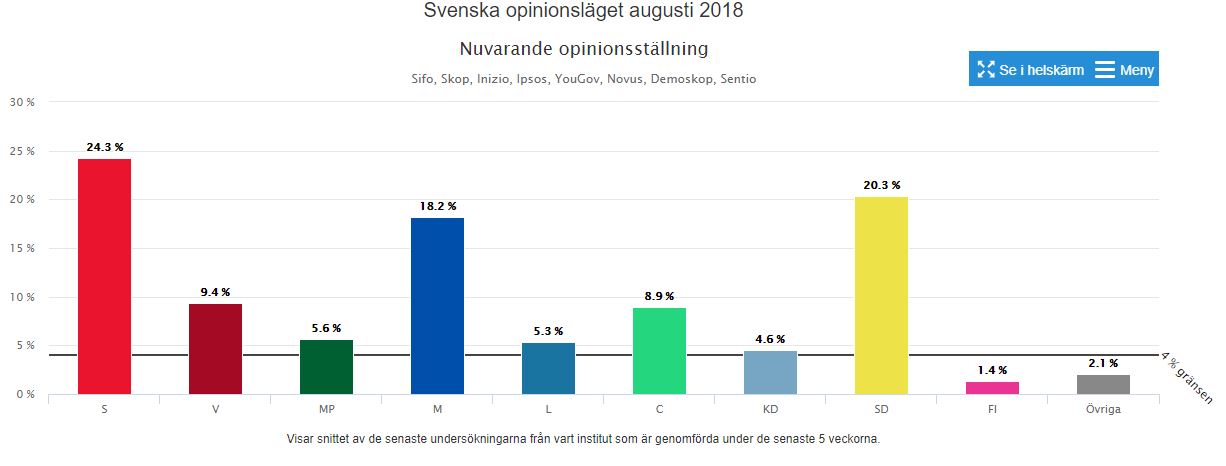
Opinion poll for August 2018. Social Democrats (S), Left party (V), Green party (MP), Moderate party (M), Liberals (L), Centre party (C), Christian party (KD), Sweden democrats (SD), Feministic party (FI), Other (Ö). Source: val.digital
The five most important issues to voters in the 2018 election are: health care (44%), education (26%), immigration (25%), law and order (24%), and environment (23%) according to a poll in the newspaper Daily News (DN, 2018).
That environment/climate change is now one of the five top issues for voters this election is due to the extreme heat, droughts and massive wildfires this summer. The extreme weather this summer hit farmers really hard and exposed the governments lack of quick and effective response to natural catastophies. The heat dome over Scandinavia from May to June this summer has strong connections to climate change and a broken, stuck jet stream.
Such extreme weather (heatwaves, droughts, floods) is now part of the new norm. Something many people thought was years away or naively believed wouldnt happen here in the far north. It has shocked both scientists and ordinary people and made it an important issue for the election.
Some of the better proposals for green investments come from the Green party and the Centre party, tax-switching from labor to polluting/consumption and investing in public transportation. However, adaptation efforts are way behind in Sweden and no party has proposed any solutions for that. Its basically up to each municipality to implement solutions and enhance preparedness. As such, some regions may be better prepared to handle extreme weather than others.
As for how the election turns out we still have to wait and se until 9th of September. An educated guess is that the Sweden democrats will climb to become the second largest party instead of the Moderate party. Similar to what has happened in the rest of Europe, the once maginal extremist nationalistic party becomes popular due to increased dissatisfaction and lack of real change. This is very unfortunate in many ways. Not only because their policies are non-scientific and mostly rubbish but it will also hinder further investments into climate change mitigation and adaptation.
Despite this summers extreme weather bringing the issue of climate change and managing our resources better to the top of the election it may turn out that not much will change or even become worse with a new government where the Sweden democrats have more power.
After a busy year I have finally found some time to write again. I also feel the need to portray the very unusually dry and hot summer that we have had here in Sweden.
I'm sure most readers have already heard about how Sweden have struggled with lots of wildfires this summer. This is due to a heat dome forming over Scandinavia because of a broken and “stuck” jet stream (as explained in the video above) leading to high pressure weather over most parts of the country for two months (May-July) straight with very little or no rainfall. Only 13 mm (0.51 in) of rain from the beginning of May to late July. And temperature soaring to >30C, which in some regions is 20C above the norm. This have also been the case where I live, in the south east, where many are suffering from the prolonged heat and drought.
Many elderly are weakened and suffer heat strokes since buildings are not equipped with cooling air conditioning. Hospitals have had to cancel operations due to the heat and systems overheating. The death toll this summer will be above the norm.
Farmers have had a bad harvest due to lack of precipitation and don't have enough hay to feed their livestock. Many have had to slaughter their cattle. The government has promised 1.2 billion kronor (117 million euros, $137 million) in aid to help farmers hit hard by the drought. But many farmers think it's too little too late to keep them from going bankrupt and it doesn't help against the lack of rain.
Lots of wildfires have been raging in the middle part of the country, forcing people to flee and emergency measure to be put in place. Approximately 20,000 hectares" of forests have burned up. Some counties have banned outdoor fires and put restriction on water use. The government has had to ask other EU countries for help to fight the many wildfires both from above and on the ground. Volunteers have also played a major part in the effort to evacuate and put out fires.
Groundwater levels in smaller lakes in the south east are below average and falling. It will take a lot of rain or snow to recover to normal levels.
Air conditioners, pools and fluid replacements are out of stock in every supermarket. Electricity use is way above normal and nuclear plants might have to be closed down due to the water that's used to cool reactors now being to warm.
Trains have malfunctioned and there has been lots of train cancellations all through the summer.
Many animals suffer as well and people have put out water bowls in their gardens to provide relief.
The only good thing about this summer is that climate change now will be a part of the election campaigns for this fall. The question is, however, if people are willing to pay for the changes that are needed. Redesigning our infrastructure will not be cheap but its a must for the future.
Another great systems theory based book on why nations fail is out. This time its academic, journalist and writer Nafeez Ahmed, who long wrote for the Guardian but now has his own crowdsourced news site (Insurge-intelligence), who has delivered the goods.
In his book, "Failing states, Collapsing systems: Biophysical Triggers of Political Violence", Nafeez presents the essential data on resource depletion, net energy decline, economic stagnation (debt bubble) and ties it nicely together with the acceleration of civil unrest around the globe. It's a big picture analysis of how the triple crises of energy, climate and food production impact societies around the world. A current example, according to Ahmed, of how these multiple stressors interact and can lead to systemic failure is war torn Syria.
Syrian oil production peaked in 1996 while population, and thus consumption, kept increasing. By 2008 the government, who relied on petrol money for maintaining the state budget, had to slash fuel subsidies which tripled the price of petrol and food almost overnight. A huge deal to anyone already spending almost half of their income on food. At the same time as an ongoing drought in the eastern part of Syria devastated harvests and drove people from the countryside into the cities. Yemen experienced a similar fate of depleting resources, peak oil, and the resulting high vulnerability to shocks. Based on these two cases it takes about 15 years for a country that experiences its peak in oil production before additional pressures, such as climate change, contribute to systemic failure.
It's not only the Middle East. Many other countries, for example Mexico, are well on their way of having little to no extra oil to export for keeping their budget in balance or pay for subsidies that people depend on. And the counties who are still able to import some oil or have some mix of energy sources to depend on will be a target of immigrants looking to flee bankrupt and failing nations. Which in turn will fuel the nationalist sentiments and a grab for what's left, military interventions. Something we are already witnessing in Europe and the US.
It’s too late when someone is already gone. That is the lesson one learns when a close relative dies. I have witnessed up close how truly crushing futile optimism can be. The fact that our human brain refuses to accept sad news and tries to cope by counteracting it with hope right up until the end can be a very cruel thing. Not being mentally prepared for the misery to come causes a shock so severe it puts one in a state of almost complete apathy. I am both lucky and cursed that I have experienced plenty of misery, both in my work as a nurse and in my own life, to know how bad things can get and therefore be somewhat mentally prepared for it. Some may call me a pessimist but I prefer the term realist. It´s not that I don’t have hopes, dreams and wishes just like anybody else. I obviously do. It’s simply that I am aware of the human brain's tendency for denial in face of difficult truths, like one’s own mortality. Denial is not only a coping mechanism but also an inherent trait of the human species. Because we are aware of our own and others suffering we realize our own mortality, which is a terrifying thing, that could lead to fear and depression that hinders reproduction and survival. Thus we need to deny death risks and mortality to keep on going, in evolutionary terms. That’s why we are overly optimistic, despite difficult circumstances, because we are wired for it.
Sure, unwarranted optimism (or reality denial) can be a good thing in certain situations, giving people extra strength to carry on despite high odds of failure. But it can also be very detrimental. For example in the case of climate change or species extinction where there is no going back. In these cases blind optimism in high tech solutions or unknown future discoveries etc. is actually dangerous. We have already perturbed the climate system to such a degree that it may change abruptly and shift into another stability domain, a much hotter and hostile one than we humans have never experienced. This is a fact. It’s not a very pleasant one but denying it doesn’t change anything. It only makes things worse, both in terms of not mitigating the worst impacts and being prepared for them. Without, at least, mental preparation people will be shocked, confused and in a panic when devastation hits. They will likely blame other people around them instead of understanding the underlying reasons for why such events happened. Like two rats in a cage getting electrocuted they won't know what to do but fight to the death.
Accepting one’s own mortality and living in a meaningful way to minimize regrets is a better way to deal with unpleasant facts. Accepting, for example, death, climate change and biodiversity loss doesn’t imply we like it. It simply means that we understand it and that we can take constructive action to build a life that is more meaningful and resilient to future shocks and disturbances. We can all find a life of meaning that is also beneficial for society and nature. A farmer knows this. We simply have to have the courage to strive for it. One day it’s truly too late...
.png)




 Posts
Posts

