Complacent adults and brave children

The Roman government kept the populace happy by distributing free food and staging huge spectacles to divert attention from a empire in decline, i.e. to prevent people from revolting. And that's basically the same short-term policies current governments employ to appease the public and distract them from collapse. The public may still voice their grievances but according to history they won't revolt until the bread and circuses stops. A surprisingly effective strategy it seems, even today.

Marx once said that "religion... is the opiate of the masses", meaning that it reduced people's immediate suffering and provided them with pleasant illusions which gave them the strength to carry on. Nowadays, such plesasant illusions are not only provided by religion but also by the entertainment industry, media and medical science in form of legal narcotics.

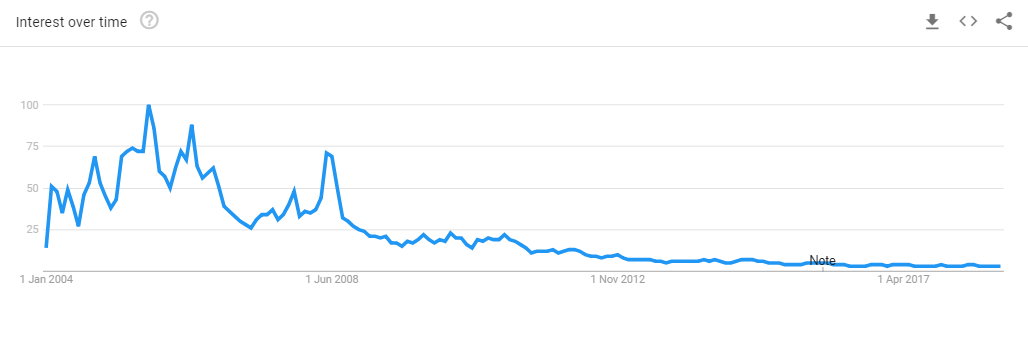
People were more worried about peak oil and accepted the science of climate change some years ago but then denial increased and they got meme fatigue, tired of reading about it. Looking at google trends on the search word peak oil we can see how interest was high from 2004-2009 but then dropped off significantly.
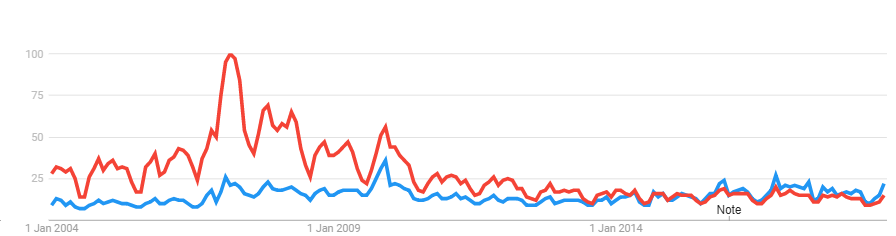
In the case of climate change the interest is more stable over time but when we look at related topics like global warming we see the same tendency of meme fatigue and denial increasing over time. And similar queries with the biggest increase in search frequency, not top search words, relate directly to climate denial and ignorance on the topic. Especially coming from North Americans, which is a reflection of how indoctrinated they are.


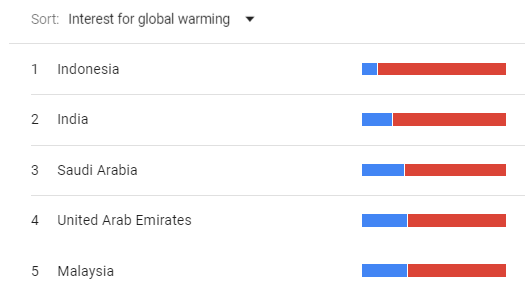
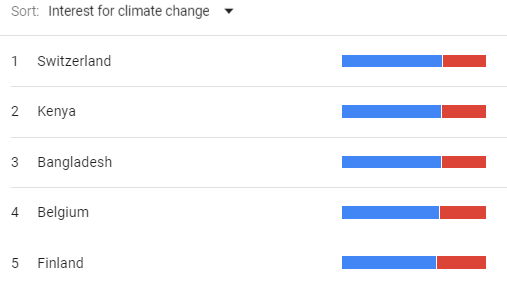
However, while many westerners seem in denial or complacent about climate change the topic seem to be of growing interest in nations like Kenya, Bangladesh, UAE, Saudi Arabia, Indonesia, India and Malaysia. Countries that are already hit hard by a changing climate, for example, 40% of Indias population suffer from acute water scarcity. 


So, my theory is that the “comfy” delusional westerners won't revolt until the bread and circuses stop. Not until costs rise even further, in form of direct taxes or indirect by inflation/deflation, and food subsidies stop coming will people rise up and demand change. Despite the gross inequality in modern societies and falling living standards people stay passive like sacrificial lambs . They are simply too comfortable in the current system. But there is yet hope. The younger generation, that have nothing to lose, may yet drive some change. Lets end with "Gretas cry for help"


Fragile systems under abrupt climate change


We know from our, humanity's, ancient history on this planet that rapid climatic changes ruin agrarian societies. Especially vulnerable are societies that mismanage their resource base and/or live on the margins, for example, in extremely arid regions that are wholly dependent on predictable precipitation patterns. But even societies that manage to survive periods of, say, extreme drought may suffer as they become increasingly fragile to any perturbations to the system.

A changing climate is not bound by any borders and often occur within whole regions or on a global scale. When highly populated areas undergo climatic fluctuations it often cause people to migrate in search of better lands. Which can collapse other, already fragile, societies as the extra pressure from the inflow of people pushes the system over the edge.

This is demonstrated in the German documentary How Climate Made History (2017), above. I highly recommend it and other videos about climate on the youtube channel Hazards and catastrophes. More informative than American or British counterparts.

What can we learn from history? 

Well, first of, Homo Sapiens hunter-gatherers, a generalist species, could adapt easier to extreme environmental conditions than neanderthals which were restricted to specific food sources, methods of hunting, or climates. This ability may have been the result of humans cooperative nature. It had nothing to do with brain size or intelligence.

Second, a relatively stable mild climate and fertile land, with ample and reliable sources of freshwater, plant and animal life, where instrumental to rise of agriculture. People settled and surpluses (food energy) from agriculture could be stored, freeing up time from simply collecting food, and giving rise to specialist occupations. It also gave rise to hierarchies, inequality, as some had more of a surplus than others. Humans also started worshipping the sun (source of energy).

Third, thriving agricultural civilisations were more vulnerable to changes in climatic conditions than nomadic peoples. When the climate changed rapidly and rainfall became unpredictable or rivers dried out people were forced to move in search of new lands to survive. Especially if they managed their lands unsustainably, degraded the land, and were more vulnerable to shocks.

Fourth, in highly populated regions such drastic changes in climatic conditions impacted civilisations both directly and indirectly. High pressure on the land from a large population made societies more susceptible to shocks. As people migrated from poorer lands into other richer areas they tended to destabilise societies that could have survived longer if not for the extra pressure. It also led to unrest and conflict over remaining resources.

Fifth, when civilisations collapsed people spread out to look for resources and knowledge was lost. What we call a dark age occurred.

Implications for modern society

Climate change is occurring rapidly and it is uncertain to what degree we will manage to adapt. We still live in agrarian type societies and are dependent on predictable rainfall, some regions more than others of course. Desertification and water scarcity is a major problem in many parts of the world already. Many societies are extremely fragile to shocks due to overexploitation and land degradation. Crop yields are falling. Seas are rising. Taking for granted that fossil fuels will save us is not a good idea for several reasons. Some societies may succeed better than others in managing their resources but will be vulnerable in other ways, e.g. to climatic changes, financial shocks, trade shocks and/or migration flows. Today there are no new/empty regions to populate once other areas fail. Resources are limited on a global scale.  Tensions over scarcity are rising. Some societies, like Syria, have already collapsed. While others, where most of the remaining resources are located, are having issues with immigration. It will be a very difficult journey for humankind. But as history shows, even if civilisations collapse, humanity survives. We are a tenacious species.

The big meltdown - 2020?

Charles Blomfield's painting of the 1886 eruption of Mount Tarawera based on eyewitness accounts

Are we headed for the next succession of financial destruction? It’s been ten years since the global financial crisis (GFC) of 2008 that almost ruined western industrial civilisation. And while rich people in the west, at least mainstream media, seem to have the impression that we now are “back to business” lots of people around the globe are suffering from the reality of limits to growth that struck at the heart of the global economy in 08. Even if more fortunate people, like Swedes, can go on deluding themselves (for a little while) that there’s no problem with our current perverse growth paradigm there are people who don't have that luxury. Just take a look at most of the countries in the Middle East and you will quickly understand how peak oil, water scarcity, food crises, overpopulation and climate change can trigger endless misery and suffering (read Nafeez Ahmeds excellent book on this).

Contrary to the dominant narrative of “progress” I see major systemic crises converging towards the year 2020, or sooner! Are we reaching a major tipping point or simply another wave of entropy entering the system?


The symptoms of this can be found in the global economy itself with the rate of global growth stagnating (i.e. energy and debt limits) and tensions between countries competing for limited resources increasing. We also see it in the political sphere where maniacs with empathy deficit disorder get into power as a response to people's frustrations and start talking about all kinds of warfare: cultural, economic and military. We already see social unrest, conflict and trade wars but also talk about military wars connected to resources, mainly oil. Most societies are already very vulnerable, lack resilience to withstand further shocks, so a global financial meltdown could escalate fairly rapidly into chaos and destruction. When people lose everything, and they don't know why, they tend to get angry and violent. How will the US act? Will they unwind the empire, all military bases etc., or spend every bit of their last resources to plunder the planet? The place is more like an oligarchy so the über rich might decide they want the last of the oil, not for the people but for themselves. Europe is a basket case and is likely to break down, every nation on their own eventually. If a economic collapse doesn't do it, the flood of climate refugees will.

As for Sweden, we will see our massive housing bubble pop and a deep recession meanwhile people fleeing from the middle east will want to immigrate here. With the nationalist and xenophobic party, the Sweden Democrats, now being the third largest party things could turn out to their advantage as people become poorer and are likely to blame immigration issues. Similar to what we see in the rest of Europe. There is, however, a fairly strong left still in play in Sweden and to my surprise they got 10% of the votes in this year's election. So perhaps there is still some balance left in the political system, but without any major blocs the grownups in the government has yet to come to an agreement about how to rule, so maybe not. While they argue about who get what seat the world is on fire, and so it goes with large bureaucratic structures that become incompetent. And so the likelihood of social unrest increases.

As for the UN climate targets last chance of bending the emissions curve, I'm pretty pessimistic. A global financial meltdown will put all those hopes on hold and even if action did occur its likely too late to stop the climate from going above the 2C target. Moreover, what we need is not “green growth” but actual downsizing which would happen when the economy contracts. If we won't voluntarily give up consumption, mother nature will do it for us. But of course, it won't be what most people hoped for, it likely won't be a civilised and peaceful decent.

Will there be a global financial meltdown soon? Somewhere between 2018-2020? Well, I don’t know, but what's certain is that something has to give since we live on a finite planet where endless growth is impossible. There's no negotiating with nature.

Blowing past 2°C, headed for 4-5°C?


Wishful thinking is today so prevalent that it even has infected the brain of people who are trained not to be biased, scientists. I mean sure, economists have always been blissfully ignorant and wrong in their predictions but what I’m talking about is more widespread. It's a deep denial among the people researching our most critical issues: climate change and energy limitations. 

You see it in the media when scientists discuss oxymorons like “green growth”, or proclaim that we can “decarbonize our entire economy within 20 years”, or that “agriculture will save biodiversity”, or that “lab grown meat will solve our food problems” and so on. It's nothings but grasping at straws in a world that is on fire. Such delusional statements are more about belief systems and identities reflecting values than science. It's also because climate scientists have been told by behavioural psychologists not to scare people as it may hamper action. But isn't it odd that the profession that claims to be devoted to curiosity and truth seeking wants to restrict exploration of future possibilities and censor people due to how it might come across to others?

Our climate reality is harsh. Most scientists tend to underestimate our predicament because they are too conservative, not the other way around. But now it's becoming clear, predictions made by oversimplified climate models have underestimated the changes we're already witnessing due to climate change. Earth, the biosphere, ecosystems and human systems such as the economy are dynamic complex systems and their behaviour is nonlinear. A model that does not include critical feedbacks in the system will not be able to accurately predict results in the real world. This has now become obvious as real world observations about the sad state of our climate is pouring in. Climate change is accelerating.

Sea ice in the Arctic is melting at an alarming rate and looks to be completely gone summertime some time in the coming years (2022?), accelerating global warming further. Ice and snow reflect about 80 percent of the Sun’s energy back into space while the darker ocean and land will absorb 90 percent of that heat. The albedo effect due to vanishing sea ice is already responsible for about 25 percent of global warming (Pistone et al. 2014). Greenland shed about 280 gigatons of ice per year between 2002-2016 and the island’s lower-elevation and coastal areas experienced up to 4 meters of ice mass loss (expressed in equivalent-water-height) over a 14-year period (NASA, 2018). Accelerating rates of ice loss also implies accelerated rates of sea level rise. Certain cities will have to be abandoned. In ten years prior to 2016 the Atlantic Ocean soaked up 50 percent more carbon dioxide than it did the previous decade, speeding up the acidification of the ocean (Woosley et al. 2016). And the list goes on and on with increasingly worrisome observations.

With an increase of carbon emissions of 2% in 2017 (Carbon Brief, 2017), the so called “decoupling” of economic activity from emissions is not yet making a net dent in global emissions. Even if we start reducing emissions now it's not going to be enough to prevent dangerous climate change since there is about a decade lag between emissions and resulting warming (Ricke & Caldeira, 2014). We have already (95% probability) gone past the 2°C warming point/UN target (Raftery et al. 2017), and are  likely headed towards 4-5°C (Steffen et al. 2018). That's because the Earth system is dynamic and is more likely to continue warming until it stabilises at another point, which in the Earth's past occurred at about 4-5°C warmer than pre-industrial levels. By the way, it is generally accepted that a 5 degree rise in temperature is not compatible with human civilisation as we know it. At the same time, perhaps a complete collapse of civilisation could prevent the worst climate change outcomes (Garrett, 2012). But no one is going to promote or talk about that in public. Even if diminishing returns on resources, especially oil, likely will shrink our civilisation in the near future, whether we like it or not (Turner, 2014). 

No one likes either outcomes of this predicament and that's why most experts are basically just arguing over different options of removing carbon from the atmosphere through geoengineering. Using machines to suck out carbon, however, is not feasible both in terms of cost and scale and could cause more harm than good. Current technology would have to be scaled by a factor of 2 million times within 2 years. That's just not going to happen. Biological approaches to carbon capture such as planting trees, restoring soils, holistic grazing, and growing seagrass and kelp appear far more promising. 

Anyway, the real issue for ordinary people is how to adapt to a world that is increasingly hostile while using less energy? Not wasting time listening to myths about "green tech" or believing in fantasies like "colonising Mars" or "geoengineering the entire planet"

Albatross - A sad love story


"Until my gastly tale is told, this hearth within me burns" - Samuel Taylor Coleridge

Midway atoll, located at the middle of the remote North Pacific Ocean, is the farthest you can get from any continent on Earth. There, tens of thousands of Laysan albatross chicks lie dead on the ground, their bodies filled with plastic. Chris Jordan, artist and filmmaker, started visiting this remote place in 2009 and returned again and again over eight years to document the cycles of life and death of these magnificent seabirds.

Its a movie that moves you to tears of sadness and joy over the way the Albatross fights to survive in a world degraded by humans. Most of all, its a beautiful piece of art. Its hard, emotionally, to watch but we cannot turn our eyes away from reality. Can we let ourselves be moved deeply, to take action to transform our socities for a better future, not just for us but also for the sake of other living beings on this planet? I hope so, I sure do.

You can watch the entire movie for free at www.albatrossthefilm.com/watch-albatross

Democracy enough to handle ecological crisis?

Pagoda Japan. Source: WaSZI CCO Creative Commons

How to handle a crisis of overexploitation


Throughout history, agricultural societies have had to struggle with the balance between population growth and maintaining sufficient resources to support themselves. Some failed to manage their resource base sustainably which lead to collapse or disbanding while others took measures to ensure more sustainable use of their lands and persisted. 

In modern times we all assume that democracy is a better option than authoritarian forms of government. Of course no one likes the idea of abuse of power and state violence that usually comes along with such forms of government. But are democracies inherently superior to authoritarian regimes in dealing with crises such as resource depletion? 

To adapt to/or manage scarcity governments may have to do some unpopular things like restricting consumption, manage usage rights of natural resources and punish offenders. Can leaders find support for such policies through elections? Its very much an open question. Small communities have been known to manage pasture lands in a democratic manner more sustainably. But today's societies are huge in comparison. 

Let's look at a historical case in which the Japanese, that had relatively large cities in terms of number even back during feudal times, managed to establish more sustainable forest management through both top-down and bottom-up practices.


Forest Management in Feudal Japan

Ecological crisis


Japan had a serious deforestation problem 300 years ago as a consequence of a growing population and unsustainable forest use. Forests were overexploited by logging mainly for timber and fuelwood. By 1570 Japan's population had reached 10 million people and needs for forest products had increased correspondingly. With the advent of the Tokugawa shogunate and peace, followed by rapid growth of cities and construction of castles, temples and shrines, logging increased during the 1600s to a scale never before experienced in Japan. Conflict between villagers and rulers over the use of forest lands became intense. By 1670 the population had increased to nearly 30 million and all the old growth forest had been completely logged, except for in Hokkaido. The supply of timber and other forest products was running out. Soil erosion, floods, landslides and barren lands were becoming common. Japan was headed for ecological disaster. 


Feudal lords take action


There were three principal types of forest land tenure during the Tokugawa period (1603-1867). Feudal lords tenure, communal tenure and individual tenure. Individual tenure failed to develop because individual land ownership was prohibited in principle by the Tokugawa Shogunate. Therefore, almost all Japanese forest land tenure was either the feudal lords tenure or communal. 

Access to the forest owned by feudal lords was strictly limited and those who logged illegally were severely punished. A typical example of forest owned and managed by a feudal lord was the Kiso area that was owned and managed by a relative of the Shogun.

The two major cities Edo and Osaka and forest management places like Kiso. Source: Iwamoto (2002)


Before the Tokugawa period, Kiso was covered with thick forest but by the late 17th century iso forest resource had deteriorated greatly. The feudal lord therefore carried out the first reform in 1665, instituting seedling protection, strengthening of patrols and selective cutting. The reform reduced timber production by half and cut the feudal lords income severely. Only a few years later the lord ordered an increase in timber production for financial reasons. Even though the reform first failed the second reform was planned in 1724. In this reform, timber production was reduced by more than 60% and this time it succeeded, carrying on for 30 years and thus allowing the forest to recover. 


Common lands


During the Tokugawa period most Japanese people made their living by agriculture, managing uncultivated mountainous common lands surrounding their villages. Common forest lands provided a wide variety of ecosystem services such as timber, fuelwood, fertilizer, feed, clean water, erosion control etc. In the late 17th century, intensive forestry with artificial planting was begun by members (farmers) of the commons in response to increasing demand for wood. People planted valuable conifers such as sugi and hinoki and developing new techniques for planting, thinning and pruning plantations necessary for high-quality timber. Wandering scholars wrote silviculture manuals and traveled around the country spreading the new technology from village to village. Forest management stimulated new social institutions for the ruling elite and villagers to cooperate on timber production in a way that provided villagers incentives to produce timber: yamawari (dividing use rights of common lands among families), nenkiyama (long term leases of forest lands to villagers by the rulers), and buwakibayashi (villagers producing timber on rulers land and sharing the harvest with the elites). Slowly but surely reforesting took place. 

Lessons from history


First of, action on the part of the ruling elite and villagers did not happen until forest resources were severely degraded and conflict arose between the two. New management practices were forced upon the population and breaking the rules meant severe punishment. Reforms sometimes failed due to financial interests and needs. Relying heavily on one sector for the majority of income was a bad strategy. A more diversified income probably helped later reforms to succeed. New forest management practices lead to the development of new social institutions that were more cooperative and respectful of usage rights. During hard times forests may have been overexploited but reforestation efforts during easier times helped prevent the worst of outcomes. The feudal lords were probably not very lenient towards villagers and ordinary people must have, at first, disliked the decision to cut back on timber production and being punished for logging in certain areas. However, they adapted to this new reality and started planting trees to meet the demand. Its a case of non-democratic rule that actually had a positive outcome in terms of more sustainable use of Japan's forests. Now, it should be mentioned that forests were again overexploitation during the second world war. And perhaps the previous reforms only succeeded due to times of peace. It also should be mentioned that after the war forests, both from common and lords lands, where taken up into public lands managed by the state. But it's still an interesting example to ponder. Perhaps a mix of both top-down and bottom-up rules is needed but to achieve successful management but its hard to imagine it happening without some amount of unpopular decision-making if the society is large.