Is there such a thing as natural rights?

Garden of Gods. Credit. John Fowler CC-BY 2.0

Europeans have for the last 30 years lived in their own little bubble of financial scams protected by American hegemony, but that is now imploding by debt deflation and utter disgust with the ruling elite. And while criticising the current neoliberal economic paradigm is one step in the right direction there still seems to be an unwillingness to reflect upon our deeper values, about rights and freedoms, that ultimately led us here.

We live on a finite planet that is now full of people but running low on resources. Our social contracts and economic frameworks developed during a time when the world was less crowded and had plenty of resources. Disregarding biophysical realities is not an option anymore. Therefore one must ask, are those social constructs of ours still valid?

Well, we know that our economic framework certainly is not. There's plenty of evidence to prove that. But how about our ideas about so called “natural” rights?


Social contract theory


The political ideology called liberalism, that we now take for granted, arose from 17th century European ideas about natural rights and social contract theory.

The idea and theory of a social contract gained prominence in Europe when it became one of the leading ways of explaining and delimiting peoples duty of obedience to their government and of their right to resist and overthrow government when it became oppressive. It was an attempt to explore the best form of government and its justifications. What should laws require? When do people have a duty to obey decent government? And when may they justly exercise their right to resist oppressive government?

According to the early formulations of social contract theory citizens may justly exercise their right to resist governments that flagrantly and systematically fails to perform its basic tasks or preserve fundamental rights. And laws are only legitimate when they are generated by the institutions and procedures that are part of the terms of the social contract.

Until the end of the 17th century the social contract was understood in communitarian terms. It was not understood in individualistic terms. The government received its legitimate power in a grant from the community as a whole, not from the the individuals comprising that community. And governments only have legitimate authority when that community consents, through its rightful representatives, to transfer its power to the government. Therefore, the right to resist an oppressive government was only justified by the community as a whole, not individual persons.

But then Thomas Hobbes came along and dropped a bombshell in his famous book Leviathan. He rejected the communitarian aspect of the social contract tradition and claimed that rights belonged to individual persons but that they are at constant war with each other, due to human nature being fundamentally egoistic, and therefore needed to grant power to a strong state that in turn would ensure protection. He believed such a social contract therefore needed to be non-liberal and absolutist-authoritarian.

During the early 19th century the idea of metaphysical natural rights came under attack. Utilitarianist like Bentham rejected the idea that any objective, universal and moral rights possessed by humans in virtue of a common human nature existed. More people agreed with Rousseau's ideas that human nature changed through history. Hume claimed that very few people had actually ever consented to be governed and that it was hard to see how such consent could ever be fairly proved. Furthermore, they argued, that society is much more like an organism which develops without conscious control by its parts than it is like an artificial machine controlled by some outside force. The claim of god given natural rights were believed to have led to bloody wars and revolutions that reigned terror upon Europe and so metaphysical rights and social contract theory were both out of fashion by 1815.

In the Americas, thinkers were slower to reject natural rights and social contract theory than in post-1815 Europe. But by 1861 the idea of natural rights came under scrutiny as it was suspected that the theory had contributed to the South's attempt to secede from the Union and its commitment to states founded on racial slavery. But the doctrine of natural rights continued to be widely popular throughout the period. Many anti-slavery arguments appealed to natural rights. And many pro-slavery arguments did the same, arguing that which legal rights anyone had depended on their natural rights, but slaves were not genuinely human, and so did not have the natural right not to be enslaved!

In Latin America, the idea of natural rights were seen as a obstacle in trying to create a stable government by the 1870s. They rejected the idea in favour for the liberal principles of J.S Mill and Herbert Spencer, as well as those of Auguste Comte´s authoritarian socialism.

The massive and seemingly pointless slaughter of the first world war came to be blamed on the organic theory of the state and society. That blame, along with modernisms distaste for evolutionist models, dethroning Darwin and makine Einstein king of scientific thought, eventually overthrew the organic theory. But utilitarianism continued to predominate in secular moral theory and political thinking, especially after the Great Crash of 1929 when people were sympathetic to socialist and collectivist premises.

But by the 1960s, utilitarianism were overthrown and in the 1970s collectivism was abandoned and replaced by individualism. Natural rights and social contract theory returned to the stage. This was much due to the US unjust war in vietnam killing hundreds of thousands of innocents. People blamed it on deranged utilitarian thought. Unfairly utilitarianism itself was blamed for the US morally corrupt reasoning. And so people turned to Rawls, Nozick and Dworkin's ideas of individual rights trumping collective-utilitarian policies and the Kantian view that governments main duty is to give equal respect to all its citizens.


Modern critique

Given what we know today one must reject the old fashioned ideas of natural rights and social contract that originated from the 17th century and came back to force during the 1960s.

First of all, these ideas came into being in a world that still had plenty of resources and healthy ecosystems to support the population. It was a world were only white men were allowed to take part in discussions, where slavery was rampant, and humans believed themselves to rule over nature.

Our understanding of the world is much better today. We now know that we live in a world that is completely beholden to physical laws such as thermodynamics, conservation of mass, evolution, and diminishing returns of complexity.

We know that there are no such things as objective god given or natural rights, we made them up. We know that people in the past used the claim of natural rights to justify slavery because they didn't want to give up the “free” energy that generated their wealth. Similarly, they didn't recognize that all humans come from a common ancestor and that we are part of the larger animal community. Or that females often chooses the male, not the other way around. Neither did they consider the fact that without healthy ecosystems humans wouldn't survive.

We have to move away from the old reductionist thinking that treats humans and other organisms as isolated parts in a big machinery. We know that the world doesn't work that way. We are part of a whole that interact and feedback on each other. Outcomes are an emergent phenomenon that cannot be derived from studying parts in isolation. Depending on guiding principles, incentive structures, we get different outcomes. Our current incentives tells us to destroy ecosystem for profit so that we can consume even more resources until they run out and we starve. That's simply suicidal.

Moreover, we know that human nature is not just based on selfishness. Humans are capable of both egoistic and altruistic actions but incentives guide them to behave in one way more than the other. It is true in a strict biological sense that humans try to maximize their own and kins net energy in order to survive and thrive but we also know that reciprocity and cooperation has had an evolutionary advantage. By hunting or farming in groups, bigger prey or larger fields can be used to gain a larger energy surplus. Thus being an advantage also to the individual. But a society is much larger than any tribe (say 250 people) and so eventually one cannot rely on personal trust and reciprocity to maintain order. Therefore people invented social constructs like culture and religion to guide human behaviour. Later one, as societies grew ever larger they instituted authorities to oversee that these incentive structures were being followed.

In a full world, there is no room for individual rights over collective outcomes if we wish to avoid mass suffering of both humans and nature. Of course, people will react to this and say “look at all the dictatorships” bla bla etc. But they forget that they will eventually have to kiss their so called “individual rights” goodbye anyway if we continue on the current track. Fossil fuels and other resources are depleting, making us poorer, more unequal and more at risk of death from climate change. Resource limitations often lead to competition, conflict and war. Something we have already started seeing. The neoliberal capitalist ideals born out of the 1960s return to 17th century ideas about natural rights have been an utter failure.

And if we want to talk about rights we must admit that they are made up by humans and can be changed. From an objective perspective, a human has as much right to live as a hedgehog or an oak tree. Either that, or none of us has any rights at all and matters of mass killings or mass extinctions are simply a tragic fate of natural laws.

Abrupt thaw of permafrost lakes in the Arctic


There's an ongoing debate in the scientific community regarding the threshold value, tipping point, for frozen grounds in the Arctic, permafrost, to start thawing irreversibly. And whether released methane from the permafrost will occur gradually over time or more abruptly. There is more stored carbon in frozens soils than we currently have in the atmosphere.

There are basically two camps, some believe the permafrost to be stable with a threshold value around <3°C while others claim 1,5°C is enough to start thawing large parts of the frozen grounds and lakes in the Arctic. 

For a lay person this is quite confusing, but it simply means that there isn't enough data to know for sure and so some scientists are more or less conservative in their estimates. Then there is the question of using climate models to try and predict potential threshold values or doing actual fieldwork and extrapolating conclusions from that. To my knowledge, climate models have a pretty bad track record of capturing highly non-linear dynamics in the climate system. For example, Arctic sea ice passed a tipping point in 2007 and is now in a death spiral but models had predicted sea ice to remain until the end of this century. Pretty high margin of error if you ask me. Also, we are learning that there seems to be differences in how permafrost soils and lakes thaw. 

According to a recent field research study funded by NASA of thermokarst lakes, formed by thaw of permafrost below the soil, in Alaska and Siberia the potential for abrupt thaw (decades) is now likely and irreversible. As the Arctic warms more of these lakes are appearing and growing in size which expands the thaw below. It has been estimated that they now cover about 20% of northern permafrost regions. This could double the release from terrestrial landscapes by the 2050s. A carbon cycle feedback that is not yet included into climate models.

"Within decades you can get very deep thaw-holes, meters to tens of meters of vertical thaw"

This is bad news for climate change mitigation efforts. This feedback is significant because methane is about 30 times more potent than carbon dioxide as a heat-trapping gas. And the lakes are expected to thaw even under the lowest IPCC emissions scenario, adding further warming. Since we most likely are already committed, warming yet to come from current emissions, to 1,5-2°C this extra warming from the permafrost reinforcing feedback could take us above the 2C threshold for potentially catastrophic warming. Unless we rapidly decarbonize our economy and try to take out carbon from the atmosphere by for example large-scale reforestation efforts. Time is not on our side. We need a climate emergency plan.

Converging crises - Synchronizing failure

Climate mayhem, falling net energy and debt deflation

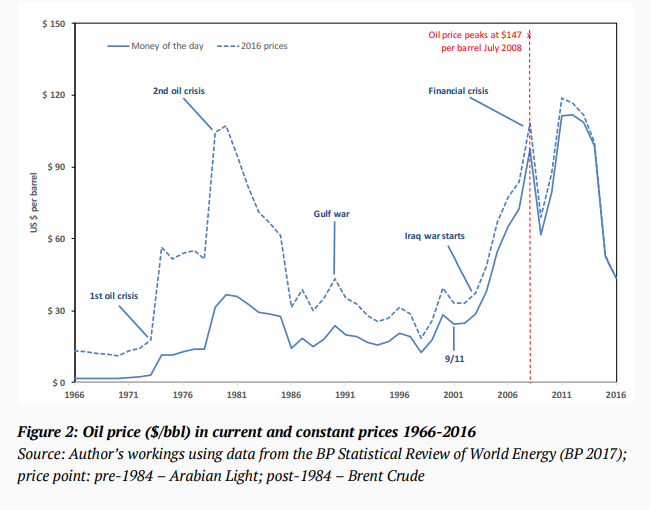
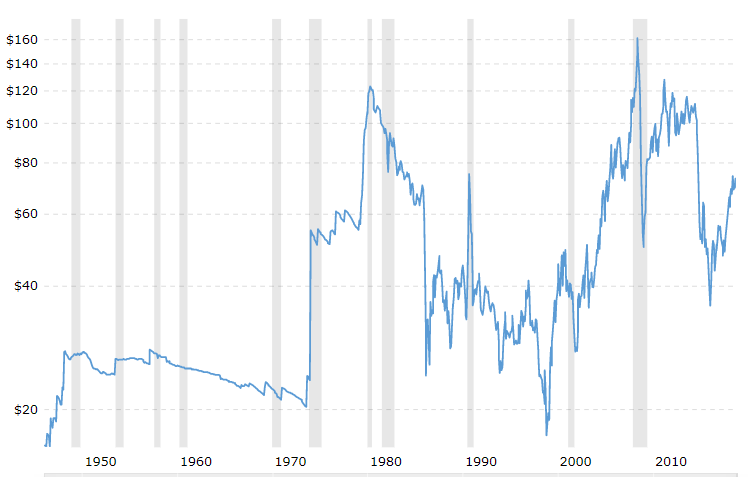
We are in for another global oil supply crunch from 2018 onwards that many experts say will trigger another severe economic recession if not depression. A fragile global economy, with a massive debt overhang, cannot handle too high oil prices. A large portion of most countries budgets, and individuals budgets as well, are spent on fossil fuel energy. That's why rapid price increases (over $60 per barrel) crushes demand and flips the economy over into a recession. In turn, leading to the bankruptcy of non-profitable unconventional energy ventures like tar sands and fracking. Thus further reducing supply over the long term.


Since the early 1970s global energy costs have steadily increased. Even if oil prices have oscillated with recurring spikes and drops, as the economy tries to adjust, the overall trend is a steady increase. This is due to the fact that extraction has become increasingly difficult and costly, yielding ever lower return on investment. The problem of course is that we built our economies based on cheap energy that yielded relatively high net energy to society. But that is a thing of the past and now we are struggling to afford our current lifestyles. Thats basically why we started this massive global debt bubble, pulling forward future consumption with cheap credit. But costs will eventually have to be paid.

We have now reached a point when all the energy and resources available to society are required just to maintain our existing level of complexity. A phenomenon puzzling many commentators, calling it secular stagnation. All these factors have made the global economy so fragile that even small perturbations from climate change, wars or falling credit could tip the system over into a deflationary spiral. With economic inequalities already increasing, increasing social instability, this is a recipe for disaster. 

No economy will be able to recover unless it transitions to non-fossil fuel energy sources and writes down its debts. And even then net energy will likely be much lower, meaning that society still has to lower its overall consumption of energy and resources. Implying a voluntary measure to reduce organizational complexity in society. Something few previous civilisations managed, perhaps the British did when they dismantled their empire. 

Implication for food security


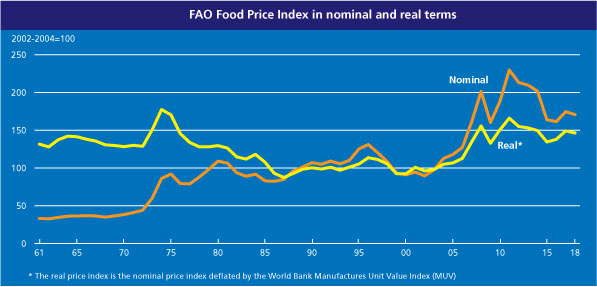
Global food prices have increased steadily since 2005, about the time of global peak oil, now at 1970s highs or above. Further exacerbating the problem is booming populations, freshwater scarcity and climate change. 

Today’s population levels depend on fossil fuels and industrial agriculture. Especially vulnerable to rising food prices are people with low purchasing power and without subsistence farming to fall back on. We know that food price increases that reach 200 on the FAO index have led to riots and unrest.

Many countries in the Middle East are especially vulnerable due to convergence of several different crises. State revenue losses from falling oil exports, due to depleting resources and higher domestic consumption, with a need to cut food and fuel subsidies usually make people very upset. Especially when, as is the case in the region, people have no way of making a living coupled with overexploited water reservoirs and eroded soils. As if that wasn't enough, scorching heat and significant risk of recurrent droughts makes the entire region utterly unsustainable. Without energy they have nothing. The chances for further conflict and wars in the region are high. Massive, continuing, migration flows towards Europe is to be expected. 

The infamous ‘Doomsday Clock’ is again at two and a half minutes to midnight  -  the closest since 1953

Faster than forecast - Melting Arctic


Half a truth is often a great lie. - Benjamin Franklin

Abrupt climate change in the Arctic

Ice covers 10 percent of Earth's surface and helps moderate the planet's temperature. Glaciers, sea ice and ice sheets around the world are melting at an alarming rate. Much faster than climate models had predicted, like what Peter Wadhams, expert on ocean and ice physics, discusses in the video clip above. Climate models fail to interpret the real climate system because they ignore nonlinear dynamics, like key carbon cycle feedbacks and tipping points, crucial to the real system.

The Arctic (North of 60° N) is a key strategic region of global importance. Changes in the Arctic impact Earths energy balance, cloud formations, global wind patterns and ocean currents, release of methane, sea level rise, phytoplankton blooms and much more. As seen in the image below.

Component state variables and dynamic processes operating in the Arctic. There are strong couplings, feedbacks and nonlinear behaviors arising from their interactions, which together define the Arctic system. Source: Arctic System Synthesis, 2018


A recent study published by NASA shows how, since 1958, Arctic sea ice cover has lost about 66% of its thickness, averaged across the region at the end of summer. Old ice has shrunk more than 2 million square kilometres and today 70% of the ice cover consist of ice that forms and melts within a single year. Thinner, weaker seasonal ice is much more vulnerable to weather than thick ice and can easily be broken apart by storms. 

That's very bad news for our planet as darker ocean waters absorb more sunlight and triggers further warming. Melting sea ice has already contributed to about 25% of current warming but could add double that amount when the Arctic ocean starts becomes ice free in summer. That's a very strong reinforcing feedback process that accelerates warming which in turn accelerates further ice loss and so on. While in theory, with some sort of risky geoengineering, it would be possible to reverse this trend I really doubt we can do much to stop it. We can't even stop our greenhouse gas emissions from growing every year. No, its too late for Arctic sea ice, what we see now is a death spiral. 

Warming in the Arctic occurs much faster than at lower latitudes, a process known as Arctic Amplification. Arctic temperatures have increased at least 3 times the rate of mid-latitude temperatures relative to the late 20th century, due to multiple reinforcing feedbacks. Even if global temperature increases are contained to +2° C by 2040, Arctic monthly mean temperatures in fall will increase by +5° C. The Arctic is very likely to be sea ice free during summer before 2040, and probably much sooner than that. Not like the IPCC report says, once in every hundred years.

This will impact mid-latitude, like Europe, weather events by causing the jet stream to slow down and become more meandering which causes more persistent weather patterns as high or low pressure weather systems to get stuck in one place for an extended duration. Like what we saw this summer in Scandinavia with persistent heat wave, drought and forest fires i Sweden.

We have also detected a slowing down of the Atlantic meridional overturning circulation (AMOC) during the past 150 years since the little ice age, and that enhanced freshwater fluxes from the Arctic and Nordic seas weakened Labrador Sea convection and thus the AMOC. Its been suggested that the lack of a subsequent recovery may have resulted from hysteresis (i.e., instability of thermohaline circulation) or from 21st century melting of the Greenland Ice Sheet.

Another recent Nature article  improved a sea surface temperature proxy for AMOC strength. Their proxy AMOC fingerprint consists of a cooling in the subpolar gyre region due to reduced heat transport, and a warming in the Gulf Stream region due to a northward shift of the Gulf Stream, indicating that AMOC has been steadily weakening since around 1950, strengthened shortly during the 1990s and 2000s, then weakened again. In the short term this could cause a small cooling effect in western Europe while warming the ocean waters in the gulf of Mexico, southeast Americas. Not mentioned in the latest IPCC report. 

Last time Earth went through an interglacial period, and global temperatures were less than 1C warmer than today, sea level rose to +6-9 meters and extreme storms were common. Sea level rise has accelerated as ice sheet loss on Greenland and West Antarctica has accelerated. Also not accounted for in the latest IPCC report.

Huge slabs of Arctic permafrost are slumping and disintegrating, sending large amounts of carbon-rich mud and silt into streams and rivers. Permafrost decay is affecting 52,000 square miles in Canada—an expanse the size of Alabama. According to researchers with the Northwest Territories Geological Survey, the permafrost collapse is intensifying. Similar large-scale landscape changes are evident across the Arctic including in Alaska, Siberia and Scandinavia, the researchers wrote in a paper published in the journal Geology. Arctic permafrost caps vast amounts of old, geologic methane (CH4) in subsurface reservoirs. Thawing permafrost opens pathways for this CH4 to migrate to the surface. The concentration of methane in the atmosphere has risen sharply - by about 25 teragrams per year since 2006. Sub sea methane clathrates could also be seeping out. None of these feedbacks are included in IPCC climate models. 

Melting permafrost is altering the landscape in northern Canada on a grand scale. Credit: Wikimedia
In conclusion, putting too much trust in IPCCs climate models and scenarios is NOT recommended. One should not forget that the IPCC is a political institution and subject to political leaders meddling in the science. I have per email questioned the Swedish meteorological institute that use those models and scenarios as a reference for climate change in Sweden. When I questioned the use of IPCC material due to the fact that they don't include nonlinear dynamics I got a very angry response back that I was dead wrong. Really? So its just me and lots of other international climate experts that are worried that IPCC understates risks and uses incomplete information to draw ridiculous conclusions? Like the fact the we are already committed to 1,5C and most people think its impossible to stay below even 2C. Or the fact that all the low carbon scenarios are based on assumptions of carbon sucking technologies that we haven't tested yet. I'm I really the only one that worries about this? No, of course not. Just read the recent report by David Spratt "What lies beneath - The scientific understatement of climate risks" or take a look at the video clips and you will understand why people are worried.


The struggle to survive a collapsing society

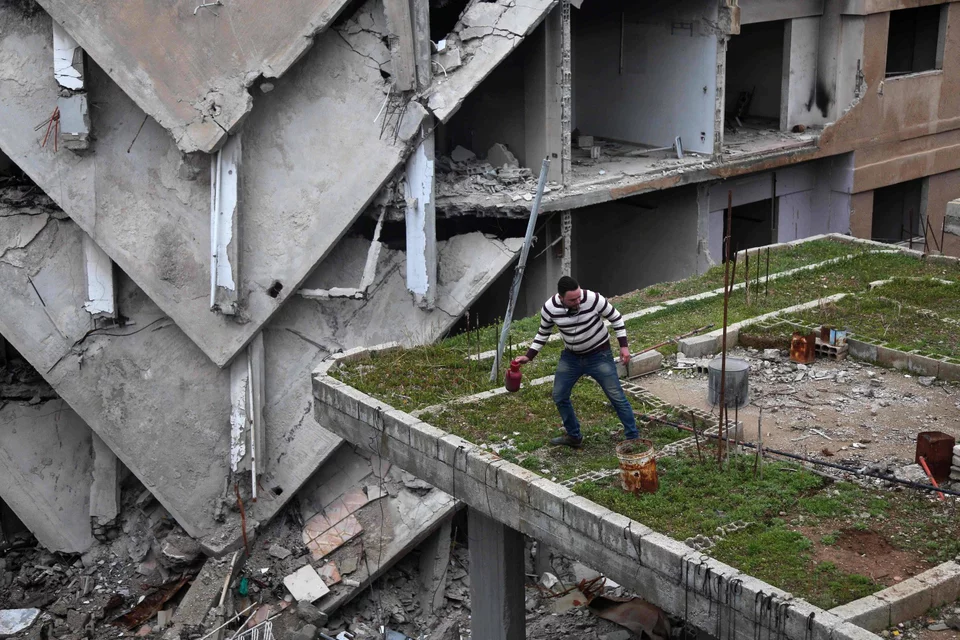
Mohamed Ataya, a 31-year-old Syrian tends to his plants on the rooftop of his damaged building in the Syrian rebel-held town of Arbin, in the eastern Ghouta region on the outskirts of the capital Damascus last week. Ataya, who used to be a professional football player before the war, cultivates seeds for sale. Reddit March, 2017.

The crisis of civilisation


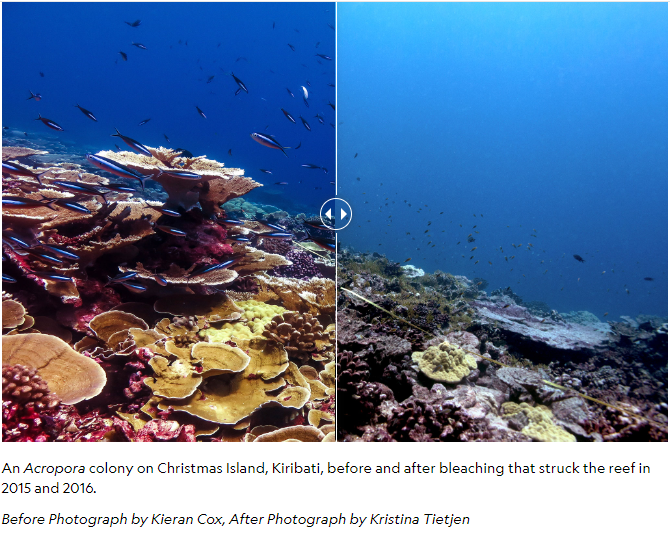
People seem confused, deluded by mainstream media into to wishful thinking, about the current state of affairs in the world. But there is that uneasy feeling that all the alarming reports about peak oil, climate change, desertification, species mass extinction, freshwater scarcity, dying coral reefs, melting of polar ice caps and toxification of our environment are piling up. In fact, we are currently living in a time of a collapsing civilisation, the end to wasteful resource use and reliance on fossil fuels. Everything is becoming increasingly expensive leading to falling standards of living and a majority of the world's population who can barely afford food, shelter or gas for transport anymore. When food becomes too expensive people riot and revolt against the ruling elite. Conflict arises and sometimes it breaks out into wars. Syria being the prime example. For Syrians who are still within the country's borders a total and rapid collapse has long since been underway and is continuing to this day. Look at the man watering his seeds in a city of concrete ruins. Its utterly sad and beautiful at the same time. That is reality. And we will be seeing more of it as entropy starts moving in from the periphery of the global economy towards the centre.


Since it's clear now, almost fifty years after The Limits to Growth (1972) was published, that humans will not take preemptive action to avoid a collapse of the system, the global economy will have to shrink. And the process has been underway for some time now, especially since 2008, it's just that some regions will feel it much harder and sooner than others. Nobody is safe from its crushing effects, that's why building resilience is important for every community on Earth.


People who are well aware of the seriousness of our current situation are suggesting radical ideas because they know there will be mayhem as hundreds of millions of people will be displaced due to a rapidly degrading biosphere and unstable climate.

Why not create a climate passport, actually, give it to all those people who cannot live anymore in their original homes, which gives them access to all the countries who destroyed their home, like the United States” - H.J Schellnhuber (Climate Change: A Last Call for the Planet, 2018)


Well, sure... that probably wont happen but it shows the inequality of the issue and where, to the centre of the global economy, people with the possibility to do so will be fleeing as their own areas are devastated. The world's richest 10% account for half the carbon emissions while the poorest 3.5 billion account for just a tenth. 

Now, climate is not the only issue here, it's just one of the symptoms of a full world. Syria suffered lost state revenue from declining oil exports due to a peak in production, massive population growth, reduced food and fuel subsidies, at the same time as they had the worst drought in 900 years. It's a combination of converging crises that crushes nations that lack resilience. This is only one way that collapse manifests. But it will impact every nation, either direct or indirect, and cause instability and hardship for ordinary people while a small percentage of the rich continue to overexploit remaining resources.

From growth to inequality and collapse


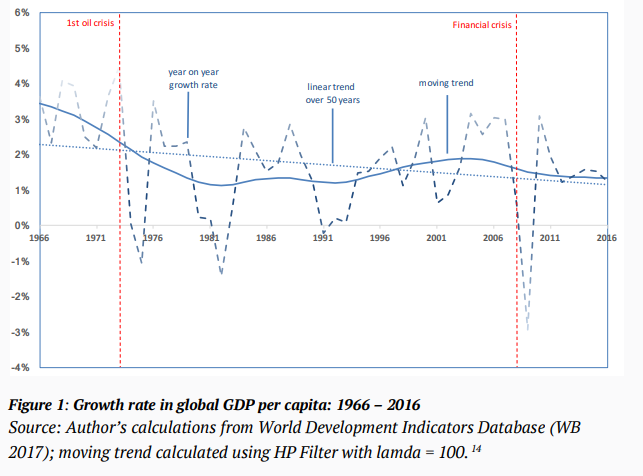
Economic growth as people know it, in terms of GDP, has stagnated and started to turn negative. Most reactions to the absence of growth have consisted in trying to get it back again as fast as possible, whatever the cost, further degrading the biosphere at an accelerated rate. We have seen low interest rates, debt expansion, bank bailouts, government stimulus, land-grabs, tax havens, fiscal austerity, and stock buybacks etc. Most of these things did nothing to increase the wellbeing of ordinary people but greatly profited the richest in society. The massive debt overhang from such policies have now become a burden on the real economy. All it did was to divert people's attention from the inconvenient truth that there will be less material goods and energy flows in the future, not more.

This massive wastefulness of resources comes at a time when we could have used those means to invest in benefitting projects like affordable housing, a basic income, low carbon infrastructure, ecologically sound agriculture, adaptation to climate change etc. Instead we have chosen to let the oceans contain more plastic than fish and species go extinct a thousand times faster than any time in the last 65 million years. The central bank and governments desperate policies after the 2008 financial crisis is the biggest failure in our time. When the next crisis hits, which could be very soon, there will be neither fiscal nor monetary room for manoeuvre.


In his latest paper Tim Jackson show how declining growth in the real economy caused by resource limitations has led to increasing economic inequality. A factor that greatly increases the instability of a society. The rising inequality that has haunted advanced economies over the last decade is a direct consequence of policy decisions trying to promote growth in a dying capitalistic society that cannot be supported by underlying fundamentals. All it has done is to redistribute wealth from the bottom to the top. The growth fetish has hindered ecological investments, reinforced inequality and exacerbated financial instability. The social and ecological prosperity that once was is being undone by this allegiance to growth at all costs. 


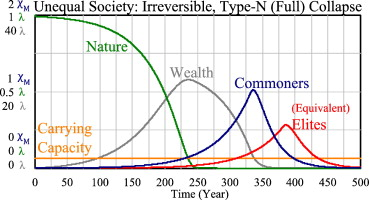
As shown in the HANDY-model (2014), overexploitation of both nature and labour leads to a fast total collapse of society. Economic stratification is a symptom often found in many past collapsed societies and is an outcome of elite overconsumption in a society overshooting its ecological carrying capacity. Such a collapse often lead to inequality-induced famine, due to widespread poverty, that causes the loss of workers rather than a collapse of the ecological base itself. Elites consumption keeps growing until the society collapses.

This is a very ugly possibility. And it shows just how important issues of ecological degradation and inequality are for social stability. The fact that we see widespread resource/economic inequality indicate that we, some societies more than other but talking globally, are far gone in the process towards collapse.

However, in another paper by Jackson, there are post-growth scenarios that dont necessarily lead to increasing inequality. Jackson claims that it depends on three structural features of the economy: elasticity of substitution between labour and capital, the dynamics of the capital-to output ratio, and the behaviour of the savings rate. Under conditions more favourable to wage labour (than capital) measures like a tax on capital and a universal basic income can decrease inequality even as growth decline. However, these measures are insufficient to reduce inequality when institutions aggressively favour capital over labour.