 |
| The Amazon River in Brazil. Source: NASA |
The Bloodstream of the Biosphere
Human pressure on the Earth’s Biosphere is so large that geologists have announced that we live in a new era, the Anthropocene, in which humanity is the largest driving force of global change. The mounting stresses on the biosphere to support 7,3 billion (to become 9 billion) people may cause collapses and major shifts in ecosystems, from local to global scales. The ability to generate social and economic well-being is now threatened. Freshwater is at the centre of this change.
Freshwater
Freshwater is the bloodstream of the terrestrial Biosphere. Greenwater (used by plants) and blue water (rivers and groundwater) are linked across all scales. It is a resource that supports human health, industry and energy generation. Many water systems have undergone ‘regime shifts’ whereby disturbances forces the water ecosystem to flip to an alternative stable state. For example, the Baltic Sea has gone from a low nutrient clear state to a high nutrient murky state due to eutrophication and overfishing. Potential future regime shift, with global implications, include the dieback of the Amazonian rainforest, Arctic ice loss and the Atlantic deep-water formation.
Water for food
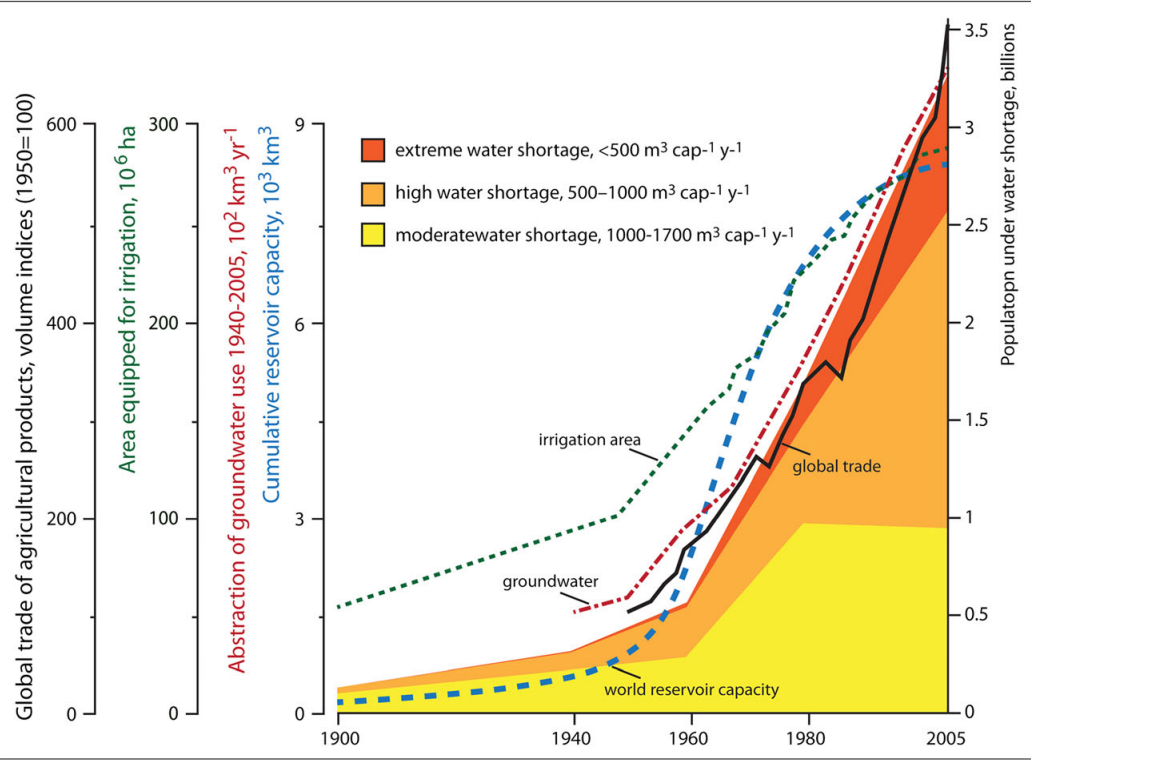
Food production is the world’s largest user of freshwater. In many countries such as Brazil and China diets are changing to include more meat and dairy product which increases food water requirements. Globally, as much as 40% of the grain produced is converted to animal feed. By 2050, currently available water for croplands will not be sufficient for producing enough food for humanity. Agricultural water management is key to lowering freshwater depletion rates and increasing farm productivity. Global consumptive use of blue water has been estimated at 2600 km3 per year. Several regions already suffer from the widespread impacts of the overuse of blue water. River basins with withdrawals exceeding more than 40-60% of available water resources experience severe water scarcity. The number of people living in areas which suffer from blue water scarcity is soaring. In 2005, about 35% of the global population where living in areas with chronic water shortage.
Unsustainable water use
About half of the river water withdrawn for societal use has evaporated, literally consumed during use, and about 25% of the rivers on land are highly affected by overuse of blue water. River depletion is considerable in irrigated regions of the world and many economically important river basins are already surpassing their ecological limits. Blue water security is subject to a high level of vulnerability to change in both Asia and Africa. For example, the Indus and Ganges-Brahmaputra-Meghna basins upon which some 1.5 billion people depend are highly vulnerable to change. Zones of particular concern are north-western India, the north China plain, the Great Plains of the US and the Central Valley in California. At the national scale, 5 countries are withdrawing more groundwater than can be recharged in aquifers, these include: Saudi Arabia, Libya, Egypt, Pakistan and Iran.
Climate Change and rainwater
Until recently, humans have been able to assume that precipitation was relatively stable and predictable. However, new insights now show that this assumption no longer holds. Climate change is a major driving force of a changing water landscape and its projected that a 2 °C increase in average global temperatures will result in an increase of 40% of people living in absolute water scarcity. Floods and droughts will become more prominent and rainfall patterns could change. There are large uncertainties about future rain, monsoon and snow patterns that influence river flows. Glacial melt has been widely observed in the mountain water towers of the world, including the Himalayas, the Andes, the Alps and the Kilimanjaro.
Worst drought in a century
Last couple of years (2012-2014) California has experienced severe drought conditions. However, the worst effects won’t be felt until this year when the conditions continue due to lack of precipitation and record heat. This winter has been the
warmest on record in California, resulting in less snow and rain. The overall trend toward drought persistence has continued, depleting already low snowpacks and reducing spring runoff for much of the region. The lack of snow raises concerns for this years spring and summer water supplies.
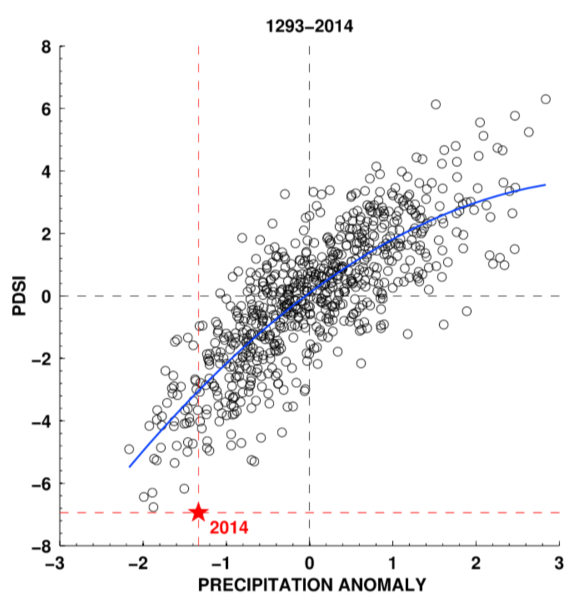
California's record warm winter comes after the warmest year on record globally, 2014. The 2012-2014 Californian drought has already been claimed to be the
worst drought in 1200 years, according to a new
study.
Last week governor Jerry Brown declared
restrictions for water use for the first time in California history. Over 400 local water plants are now forced to reduce water consumption by 25% compared to 2013 levels. Other restrictions include: a ban on garden irrigation other than drip irrigation, limits on golf course and churchyard irrigation, detailed water use reporting by farmers etc.
Previously, groundwater was only used as reserves but now they are pumping like crazy. Some regions have reported collapsing soil and salt intrusion, both a sign of
overpumping. Despite the very serious water scarcity, California is
the only state in Western US that have no limits on private pumping or consumption of groundwater.
Farmers can buy water rights from one another and they can pump as much groundwater as they like. As a result, the state's groundwater has been depleted considerably. Gov. Brown recently signed a restricting groundwater use law but it will take years to implement and it doesn't require groundwater basins being run sustainably until 2040. Too little too late, in my opinion.
Colorado river groundwater is also disappearing at a stunning rate. Streamflow from the river is the
most overallocated in the world. Demand for this renewable resource is now outstripping supply, according to a
2014 study. Between December 2004 and November 2013, more than 75% of the water lost in the Colorado River Basin was from groundwater. The region has been experiencing drought conditions for the last ten years according
NOAA.
Because of the long duration of these drought conditions, all kinds of people are becoming interested in expert opinion on climate-related topics. Unfortunately so far it seams like most are
only interested in whom to blame. Hopefully Californians and the rest of Americans will start realising that climate change is already happening, and effecting them personally. Maybe then negotiations on climate change will take a turn for the better, but it has to happen before December 2015.
Heat-producing microbes in Greenland permafrost soil
Permafrost is soil at or below the freezing point of water 0 °C that stays frozen for two or more years. Permafrost comprises 24% of the land surface in the Northern Hemisphere and can be found at Arctic ocean shelves and floor. It contains large quantities of trapped greenhouse gases such as methane and carbon dioxide, and is usually regarded as a carbon sink. Researchers have become increasingly worried that with climate change large permafrost areas could start to thaw and ultimately melt, releasing massive amounts of carbon that would exacerbate global warming.
A small team of scientists working in Greenland have now found evidence that as microbes become active in permafrost, they produce heat, which can increase the rate of permafrost melt. In their paper published in
Nature Climate Change, Hollesen et al. (2015) describes computer simulations that showed possible impacts of microbe activation in permafrost areas. Previous attempts at predictions for permafrost melt through modeling are now looking like they will have to be revised.
Suspecting that microbes in the soil might have an impact on warming permafrost, Hollesen et al. collected 21 samples of permafrost soil from six locations across Greenland. They then exposed the samples to different temperatures in a laboratory. By monitoring the heat production from microbes they were able to gather enough information to create a computer simulation. That simulation revealed that as global temperatures rise, a feedback loop occurs in permafrost areas. Heat causes melting which stimulates the microbes that start decomposing organic material, and producing heat, which adds to the increased temperatures, on and on until the permafrost melts, releasing massive amounts of carbon into the atmosphere far earlier than previous models have predicted.
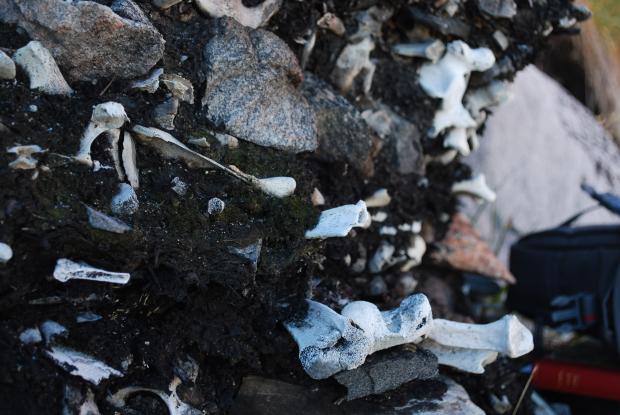
One immediate consequence of thawing permafrost in Greenland is the potential for destruction of unexcavated archeological findings. The National Museums of Denmark and Greenland have now started several
projects where decomposing wooden artifacts and bones from the first people on Greenland will help identify areas most threatened. This is mainly happening because the average temperature has risen by 2-3°C in Greenland. Thawing of protective permafrost leads to archaeological material rotting because the amount of oxygen rises and the decomposition process accelerate. Other concerns are related to coastal erosion, resettlement and infrastructure damage.
More long-term consequences of permafrost thaw is of course increasing greenhouse gas concentration in the atmosphere, and in turn a warmer climate.
Previous estimates have pointed to 120 ± 85 Gigatonne of carbon emissions from thawing permafrost by 2100, which could increase global temperatures by 0.29 ± 0.21 °C. However, we now know that permafrost starts to thaw much earlier than expected, so we need to start including this knowledge into climate models or we risk overshooting the 2°C warming limit. For example, the most recent knowledge on permafrost/carbon feedbacks are not included into IPCC climate projections.
Changes in Atlantic Ocean circulation worries scientists
The risk of abrupt and/or irreversible climate change is determined by a crossing of tipping elements in the Earth system. One such tipping element is the North-South ocean current circulation in the Atlantic Ocean, also known as the Gulf Stream system. The Gulf Stream system is one of Earth’s most important heat transport systems, pumping warm water northwards and cold water southwards. It is responsible for the mild climate in northwestern Europe and the most important source of heat transport to Scandinavia.
A potential abrupt change, or slowing down of the Gulf Stream circulation could lead to a weakening of heat transportation towards the Arctic which in turn would result in a cooling effect of high northern latitudes (including Scandinavia).
Scientists at Potsdam University have now found
evidence for a slowdown of the Gulf Stream (published in Nature). Multiple lines of observation suggest that in recent decades the current system has been weaker than ever before in the last 1000 years. The gradual but accelerating melting of the Greenland ice-sheet, caused by man-made global warming, is a possible major contributor to the slowdown.
|
|
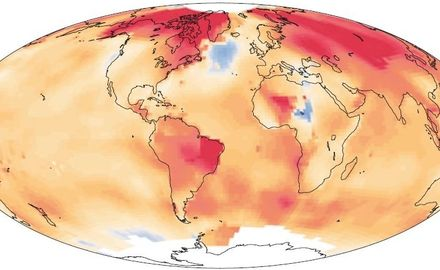
The blue cooling spot south of Greenland: NASA GISS warming map 1901-2013.
Source: PIK-Potsdam
|
“Now freshwater coming off the melting Greenland ice sheet is likely disturbing the circulation”, says
Jason Box of the Geological Survey of Denmark and Greenland. The melting glaciers are diluting the North Atlantic ocean salty water. Less salty water is less dense and doesn’t sink to the ocean deep as easy.
The observed cooling in the North Atlantic, just south of Greenland, is stronger than what most climate models have predicted so far. One reason for this is that most computer simulations underestimate the stability of the Gulf Stream or don’t account properly for the Greenland ice sheet melt. This is yet another example where observations suggest that climate models are too conservative when it comes to the pace at which certain aspects of climate change are proceeding.
A slowing down of the Gulf Stream will not lead to a new ice age but it could have major negative effects on ocean ecosystems and thereby fisheries and coastal livelihoods. A slowdown also adds to the regional sea-level rise affecting cities like New York and Boston. Further weakening of the current could also result in temperature changes in the northern latitudes, influencing weather systems on both sides of the Atlantic, in North America as well as Europe.
Central bank folly continues
It's been six years since the 08 financial crash that almost wrecked the world economy. Governments claim that the crisis is since long over but central bankers are still pulling on all levers, now governing market behaviour, in trying to reach their inflation targets. But unemployment is still at all time highs in Europe and sanctions aimed at Russia have also hurt many European businesses. Over-indebtedness is the problem but central banks believe that the solution is to borrow more, not less. They have tried this method for several years now, Japan for the last 20 years, and the only thing that has happened is that economic inequality has risen dramatically. Thats what happens when you have a zero sum game i.e. running out of cheap resources to produce a surplus. In this case savers are punished and debtors are rewarded. So people with pensions are the first to lose, and banks/people with massive loans the first to gain.
This week the Swedish central bank (Riksbanken) announced negative interest rates of -0.25%, in the belief that "doing more of the same will yield a different result". This comes after the European Central Bank (ECB) announced its new quantitative easing (QE) program on January 22nd. Since then, only three months ago, we now see a massive formation of bubbles with warning signals showing up in European Equities and Global Fixed Income. At least according to the March report from the
Financial Crisis Observatory. 56% of all the European Stoxx Equities Sector Indices gives clear warning signals, a month ago that was 0%. The market is overvalued and turned red almost in an instant. However, it is very difficult to anticipate market movements in these global markets that are guided by central banks' over the top measures. It is not free market capitalism any longer, but rather, central bank folly that governs the market.
The US dollar strengthening is global and warning signals can be seen in many currency pairings, for example FX US dollar/Swedish krona. While the Euro and the Russian Rouble has continued momentum downwards. Energy, softs and metals, show negative (undervalued) bubble signs which probably imply weak global demand. The massive increase in warning signals in European Fixed Income is largely due to the size, purchasing 220% of the total net issuance over 1 year, of the ECBs QE announcement. After a 15% rise in 2 months, 56% of all European sector indices show clear bubble signals. This is important to note, especially since the implied Vol, risk perception index, has dropped instead of risen. In the case of Sweden it has now become even cheaper to borrow money, which will fuel the housing bubble and probably end in tears at some point in the not to distant future. Similarly to what happened in the early 90s.
The beginning of the end for endless growth
In a new book called
The Great Transition (2014) Mauro Bonaiuti tackles several themes of interest to those who study the interplay of resource depletion, pollution, and economic growth. Among others the effects of overpopulation, decline in EROEI, environmental degradation and more. The book also contains a discussion on how society could organize itself in a post-growth world.
As the global economy is once again on the verge of collapse, some see room for positive changes. While global crises are accelerating - climate change, energy instability, biodiversity loss and economic instability - a number of interconnected systemic revolutions are converging in a way that could facilitate positive transformation of the global economy according to Bonaiuti. From a economy that maximizes material consumption for the few, to a economy that caters for the needs and well being of all.
Bonaiuti argues that our current economic crisis is a symptom of a transition phase of civilization. Advanced capitalist societies have entered a phase of declining returns since the period after the Second World War. There has been a fluctuating but consistent long decline in GDP growth rate. Declining returns are to Bonaiuti a consequence of the interaction between limits of biophysical nature (peak resources, global warming etc.) and the increasing complexity of social structures (bureaucratisation, education and social security etc.).
As a result civilization is undergoing a huge phase shift as the current form of predatory capitalism crumbles beneath the weight of its own mounting unsustainability (debt burden). But this crisis also opens up for new opportunities and a range of scenarios for new forms of society. There is thus space for a great transition towards new institutional forms that could include greater democratic self-government of communities and their territories. And we can see how people are asking for this in Europe.
However, this process is also very disruptive. We cannot know how things will turn out and that is scary when we face major change. Some will strive to “return to the old society” as we see in nationalist tendencies in Europe, while others will want to “break free” from global capitalism and return to self-governance as we see in Spain and Scottland. Others will try to keep the old system intact for as long as possible. All we know is that when the framework changes, complexity science teaches us, that there will be other forms of economic and social organization more suited to the new situation. Crisis may enhance cooperation among decentralized, smaller scale economic organisation and offer greater chances of success as conditions change.
If Bonauiti is correct, then even as conventional economic tools turns out to be increasingly ineffective, we could expect to see more signs of a changing framework and with it the emergence of potential new forms of economic and social organization that function better than the old industrial paradigm. However, this is not to say it will be easy or that there won’t be winners and losers. It is the most adaptive to change that will win in the end, or so evolution teaches us.
Welcome to 2015, a year of transformation.
.png)






 Posts
Posts

