2017 - When bad turns worse

Sweeping the pengő inflation banknotes after the introduction of the forint in August 1946. Source: Mizerák István (CC-BY-SA 3.0)
I must say that I'm amazed over the fact that the international monetary system is still intact. It's now eight years since the global financial crisis first broke out. Irresponsible lax monetary policy in the belief of a "perpetual money machine", i.e lowering interest rates and expanding monetary supply, has lead to several bubbles and bursts. A process that started in the 1980s when industrial economies stopped generating GDP growth from productivity increases. And eight years is about the interval between every bubble bursting since then. 2017 could be the year when people finally lose faith in the system.

Of course there's a much deeper story to all this. The massive debt explosion that started in the 1980s has to do with diminishing returns on resource extraction. As real GDP growth slowed down, and wages stagnated, the cost of basic goods and living increased. People and governments started taking on huge loans to cover their continued consumption. An act of postponing the harsh consequences of going broke into the future, on to the next generation, while enjoying the present. By now we all know that most nations, and its peoples, are basically bankrupt since global GDP growth has come to a standstill while debts, not even including liabilities, have increased and are now impossible to pay back.

Instead of dealing with the real underlying issue, most nations have decided to double down on a failing policy of ever lower interest rates that keeps inflating markets and creating massive bubbles in stocks, bonds and housing. Sweden is a prime example of a country that never deleveraged during the last crisis and thus runs a much higher risk of having to face a major financial crisis soon. It doesn't take a genius to figure out that with its negative interest rates and  massive housing bubble Swedes are living way beyond their means. A small 40 m2 flat in central Stockholm cost at least 2-3 million SEK which makes it the third most overvalued housing market in the world, after Vancouver and London.
  
Mainstream media is still mostly blind to all this, claiming rising prosperity and a bright future ahead. And the few people who do stick their neck out are ridiculed based on silly arguments like "if it's a bubble why hasn't it popped yet?" as if that proves anything but faulty linear thinking of complex systems. It takes time for instabilities to build up. At a certain point, incremental change is suddenly replaced by abrupt change that can collapse the entire system. This is well-known within systems theory. To bad most economist never even study this and thus understands nothing about how the financial system or economy actually works as a whole.

Who knows how long this pretend and extend game can go on for, but one thing is certain, people are starting to lose faith in the system. We see that clearly in the political arena and spread of alternative media. We also see it in the rise of ever more elaborate conspiracy theories. The status quo is breaking down.

Unfortunately there are plenty of madmen and privileged people who are ready to use the resulting polarisation and confusion for their own benefit. The "let's blame immigrants" card is already in full swing. Cutting funding for climate change research is another type of witch hunt that's not happening only in the US, for example, the Sweden Democrats want to do something similar here claiming the meteorological authority's scenarios, which are based on IPCC's research,  are too alarmist. For us who study the topic of climate change this statement is laughable as it's more like the other way around, most projections underestimate the risks. Also, the increasing flow of refugees are partly a consequence of depleting resources and climate change. Perhaps politicians fear a loss of voters if the public understood that fact properly.

Anyway, 2017 looks to me as a year of high risk of political turmoil, social unrest, and financial calamity. Drawing most attention away from the underlying issues: resource depletion, biodiversity loss, climate change and overpopulation.

Thank Ice Ages for Lakes

Map of the world's lakes with surface areas of 10 hectares or more. Dark blue areas reflect the high concentration of lakes in those regions. Credit: HydroLAB, McGill University

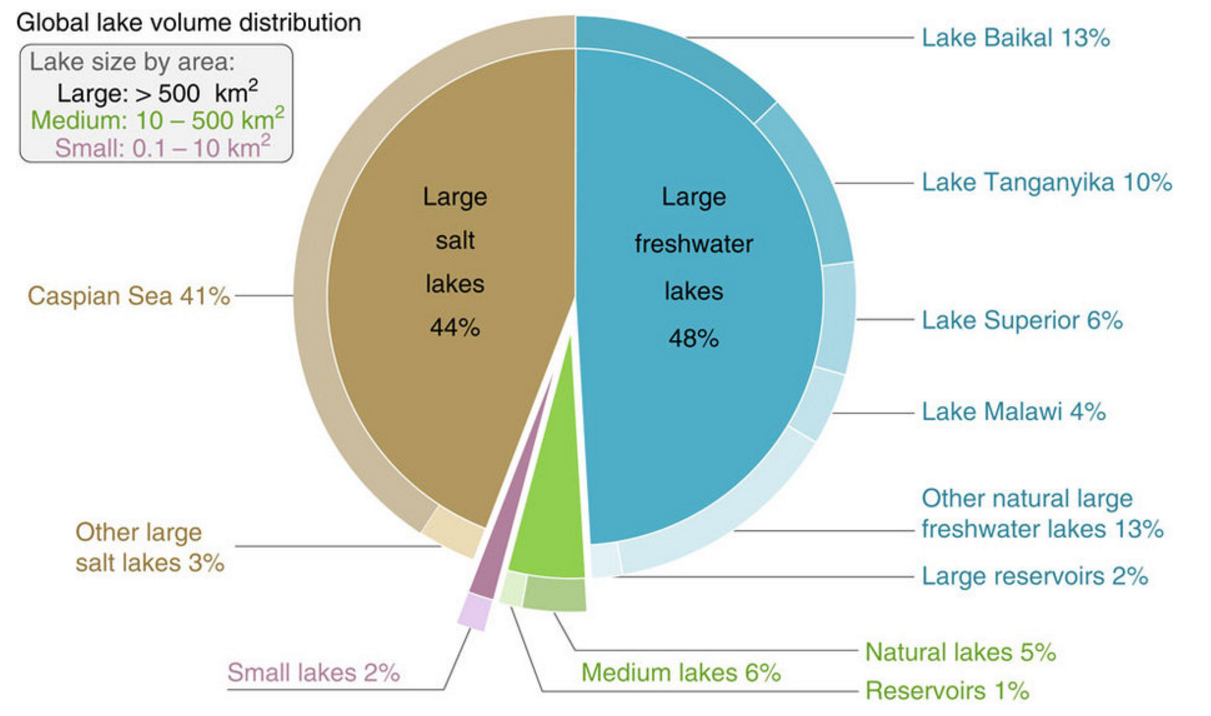
New research from the McGill University, published in Nature Communications, maps the distribution of our planet's lakes. It clearly shows how the last ice age shaped and formed many of the 1.4 million lakes, larger than 10 hectares, that contain 15% of all the lake water in the world. Dark blue color indicates density of lakes, and as the map shows the highest density can be found in the northern hemisphere, in regions previously covered in large ice sheets. The rest of the worlds lake water, 85%, can be found in the 10 largest lakes. About half of the lakes are freshwater and the other half are salt lakes.


Global distribution of water volume stored in lakes and reservoirs with a surface area of at least 10 ha. Source: Messager et al. (2016)

If we look at individual countries (table below) we find that Canada, Russia, USA, China, Sweden, Brazil and Norway rank in the top in regards to number of lakes and area (km2). While Russia stands out with the largest volume (103 km3) due to its many deep water lakes (e.g. lake baikal and lake vostok). Thinking in terms of drinking water, volume would probably be the most important parameter. But then again, distribution, pollution and many other factors come into play when determining access to safe drinking water.

Countries with most lakes
Country
Number of lakes (103)
Area (103 km2)
Volume (103 km3)
Canada
879.8
856.5
12.6
Russia
201.2
667.4
102.2
USA
102.5
340.3
23.5
China
23.8
81.0
1.0
Sweden
22.6
34.3
0.5
Brazil
20.9
31.4
0.2
Norway
20.0
13.9
0.3

The study only focuses on mapping out lakes it doesn’t say anything about what state these lakes are in etc. What we can tell is that the distribution of lakes is very uneven, very few along the equator and plenty in the north. Since water is such a critical resource and we’re already witnessing extreme heatwaves and extended droughts along the equator (e.g. southwestern US, Middle East) people are already realising that agriculture has to shift further north to survive, as do they.

Death of the American Empire: A dangerous time for peace

Two destroyed tanks in front of a mosque in Azaz, Syria. Credit: Christiaan Triebert (CC-BY-2.0)

History is full of empires which in the process of their decline refused to go down peacefully. How will the American Empire end it’s days?

I hope no one is stupid enough to launch World War III. However, many states are fragile now (due to for example: overpopulation, environmental degradation, resource scarcity, bankruptcy, inequality and corruption) so very little is required in terms of external force to trigger conflict. This is clear in the context of the Middle East. Already fragile states, for example Yemen and Syria, turned into complete war zones after civil unrest and aggressive foreign military involvement. Now there are millions of refugees trying to escape the region and people wonder why.

There is a risk that hugely over-armed United States, constantly spreading war propaganda, turn a trivial incident into a major conflict or war. Especially if the domestic population really believe that “America is exceptional” as president Obama declared at the UN General Assembly in 2013, where he listed Russia, ISIS and Ebola as major threats to national security. In 2015, Obama also added Venezuela to that list of threats. Talk about crazy. Of course we all know there is oil in the Middle East, in Russia and Venezuela. Coincidence? 

According to historian and author William Blum, since the end of World War II, the United States has:
- Attempted to overthrow more than 50 foreign governments
- Attempted to assassinate more than 50 foreign leaders
- Attempted to suppress populist or nationalist movements in 20 countries
- Dropped bombs on peoples of more than 30 countries
- Grossly interfered in democratic elections in at least 30 countries
- And have been more involved in the practice of torture than any other country in the world

Even if these numbers are incorrect its no secret that the rest of the world view the United States as the major threat to peace. While war mongering people in Washington utter crazy statements like “Assad must go even if Syria goes with him” - State Department spokesperson Mark Toner. Since the 80s, the US has intervened in the affairs of fourteen Muslim countries, including: Iran, Libya, Lebanon, Kuwait, Iraq, Somalia, Bosnia, Saudi Arabia, Afghanistan, Sudan, Kosovo, Yemen, Pakistan and now Syria. So, I can kind of understand if there are some pissed off muslims. 

Not only has the US threatened Russia but also China by surrounding it with military forces. In a report on US-China relations published by the Council on Foreign Relations in 2015 it is stated that “there is no real prospect of building fundamental trust, peaceful coexistence,’ ‘mutual understanding,’ a strategic partnership, or a ‘new type of major country relations’ between the United States and China.” And thus, the report declares that, the US must develop “the political will” and military capabilities “to deal with China to protect vital U.S. interests.” What interests? South China sea oil? Global dominance? 

I hope the US runs smack into hard physical limits that cannot be solved by borrowing or printing money, finally forcing them to cut military spending or totally bankrupt the population to the point of domestic revolution. I'm sorry my american friends but your “leaders” are not just nuts they also have way too much destructive power at their disposal. 

“Interventions are not against dictators but against those who try to distribute: not against Jiménez in Venezuela but Chávez, not against Somoza in Nicaragua but the Sandinistas, not against Batista in Cuba but Castro, not against Pinochet in Chile but Allende, not against Guatemala dictators but Arbenz, not against the shah in Iran but Mossadegh, etc.” – Johan Galtung, founder of the discipline of peace and conflict studies

The human response to a melting Arctic

As usual, humans are extremely short-sighted, trying to exploit the Arctic region now when the sea ice is melting. Putting all their resources into this instead of adapting to a new climate regime.


Snow and Ice

When it rains, it pours and when it snows, it snows a lot. On average unusually warm weather is interrupted by sudden cold spells, taking people by surprise. Both Stockholm and Göteborg have had major traffic problems with so much snow falling in such a short time period. City regions struggle to keep subways, trains and highways up and running while smaller municipalities seem to be doing fine. 

First round of snow in November. 
Then again, people who live out in the countryside are better prepared to deal with such events because they are used to having to manage by themselves. Better planning, checking forecasts, not rushing, having more supplies at home and friendly neighbours who will help in a pinch are some of the characteristics that come to mind. I have had a farmer help pull my car from a snowdrift with his tractor.  

Second round of snow in December
 The good thing about the cold and snow is that it kills of annoying parasites like ticks, mosquitos and elk flies. It also makes the surrounding landscape brighter during the day, keeping us humans more sane.

Out on the mire with my dog
And many native species are well adapted to this type of climate. Birds and squirrels eat nuts they stored in the bark of trees, elks eat lichen and fir sprouts and wolves eat elks.

Polar night

Light installation in a park where I live

On the 30th of November, the sun set at 11:38 in the most northern part, Treriksröset, of Sweden. The next time the sun will go above the horizon is on the 11th of January 2017. Days will become shorter in the entire country until the winter solstice, on 21st of December, and then it turns around. Luckily we have some snow now where I live, which makes the place brighter. 

While the cold has hit Scandinavia, parts of northern Europe, and Russia the Arctic region is suffering from very warm temperature, up to +20 C, anomalies. 

Source: Climate Reanalyzer
The loss of Arctic sea ice is of major concern. The rapid decline in extent and volume has occurred much faster than most climate models have projected. There are several factors that impacts sea ice, not only wind, air and ocean temperature, but also cloudiness and ice thickness. Sea ice loss is showing signs of a downwards spiral that most likely cannot be stopped. Adding extra heating to the Arctic region, the globe as a whole, and changing wind (jet stream) patterns.

Arctic sea ice extent as of November 1, 2016. Source: National Snow & Ice Data Center